Stop asking people for directions to places they’ve never been.
Glennon Doyle
Thanks as always for being a faithful reader of The Voracious Bibliophile. If you like what you see, please like, comment, follow, and subscribe to my email list to get notified of new posts as soon as they drop. You can also email me at fred.slusher@thevoraciousbibliophile.com or catch me on Twitter, Instagram, TikTok, and Pinterest @voraciousbiblog. Keep reading the world, one page (or pixel) at a time.
My friend and I snickered the first time
we heard the meditation teacher, a grown man,
call himself honey, with a hand placed
over his heart to illustrate how we too
might become more gentle with ourselves
and our runaway minds. It’s been years
since we sat with legs twisted on cushions,
holding back our laughter, but today
I found myself crouched on the floor again,
not meditating exactly, just agreeing
to be still, saying honey to myself each time
I thought about my husband splayed
on the couch with aching joints and fever
from a tick bite—what if he never gets better?—
or considered the threat of more wildfires,
the possible collapse of the Gulf Stream,
then remembered that in a few more minutes,
I’d have to climb down to the cellar and empty
the bucket I placed beneath a leaky pipe
that can’t be fixed until next week. How long
do any of us really have before the body
begins to break down and empty its mysteries
into the air? Oh honey, I said—for once
without a trace of irony or blush of shame—
the touch of my own hand on my chest
like that of a stranger, oddly comforting
in spite of the facts.
Thanks as always for being a faithful reader of The Voracious Bibliophile. If you like what you see, please like, comment, follow, and subscribe to my email list to get notified of new posts as soon as they drop. You can also email me at fred.slusher@thevoraciousbibliophile.com or catch me on Twitter, Instagram, TikTok, and Pinterest @voraciousbiblog. Keep reading the world, one page (or pixel) at a time.
Everyone who reads has a book they keep with them for long waits in the grocery store line or to flip through while sitting in the doctor’s office. I’m talking ratty paperbacks and ebooks read on smartphones, those books some call “guilty pleasures”. I don’t really like that term because anything that brings someone joy, as long as it’s not harming them or anyone else, should not have even a modicum of guilt assigned to it.
Enemies With Benefitsis that book for me right now. I don’t ever read it for long stretches of time, just when I have a minute here or there. It doesn’t take up a lot of space in my brain but it does bring me a lot of joy when I get to read three or four pages at a time every few days.
Are you reading anything at the moment that’s bringing you a lot of joy? Let me know in the comments.
Thanks as always for being a faithful reader of The Voracious Bibliophile. If you like what you see, please like, comment, follow, and subscribe to my email list to get notified of new posts as soon as they drop. You can also email me at fred.slusher@thevoraciousbibliophile.com or catch me on Twitter, Instagram, TikTok, and Pinterest @voraciousbiblog. Keep reading the world, one page (or pixel) at a time.
Stanley Plumly (1939-2019) was greatly influenced by his working-class background, a fact which is evident in his work. He earned his B.A. at Wilmington College in Ohio and his Ph.D. at Ohio University. During his long career, he taught at the University of Iowa, the Bread Loaf Writers’ Conference, and the University of Maryland. He also served as the poet laureate of Maryland for several years. You can read more about his life and work here.
Thanks as always for being a faithful reader of The Voracious Bibliophile. If you like what you see, please like, comment, follow, and subscribe to my email list to get notified of new posts as soon as they drop. You can also email me at fred.slusher@thevoraciousbibliophile.com or catch me on Twitter, Instagram, TikTok, and Pinterest @voraciousbiblog. Keep reading the world, one page (or pixel) at a time.
Is this primarily a book blog? Yes. Have I been posting a lot of quotes from films? Also yes. Well, this is my blog, and I’ll post whatever I want whenever I want for as long as I want. I am also of the opinion that film, as much as literature, is text. Don’t take my word for it, though—Thomas C. Foster’s Reading the Silver Screen: A Film Lover’s Guide to Decoding the Art Form That Movesis the perfect place to start for any would-be cinephile or for that matter, anyone who appreciates the movies and wants to learn more about them.
There are hints of Bergman, of course. Some Truffaut and Fellini. Van Sant is flickering always in the background. But there’s something else there too, something which belongs wholly and exclusively to Dolan.
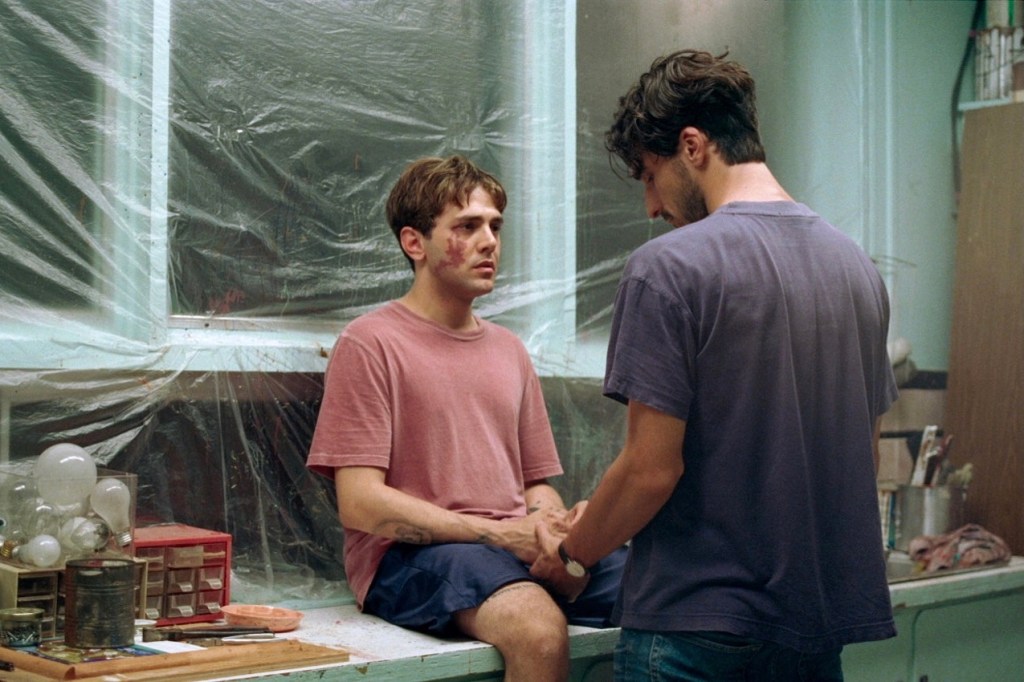
I love Xavier Dolan. Some of you may remember my review of his film J’ai tué ma mère (I Killed My Mother) (2009), which I called a “semi-autobiographical, near-perfect evocation of the vagaries of queer adolescence”. You can tell that the young auteur is well-read when it comes to great films from the way he sets up his mises en scène to the way he is able to harness every drop of emotional resonance in each frame. There are hints of Bergman, of course. Some Truffaut and Fellini. Van Sant is flickering always in the background. But there’s something else there too, something which belongs wholly and exclusively to Dolan.
The fact that Dolan is only 32 years old means that we’re hopefully only seeing him at the depth of his powers. I only hope the planet holds out long enough for us to see him at his height.
Thanks as always for being a faithful reader of The Voracious Bibliophile. If you like what you see, please like, comment, follow, and subscribe to my email list to get notified of new posts as soon as they drop. You can also email me at fred.slusher@thevoraciousbibliophile.com or catch me on Twitter, Instagram, TikTok, and Pinterest @voraciousbiblog. Keep reading the world, one page (or pixel) at a time.
Winter Journal: Threshed Blue, Cardings, Dim Tonsils by Emily Wilson
stripped batting of cloud
glimpsed ligaments
dusk coming up under
lithographic, nib-hatchings
       instruments click
       the fine-sprung locust
       replicate dinge along hill-lines
       tailings of umber, the rust smudge
There is still that hemmed ocean of oaks
       the various reds, the somehow
       silver cast over the brown-gold
       the under-brushed shadows
How can there be more of their dispensing
       into air?
The night-openings of the trees
The thousand clefts into
Their corridors shiver and merge and piece apart
There is no one beside what was once river
Only the carbons incoming
       accreting in leaves
Love of old oaks unencumbering
Root-beauties brought through
crude sieves of bare trees
the few fastened leaves
Those pods are like tongues or like sickles
The blades have been pulled from their sheaths
The backs of the clouds now upturned
They herd from pink seas
They make their untouchable stream
       through regions of steep emptiness
       against which the trees have their gestures
Drop down, drop down toward me
your little sleek scars
Make your bed in rough cedars
clangor of darks numbering in
clusters of trunks and spoked lungs
the thistles that work at the gums
Emily Wilson studied at Harvard University and the University of Iowa Writers’ Workshop. She has taught at the latter, as well as at Colby College, Grinnell College, and the University of Montana. Wilson is the author of four poetry collections: The Keep(University of Iowa Press, 2001); Morpho Terrestre(2006), a limited edition book featuring artwork by Sara Langworthy; Micrographia(University of Iowa Press, 2010); and The Great Medieval Yellows(Canarium Books, 2015).
Writing for Boston Review, James Galvin said of Wilson: “Generous in her spareness, clear in her complexity, matching wildness of diction with precision of sense, nervousness with nerve, her poems are not written for analysis, perhaps not even for approval. As we watch poetical heresies turn into orthodoxies, it becomes clear, especially in a poet like Wilson, that only originality, a signature style, remains steadfastly heretical.”
Thanks as always for being a faithful reader of The Voracious Bibliophile. If you like what you see, please like, comment, follow, and subscribe to my email list to get notified of new posts as soon as they drop. You can also email me at fred.slusher@thevoraciousbibliophile.com or catch me on Twitter, Instagram, TikTok, and Pinterest @voraciousbiblog. Keep reading the world, one page (or pixel) at a time.
Thanks as always for being a faithful reader of The Voracious Bibliophile. If you like what you see, please like, comment, follow, and subscribe to my email list to get notified of new posts as soon as they drop. You can also email me at fred.slusher@thevoraciousbibliophile.com or catch me on Twitter, Instagram, TikTok, and Pinterest @voraciousbiblog. Keep reading the world, one page (or pixel) at a time.
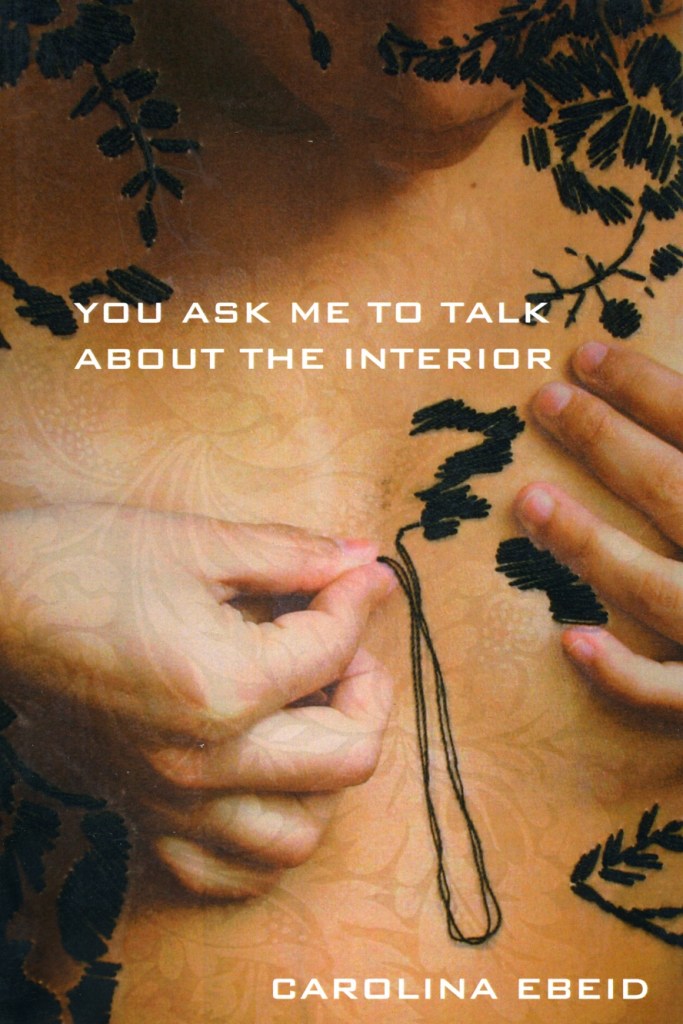
Ebeid earned her MFA from the Michener Center for Writers at the University of Texas at Austin and is pursuing her Ph.D. in creative writing from the University of Denver. She currently lives in Colorado where she teaches at Lighthouse Writers Workshop. She also serves as poetry editor at The Rumpusand edits (with her husband, Jeffrey Pethybridge) Visible Binary, an online journal specializing in experimental poetics and avant-garde expression. She has been published in numerous journals both in print and online and has been awarded multiple fellowships, among them fellowships from the Lannan Foundation and the National Endowment for the Arts.
She is the author of the poetry collection You Ask Me To Talk About the Interior, which was published in 2016 by Noemi Press and is available to purchase through Small Press Distribution.
Thanks as always for being a faithful reader of The Voracious Bibliophile. If you like what you see, please like, comment, follow, and subscribe to my email list to get notified of new posts as soon as they drop. You can also email me at fred.slusher@thevoraciousbibliophile.com or catch me on Twitter, Instagram, TikTok, and Pinterest @voraciousbiblog. Keep reading the world, one page (or pixel) at a time.
Thanks as always for being a faithful reader of The Voracious Bibliophile. If you like what you see, please like, comment, follow, and subscribe to my email list to get notified of new posts as soon as they drop. You can also email me at fred.slusher@thevoraciousbibliophile.com or catch me on Twitter, Instagram, TikTok, and Pinterest @voraciousbiblog. Keep reading the world, one page (or pixel) at a time.
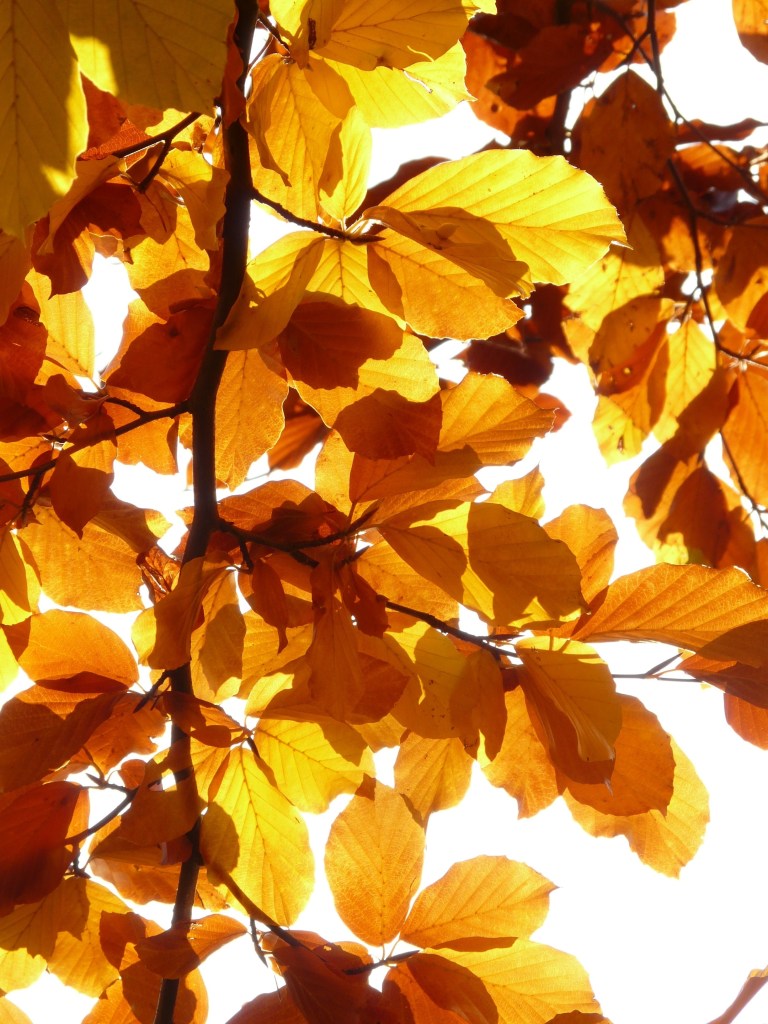
Nature’s first green is gold,
Her hardest hue to hold.
Her early leaf’s a flower;
But only so an hour.
Then leaf subsides to leaf.
So Eden sank to grief,
So dawn goes down to day.
Nothing gold can stay.
Public domain. “Nothing Gold Can Stay” was originally published in October 1923 in The Yale Review. It was also included in Frost’s collection New Hampshire, which was published that same year by Henry Holt and for which Robert Frost won the 1924 Pulitzer Prize for Poetry.
Thanks as always for being a faithful reader of The Voracious Bibliophile. If you like what you see, please like, comment, follow, and subscribe to my email list to get notified of new posts as soon as they drop. You can also email me at fred.slusher@thevoraciousbibliophile.com or catch me on Twitter, Instagram, TikTok, and Pinterest @voraciousbiblog. Keep reading the world, one page (or pixel) at a time.








 The Voracious Bibliophile