My friend and I snickered the first time
we heard the meditation teacher, a grown man,
call himself honey, with a hand placed
over his heart to illustrate how we too
might become more gentle with ourselves
and our runaway minds. It’s been years
since we sat with legs twisted on cushions,
holding back our laughter, but today
I found myself crouched on the floor again,
not meditating exactly, just agreeing
to be still, saying honey to myself each time
I thought about my husband splayed
on the couch with aching joints and fever
from a tick bite—what if he never gets better?—
or considered the threat of more wildfires,
the possible collapse of the Gulf Stream,
then remembered that in a few more minutes,
I’d have to climb down to the cellar and empty
the bucket I placed beneath a leaky pipe
that can’t be fixed until next week. How long
do any of us really have before the body
begins to break down and empty its mysteries
into the air? Oh honey, I said—for once
without a trace of irony or blush of shame—
the touch of my own hand on my chest
like that of a stranger, oddly comforting
in spite of the facts.
Thanks as always for being a faithful reader of The Voracious Bibliophile. If you like what you see, please like, comment, follow, and subscribe to my email list to get notified of new posts as soon as they drop. You can also email me at fred.slusher@thevoraciousbibliophile.com or catch me on Twitter, Instagram, TikTok, and Pinterest @voraciousbiblog. Keep reading the world, one page (or pixel) at a time.
Stanley Plumly (1939-2019) was greatly influenced by his working-class background, a fact which is evident in his work. He earned his B.A. at Wilmington College in Ohio and his Ph.D. at Ohio University. During his long career, he taught at the University of Iowa, the Bread Loaf Writers’ Conference, and the University of Maryland. He also served as the poet laureate of Maryland for several years. You can read more about his life and work here.
Thanks as always for being a faithful reader of The Voracious Bibliophile. If you like what you see, please like, comment, follow, and subscribe to my email list to get notified of new posts as soon as they drop. You can also email me at fred.slusher@thevoraciousbibliophile.com or catch me on Twitter, Instagram, TikTok, and Pinterest @voraciousbiblog. Keep reading the world, one page (or pixel) at a time.
Winter Journal: Threshed Blue, Cardings, Dim Tonsils by Emily Wilson
stripped batting of cloud
glimpsed ligaments
dusk coming up under
lithographic, nib-hatchings
       instruments click
       the fine-sprung locust
       replicate dinge along hill-lines
       tailings of umber, the rust smudge
There is still that hemmed ocean of oaks
       the various reds, the somehow
       silver cast over the brown-gold
       the under-brushed shadows
How can there be more of their dispensing
       into air?
The night-openings of the trees
The thousand clefts into
Their corridors shiver and merge and piece apart
There is no one beside what was once river
Only the carbons incoming
       accreting in leaves
Love of old oaks unencumbering
Root-beauties brought through
crude sieves of bare trees
the few fastened leaves
Those pods are like tongues or like sickles
The blades have been pulled from their sheaths
The backs of the clouds now upturned
They herd from pink seas
They make their untouchable stream
       through regions of steep emptiness
       against which the trees have their gestures
Drop down, drop down toward me
your little sleek scars
Make your bed in rough cedars
clangor of darks numbering in
clusters of trunks and spoked lungs
the thistles that work at the gums
Emily Wilson studied at Harvard University and the University of Iowa Writers’ Workshop. She has taught at the latter, as well as at Colby College, Grinnell College, and the University of Montana. Wilson is the author of four poetry collections: The Keep(University of Iowa Press, 2001); Morpho Terrestre(2006), a limited edition book featuring artwork by Sara Langworthy; Micrographia(University of Iowa Press, 2010); and The Great Medieval Yellows(Canarium Books, 2015).
Writing for Boston Review, James Galvin said of Wilson: “Generous in her spareness, clear in her complexity, matching wildness of diction with precision of sense, nervousness with nerve, her poems are not written for analysis, perhaps not even for approval. As we watch poetical heresies turn into orthodoxies, it becomes clear, especially in a poet like Wilson, that only originality, a signature style, remains steadfastly heretical.”
Thanks as always for being a faithful reader of The Voracious Bibliophile. If you like what you see, please like, comment, follow, and subscribe to my email list to get notified of new posts as soon as they drop. You can also email me at fred.slusher@thevoraciousbibliophile.com or catch me on Twitter, Instagram, TikTok, and Pinterest @voraciousbiblog. Keep reading the world, one page (or pixel) at a time.
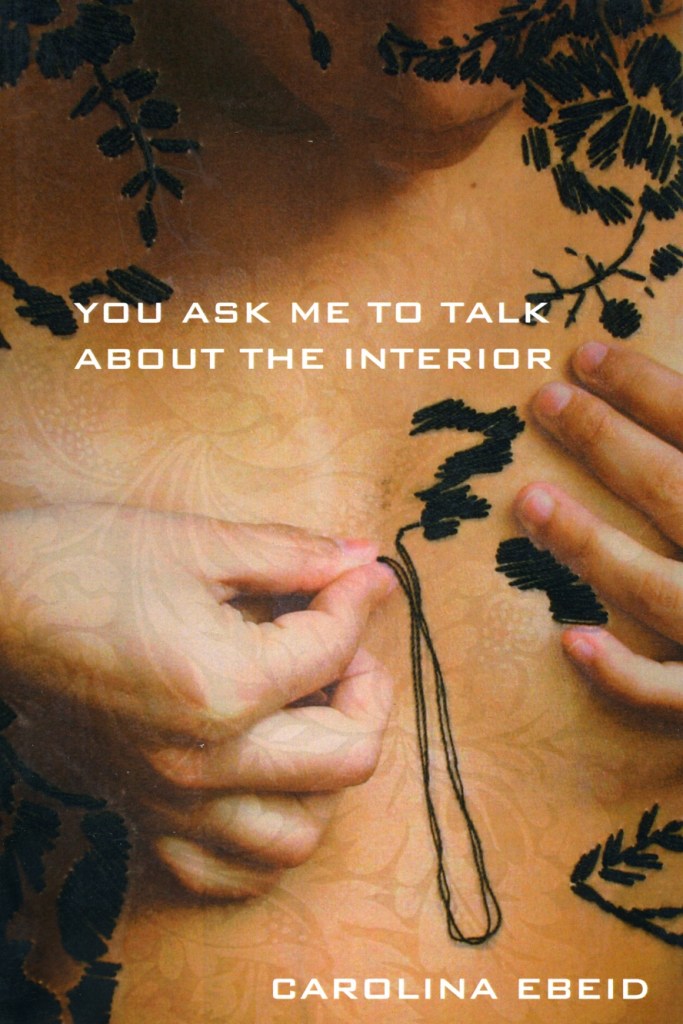
Ebeid earned her MFA from the Michener Center for Writers at the University of Texas at Austin and is pursuing her Ph.D. in creative writing from the University of Denver. She currently lives in Colorado where she teaches at Lighthouse Writers Workshop. She also serves as poetry editor at The Rumpusand edits (with her husband, Jeffrey Pethybridge) Visible Binary, an online journal specializing in experimental poetics and avant-garde expression. She has been published in numerous journals both in print and online and has been awarded multiple fellowships, among them fellowships from the Lannan Foundation and the National Endowment for the Arts.
She is the author of the poetry collection You Ask Me To Talk About the Interior, which was published in 2016 by Noemi Press and is available to purchase through Small Press Distribution.
Thanks as always for being a faithful reader of The Voracious Bibliophile. If you like what you see, please like, comment, follow, and subscribe to my email list to get notified of new posts as soon as they drop. You can also email me at fred.slusher@thevoraciousbibliophile.com or catch me on Twitter, Instagram, TikTok, and Pinterest @voraciousbiblog. Keep reading the world, one page (or pixel) at a time.
Nature’s first green is gold,
Her hardest hue to hold.
Her early leaf’s a flower;
But only so an hour.
Then leaf subsides to leaf.
So Eden sank to grief,
So dawn goes down to day.
Nothing gold can stay.
Public domain. “Nothing Gold Can Stay” was originally published in October 1923 in The Yale Review. It was also included in Frost’s collection New Hampshire, which was published that same year by Henry Holt and for which Robert Frost won the 1924 Pulitzer Prize for Poetry.
Thanks as always for being a faithful reader of The Voracious Bibliophile. If you like what you see, please like, comment, follow, and subscribe to my email list to get notified of new posts as soon as they drop. You can also email me at fred.slusher@thevoraciousbibliophile.com or catch me on Twitter, Instagram, TikTok, and Pinterest @voraciousbiblog. Keep reading the world, one page (or pixel) at a time.
This is not a small voice you hear this is a large voice coming out of these cities. This is the voice of LaTanya. Kadesha. Shaniqua. This is the voice of Antoine. Darryl. Shaquille. Running over waters navigating the hallways of our schools spilling out on the corners of our cities and no epitaphs spill out of their river mouths.
This is not a small love you hear this is a large love, a passion for kissing learning on its face. This is a love that crowns the feet with hands that nourishes, conceives, feels the water sails mends the children, folds them inside our history where they toast more than the flesh where they suck the bones of the alphabet and spit out closed vowels. This is a love colored with iron and lace. This is a love initialed Black Genius.
Thanks as always for being a faithful reader of The Voracious Bibliophile. If you like what you see, please like, comment, follow, and subscribe to my email list to get notified of new posts as soon as they drop. You can also email me at fred.slusher@thevoraciousbibliophile.com or catch me on Twitter, Instagram, TikTok, and Pinterest @voraciousbiblog. Keep reading the world, one page (or pixel) at a time.
In Golden Gate Park That Day… by Lawrence Ferlinghetti
In Golden Gate Park that day
                           a man and his wife were coming along
         thru the enormous meadow
                           which was the meadow of the world
He was wearing green suspenders
                              and carrying an old beat-up flute
                                                                        in one hand
      while his wife had a bunch of grapes
                                  which she kept handing out
                                                                         individually
                                                      to various squirrels
                                                                           as if each
                                                             were a little joke

      And then the two of them came on
                                                thru the enormous meadow
which was the meadow of the world
                                                 and then
            at a very still spot where the trees dreamed
         and seemed to have been waiting thru all time
                                                                            for them
             they sat down together on the grass
                                              without looking at each other
                and ate oranges
                                    without looking at each other
                                                            and put the peels
             in a basket which they seemed
                                       to have brought for that purpose
                  without looking at each other

      And then
                  he took his shirt and undershirt off
       but kept his hat on
                                    sideways
                                                and without saying anything
             fell asleep under it
                                           And his wife just sat there looking
at the birds which flew about
   calling to each other
                           in the stilly air
      as if they were questioning existence
                   or trying to recall something forgotten

But then finally
                   she too lay down flat
                                                and just lay there looking up
                                                                               at nothing
                        yet fingering the old flute
                                                                which nobody played
                            and finally looking over
                                                                at him
                  without any particular expression
                                                               except a certain awful look
                        of terrible depression
Thanks as always for being a faithful reader of The Voracious Bibliophile. If you like what you see, please like, comment, follow, and subscribe to my email list to get notified of new posts as soon as they drop. You can also email me at fred.slusher@thevoraciousbibliophile.com or catch me on Twitter, Instagram, TikTok, and Pinterest @voraciousbiblog. Keep reading the world, one page (or pixel) at a time.
Retired Ballerinas, Central Park West by Lawrence Ferlinghetti
Retired ballerinas on winter afternoons
          walking their dogs
                      in Central Park West
    (or their cats on leashes—
       the cats themselves old highwire artists)
The ballerinas
                leap and pirouette
                           through Columbus Circle
         while winos on park benches
               (laid back like drunken Goudonovs)
            hear the taxis trumpet together
               like horsemen of the apocalypse
                               in the dusk of the gods
It is the final witching hour
                when swains are full of swan songs
    And all return through the dark dusk
                to their bright cells
                                  in glass highrises
      or sit down to oval cigarettes and cakes
                              in the Russian Tea Room
    or climb four flights to back rooms
                                 in Westside brownstones
               where faded playbill photos
                        fall peeling from their frames
                            like last year’s autumn leaves
Thanks as always for being a faithful reader of The Voracious Bibliophile. If you like what you see, please like, comment, follow, and subscribe to my email list to get notified of new posts as soon as they drop. You can also email me at fred.slusher@thevoraciousbibliophile.com or catch me on Twitter, Instagram, TikTok, and Pinterest @voraciousbiblog. Keep reading the world, one page (or pixel) at a time.
Thanks as always for being a faithful reader of The Voracious Bibliophile. If you like what you see, please like, comment, follow, and subscribe to my email list to get notified of new posts as soon as they drop. You can also email me at fred.slusher@thevoraciousbibliophile.com or catch me on Twitter, Instagram, TikTok, and Pinterest @voraciousbiblog. Keep reading the world, one page (or pixel) at a time.
Thanks as always for being a faithful reader of The Voracious Bibliophile. If you like what you see, please like, comment, follow, and subscribe to my email list to get notified of new posts as soon as they drop. You can also email me at fred.slusher@thevoraciousbibliophile.com or catch me on Twitter, Instagram, TikTok, and Pinterest @voraciousbiblog. Keep reading the world, one page (or pixel) at a time.








 The Voracious Bibliophile