I don’t want the people who love me to avoid the reality of my body. I don’t want them to feel uncomfortable with its size and shape, to tacitly endorse the idea that fat is shameful, to pretend that I’m something I’m not out of deference to a system that hates me. I don’t want to be gentled like I’m something wild and alarming. If I’m gonna be wild and alarming, I’ll do it on my terms.
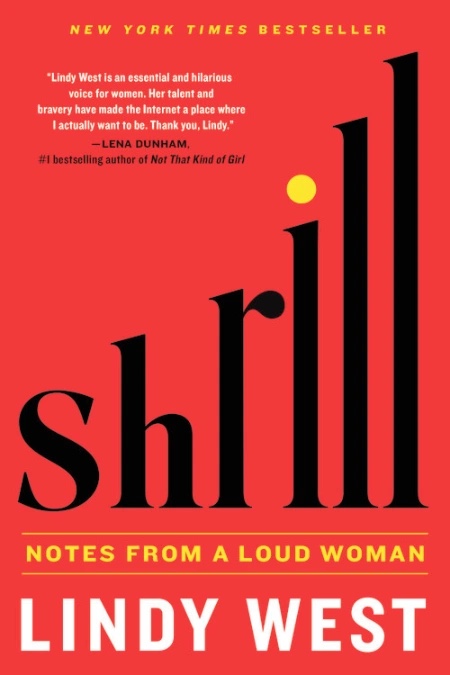
Reading Lindy West’s Shrill made me reckon with the decades of internalized fatphobia I still needed to vomit up. Now, I am unashamed of being fat. One of my best friends and I were having a conversation the other day about how fat people (we’re both fat) cannot make a single self-deprecating comment about our weight without having it psychoanalyzed or misinterpreted by skinny people.
I cannot tell you how many times that I’ve had a conversation that goes something like this:
Me: God, I’m feeling so fat today.
Skinny Rando: Oh, stop it! You’re beautiful!!!
Me: Bitch, did I say I was ugly?
Bitch, did I say I was ugly?
People really enjoy telling on themselves. You see, for the first thousand times I had that interaction, I didn’t really think much of it. But eventually, I looked deeper. When I say that I’m fat, and someone counters with something asinine like No, you’re beautiful, they’re (consciously or not) letting me know that fat can never = beautiful in their estimation.
When I say that I’m fat, and someone counters with something asinine…they’re (consciously or not) letting me know that fat can never = beautiful in their estimation.
As fat people, we confuse people when we exist in the world without the specter of shame hanging over us like a cloud. To live in a fat body, and to have the audacity to not cower, to deliberately take up space, to not cover every square inch of ourselves with fugly industrial fabric, is still considered radical. People want me to explain to them why I’m so confident in my skin. Sweetheart, have you seen me? How could I not be confident? I am so gorgeous and radiant I should come with a UV warning.
To live in a fat body, and to have the audacity to not cower, to deliberately take up space, to not cover every square inch of ourselves with fugly industrial fabric, is still considered radical.
I earned every single stretch mark that traverses my skin like so many highways all leading me home. They tell the story of how I survived, and how I keep on surviving, despite every cacophonous magpie screaming at me and asking if I’ve tried the SOUTH BEACH JENNY CRAIG KETO CARROT JUICE WONDERLAND DIET? Hell no, and you can keep it—I’ll stay fat and happy.🖕🏻
Thanks as always for being a faithful reader of The Voracious Bibliophile. If you like what you see, please follow, like, comment, and subscribe to my email list to get notified of new posts as soon as they drop. You can also email me at thevoraciousbibliophile@yahoo.com or catch me on Twitter @voraciousbiblog. Keep reading the world, one page (or pixel) at a time.
You’re the only one who can say who you are with authority.
I love this. It is so succinct in conveying the idea that it is up to each of us as individuals to decide who we are and in which way(s) we will present our identity(ies) to others. It also reminds us that we do not have to take on the words other people assign to us, especially those which are harmful misrepresentations of our characters or even contradictory to the ways we view ourselves.
It also reminds us that we do not have to take on the words other people assign to us, especially those which are harmful misrepresentations of our characters or even contradictory to the ways we view ourselves.
It takes a lot of courage to tell the world who you are and I believe everyone deserves the right to be seen and celebrated as well as have the opportunity to see others like them celebrated. Simply stated, representation matters. As a bookseller, I love those moments when young queer people clock me as a “sibling in the struggle” and look to me for resources for people like them.
When you’re fourteen or fifteen years old, and you’re any kind of Other, reading about an adult who looks the way you do, loves the way you do, worships the same way you do, or speaks the same language(s) you do, and is happy and healthy, is incredibly life-affirming. It says to them that it is possible to be authentic. To not compromise. To be radically yourself and still succeed. That feeling of being able to help someone else feel seen is like oxygen to me. I rely on it. I use it as a compass when the ugliness of the world threatens to make me lose my way.
That feeling of being able to help someone else feel seen is like oxygen to me. I rely on it. I use it as a compass when the ugliness of the world threatens to make me lose my way.
Thanks as always for being a faithful reader of The Voracious Bibliophile. If you like what you see, please follow, like, comment, and subscribe to my email list to get notified of new posts as soon as they drop. You can also email me at thevoraciousbibliophile@yahoo.com or catch me on Twitter @voraciousbiblog. Keep reading the world, one page (or pixel) at a time.
***Note: I received a free digital review copy of this book from NetGalley in exchange for an honest review.***
There’s the likeness and the icon itself. The myth and the man behind it. We owe our modern conception of Dracula to Bela Lugosi, who donned the cape of the infamous bloodthirsty count in Tod Browning’s production of Dracula, which premiered in 1931, before the pearl-clutchers would focus their prudish crosshairs on the film industry in the form of the Hays Code, which forced studios to either veil or completely eliminate references to anything the aforementioned pearl-clutchers would consider morally reprehensible. Horror films were a natural target of the Code, so it is to the benefit of the culture at-large and the horror industry in particular that Dracula was released in the pre-Code era.
Horror films were a natural target of the Code, so it is to the benefit of the culture at-large and the horror industry in particular that Dracula was released in the pre-Code era.
Bela Lugosi was a Hungarian émigré who first cut his teeth on the stage in the National Theatre of Hungary. After facing political persecution, he made his move to the promising shores of America. First starring in (as well as producing and directing) shoestring-budget theater productions with other Hungarian émigrés, young Bela soon found himself disheartened, feeling as if he was destined to die a penniless pauper.
His first big break came when he met Henry Barton, a theatrical manager who had been impressed with Lugosi’s performance in one of his Hungarian-language productions. The American impresario hadn’t understood a word of the dialogue, but had been captivated by Lugosi’s command of the stage. He told him he would be perfect in a new play he was producing called The Red Poppy if only his English were better. Never one to give up, Lugosi told Barton he was a quick learner and would be willing to have an English tutor hired with the tutor’s wages deducted from his own.
The Red Poppy’s run was short-lived, a commercial failure. Lugosi, however, was praised for his performance and afterwards he had consistent work in small-budget English-language theater and silent film productions. Once he secured the role of the titular character in Hamilton Deane and John L. Balderston’s Broadway production of Bram Stoker’s Dracula, his fate was sealed. The rest, as they say, is history.
Koren Shadmi does an excellent job bringing Bela Lugosi to life. Penning a pictorial biography of one of the world’s most iconic actors is a daunting task, certainly not for the faint of heart, but Shadmi deftly illuminates the man behind the myth, waking him from his coffin for a whole new generation.
Penning a pictorial biography of one of the world’s most iconic actors is a daunting task, certainly not for the faint of heart, but Shadmi deftly illuminates the man behind the myth, waking him from his coffin for a whole new generation.
Shadmi’s book is just as perfect for the longtime Lugosi acolyte as it is for those who only know him through his image as Dracula. It is evocative and daring and sobering. I honestly can’t recommend it highly enough.
Shadmi’s book is just as perfect for the longtime Lugosi acolyte as it is for those who only know him through his image as Dracula.
Thanks as always for being a faithful reader of The Voracious Bibliophile. If you like what you see, please follow, like, comment, and subscribe to my email list to get notified of new posts as soon as they drop. You can also email me at thevoraciousbibliophile@yahoo.com or catch me on Twitter @voraciousbiblog. Keep reading the world, one page (or pixel) at a time.
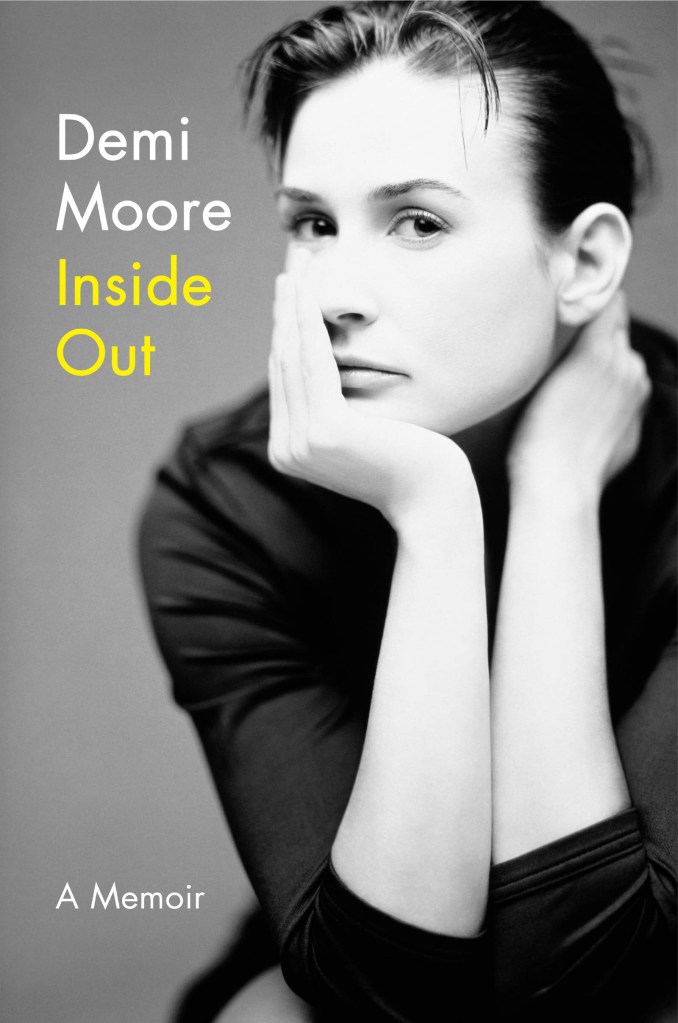
There are two reasons I wanted to tell this story, the story of how I learned to surrender. First, because it’s mine. It doesn’t belong to the tabloids or my mom or the men I’ve married or the people who’ve loved or hated my movies or even my children. My story is mine alone; I’m the only one who was there for all of it, and I decided to claim the power to tell it on my own terms. The second reason is that even though it’s mine, maybe some part of this story is yours, too. I’ve had extraordinary luck in this life: both bad and good. Putting it all down in writing makes me realize how crazy a lot of it has been, how improbable. But we all suffer, and we all triumph, and we all get to choose how we hold both.
God, I love Demi Moore. I’m quite the sucker for celebrity memoirs, but Inside Out was so meta. She really guts herself on the page and shows you who she is and what’s she’s been through and how it has all transformed her into the person she’s become. Not the movie star or the tabloid queen or that woman who was married to Bruce Willis and then Ashton Kutcher. No, within the pages of her memoir, you get to see the real Demi, warts and all. It is quite the journey.
Thanks as always for being a faithful reader of The Voracious Bibliophile. If you like what you see, please follow, like, comment, and subscribe to my email list to get notified of new posts as soon as they drop. You can also email me at thevoraciousbibliophile@yahoo.com or catch me on Twitter @voraciousbiblog. Keep reading the world, one page (or pixel) at a time.
***Note: I received a digital review copy from NetGalley in exchange for an honest review.***
I try my best to keep up with fresh new voices in the world of poetry. I like work that sidles up next to you and punches you in the face when you’re least expecting it, and Kendra Allen does exactly that. The Collection Plate covers so much ground in so limited a frame, one could almost call Allen a magician. Herein lies poems (songs? psalms?) exploring Black girlhood/womanhood, religion (its redemption(s) as well as its confines and strictures), sexual politics, family history, the tyranny of memory, and the line(age)s we cross when we decide who we’re going to be.
Herein lies poems (songs? psalms?) exploring Black girlhood/womanhood, religion (its redemption(s) as well as its confines and strictures), sexual politics, family history, the tyranny of memory, and the line(age)s we cross when we decide who we’re going to be.
the pastor is our uncle and our uncle di- / vests me of my volition / back on land / I drip / I dribble, I cough up / who I shoulda been
From “Evening service”
How does one even begin to analyze works this explosive? Poets don’t often compare religious ceremonies, in this case baptism, to a divestiture of one’s own free will, but Allen does so with aplomb and an assuredness that rings true for anyone familiar with charismatic faith traditions.
Poets don’t often compare religious ceremonies, in this case baptism, to a divestiture of one’s own free will, but Allen does so with aplomb and an assuredness that rings true for anyone familiar with charismatic faith traditions.
I don’t want to distract from the beauty of this collection with an overabundance of my own commentary, so I’ll just leave it with you like this: I’ve already bought my own copy so I can read it again and again. And again.
Thanks as always for being a faithful reader of The Voracious Bibliophile. If you like what you see, please follow, like, comment, and subscribe to my email list to get notified of new posts as soon as they drop. You can also email me at thevoraciousbibliophile@yahoo.com or catch me on Twitter @voraciousbiblog. Keep reading the world, one page (or pixel) at a time.
One of these days, I’ll take a match and set fire to everything.
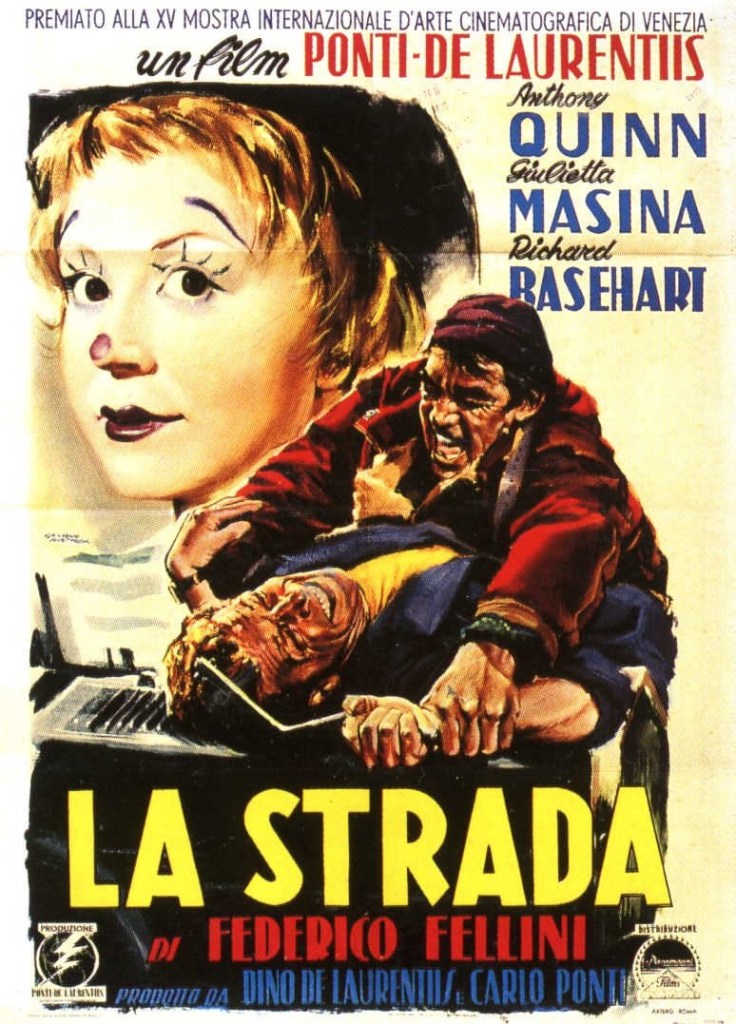
La Strada
Year: 1954
Director: Federico Fellini
Country: Italy
Cast: Giulietta Masina, Anthony Quinn, and Richard Basehart
Score: Nino Rota
Cinematography: Otello Martelli and Carlo Carlini
Streaming: Criterion Channel and HBO Max
Why I Love It: Giulietta Masina, who stars as the simple-minded and tender-hearted Gelsomina, was one of those rare performers who make you forget that the worlds they create are fiction. At the beginning of the film, Gelsomina learns that her sister Rosa has died while traveling with Zampanò (Anthony Quinn), a coarse and somewhat thuggish sideshow performer. Because her mother has other young children to feed and they all appear to be on the brink of starvation, she sells Gelsomina to Zampanò for 10,000 lire, and so begins her journey on the road.
Giulietta Masina, who stars as the simple-minded and tender-hearted Gelsomina, was one of those rare performers who make you forget that the worlds they create are fiction.
La Strada is not your typical Bildungsroman. Gelsomina’s narrative arc is not centered around some destination or goal that she spends the film pursuing. Instead, we see her find tenderness and beauty everywhere, no matter how cruelly Zampanò treats her or how desolate the landscape becomes.
I won’t spoil anything by telling you how the film ends, but I will warn you to make sure you have plenty of tissues handy. La Strada is indeed a journey, and it reveals much about the human condition to those patient enough to sit with it.
La Strada is indeed a journey, and it reveals much about the human condition to those patient enough to sit with it.
Also noteworthy is the gorgeous score by Nino Rita. Usually, cinematography is something I like to discuss more so than scores, but I have a deep and abiding passion for Nino Rota. In addition to La Strada, Rota collaborated with Federico Fellini on several other films, as well as with Fellini’s rival, Luchino Visconti. Other works of his include scores for Franco Zeffirelli’s Romeo and Juliet (1967) and Francis Ford Coppola’s The Godfather (1972) and The Godfather Part II (1974), the latter of which garnered him an Academy Award for Best Original Dramatic Score (shared with Carmine Coppola).
Rating: ⭐️⭐️⭐️⭐️
Thanks as always for being a faithful reader of The Voracious Bibliophile. If you like what you see, please follow, like, comment, and subscribe to my email list to get notified of new posts as soon as they drop. You can also email me at thevoraciousbibliophile@yahoo.com or catch me on Twitter @voraciousbiblog. Keep reading the world, one page (or pixel) at a time.
Sometimes Twitter is just *chef’s kiss* magnificent. While no social media platform is perfect and some are downright godawful (here’s looking at you, Facebook!), I always return to Twitter for conversation, community, clarity, and hilarity.
I am so dedicated to Twitter, in fact, that I have a Google Drive folder full of screenshots of tweets that speak to me. I hope you enjoy them as much as I do.
Note: Under the screenshots, I’m going to re-type the text appearing in the tweet as well as text descriptions for any gifs or photos so they’re accessible to everyone.
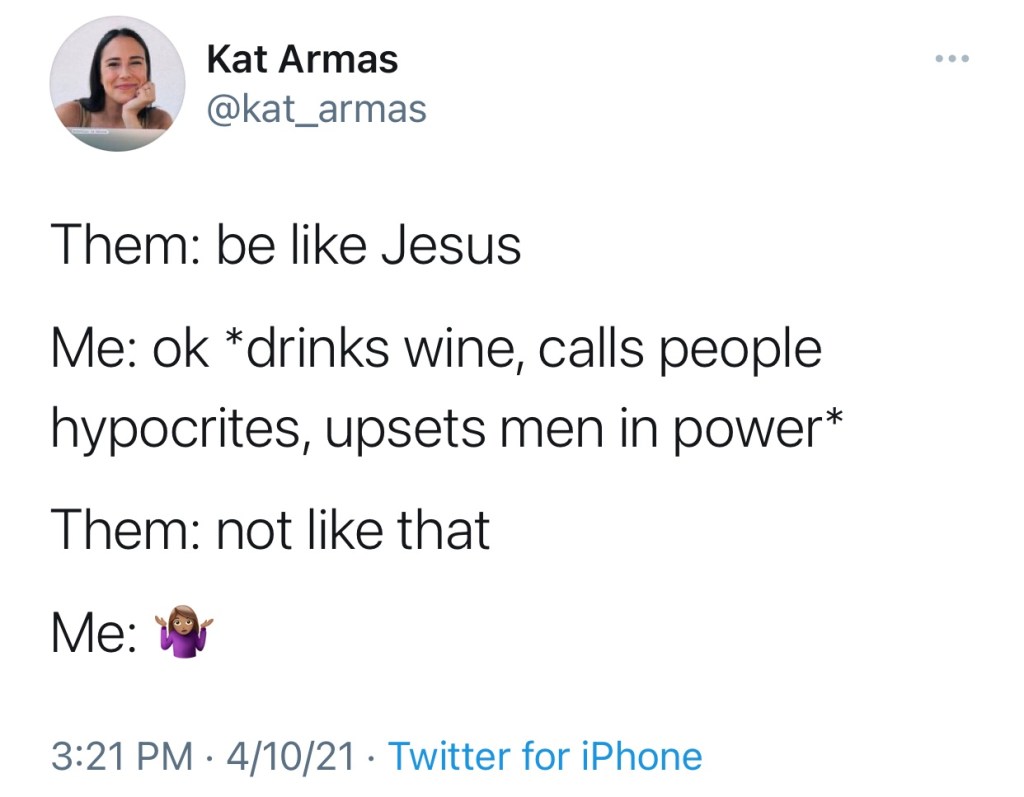
@kat_armas: Them: be like Jesus Me: ok *drinks wine, calls people hypocrites, upsets men in power* Them: not like that Me: *shrug emoji*
So, I love this tweet for many reasons, not least of all because it paints Jesus as a rebel contrarian, which he was. If “Fight Me, Heathen” Jesus isn’t your favorite Jesus, what are you even doing with your life?
@socompliKATIEd: Phil Collins created that Tarzan soundtrack with the passion of someone whose parents were personally killed by a leopard
Yes! It has always been my assertion that Tarzan has the best soundtrack of any Disney film ever, and that still tracks. Frozen could never.
@Potatopolitics: Vikings worshipped crossdressing genderfluid gods, I am fairly sure they’d be fine with trans folks actually
The beauty of this tweet is the fact that it’s so many things at once: a call for trans rights and visibility, a history lesson, and a call-out on the ahistorical ignorance of the heteropatriarchy.
@internetanja DKNY: is a fashion label my brain: donkey kong new york
I am so glad I’m not the only person who’s said this in their head. Also, I have a tendency to read initialisms as actual words in my head so I’ve also read DKNY as dick-knee, which is something we should have access to. If I had dicks on my knees and could slap people with them when they’re rude in public, the game would be over. Game. Set. Match.
@CornOnTheGoblin: im a bitch / im a plumber it’s-a me / luigi’s brother
You have to be from a very specific micro-generation to appreciate the humor in this tweet. I am specifically talking about people who were school-age in the early-to-mid aughts, with at least one parent who owned an NES console as a child. Fun fact: my first exposure to the song referenced in this tweet was the critically-unappreciated-but-still-managed-to-get-a-remake banger of a movie, What Women Want, starring the goddess Helen Hunt and the human trash bag Mel Gibson.
@realemilyattack: I’m locked out of my dogs Facebook account that i created in 2010 and they won’t let me back in unless I send over a copy of his drivers license
This reminds me that I used to know a girl who had a Facebook account for her bedroom. Like, her actual bedroom. I’ve also friended people’s pets but in the end, it’s too much to deal with because they always die and I don’t think you can make a legacy account for a non-human.
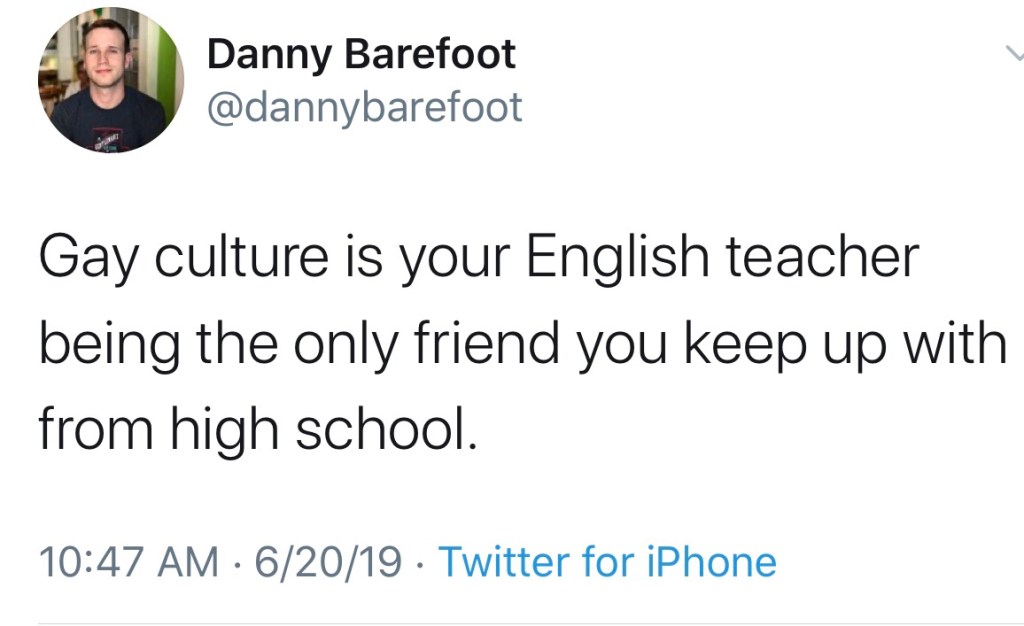
@dannybarefoot: Gay culture is your English teacher being the only friend you keep up with from high school.
Why is this so painfully accurate? True story: when my high school girlfriend and I broke up (stop laughing, you swine!), we returned each others’ books using our English teacher as a go-between. Nothing says petty like telling your English teacher to tell your ex that you want your Capote back. Jesus Christ, how did no one realize I was gay?
Nothing says petty like telling your English teacher to tell your ex that you want your Capote back. Jesus Christ, how did no one realize I was gay?
@_RobertSchultz: millennials love picking a movie they watched once as a kid that has a 20% on Rotten Tomatoes and then making it their entire personality
Okay, first of all, I saw Batman & Robin way more than once and I’m fairly certain it has something like a 7% rating on Rotten Tomatoes. I don’t understand the lack of appreciation for this cinematic masterpiece. People didn’t like the Schumacher Batman films because they were expecting them to be like the Burton (and later, the Nolan) Batman films, and that wasn’t Schumacher’s schtick. Those movies were *supposed* to be campy and overdone, and so what if they were a little too focused on the bat-nipples and bat-codpieces?! Chris O’Donnell is the reason a lot of comic book-loving little boys grew up to be raging homosexuals—it’s science.
Chris O’Donnell is the reason a lot of comic book-loving little boys grew up to be raging homosexuals—it’s science.
@SHEsus_Christ: The fact that we blur women’s nipples but Ted Cruz’s face is still visible is blasphemous.
This one pretty much speaks for itself.
@BibliophlMarie: tfw you’re tidying your bookshelves & find that book you were thinking about buying.
Is this callout culture? This has happened to me so many times, but more often than not I don’t discover a book until I’ve already purchased it for the second time and then not until it’s way past the date by which it was returnable.
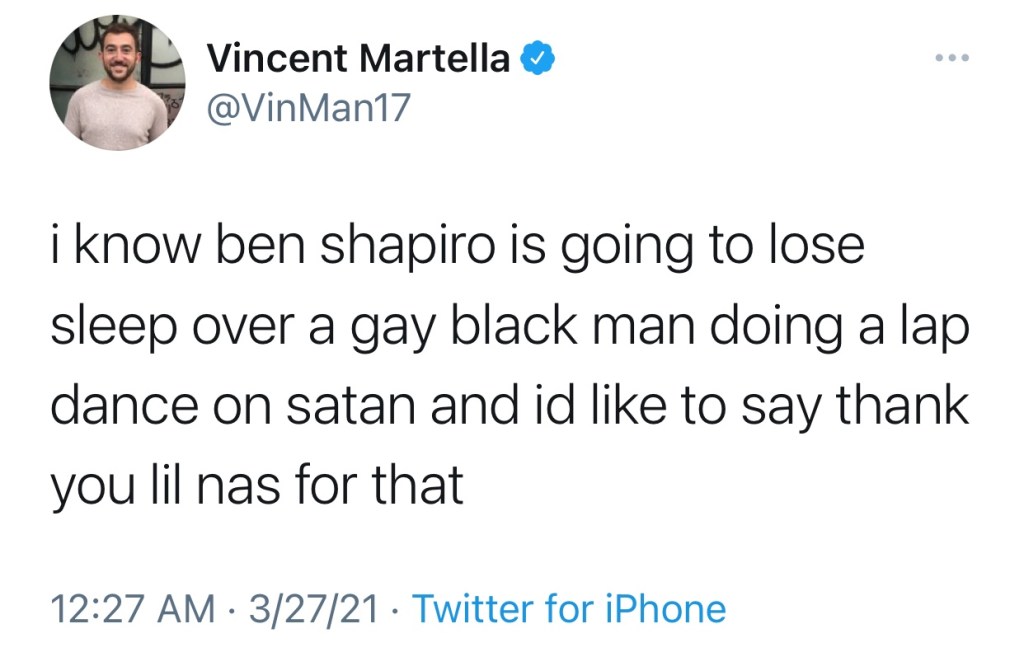
@VinMan17: i know ben shapiro is going to lose sleep over a gay black man doing a lap dance on satan and id like to say thank you lil nas for that
Y’all, people in the Evangelical Christian Right really lost their minds over that video. My question is: what did they expect? If you tell someone they’re a vile and irredeemable sinner enough times with enough vitriol, damning them to an inescapable hell, why do you get mad when they say they’re going to enjoy the trip?
Fun fact: did you know that Mara Wilson (of Matilda fame) and Ben Shapiro are maternal first cousins? Don’t worry, though; they don’t speak and she has him blocked on all the socials.
I really don’t like any of the right-wing blowhards, what with their demagoguery, proto-fascism, and intellectual dishonesty, but I really dislike Ben Shapiro. He’s an idiot’s version of a smart man—all bluster and no substance. Not to mention that whole Aryan master race thing he’s got going on with his face.
He’s an idiot’s version of a smart man—all bluster and no substance. Not to mention that whole Aryan master race thing he’s got going on with his face.
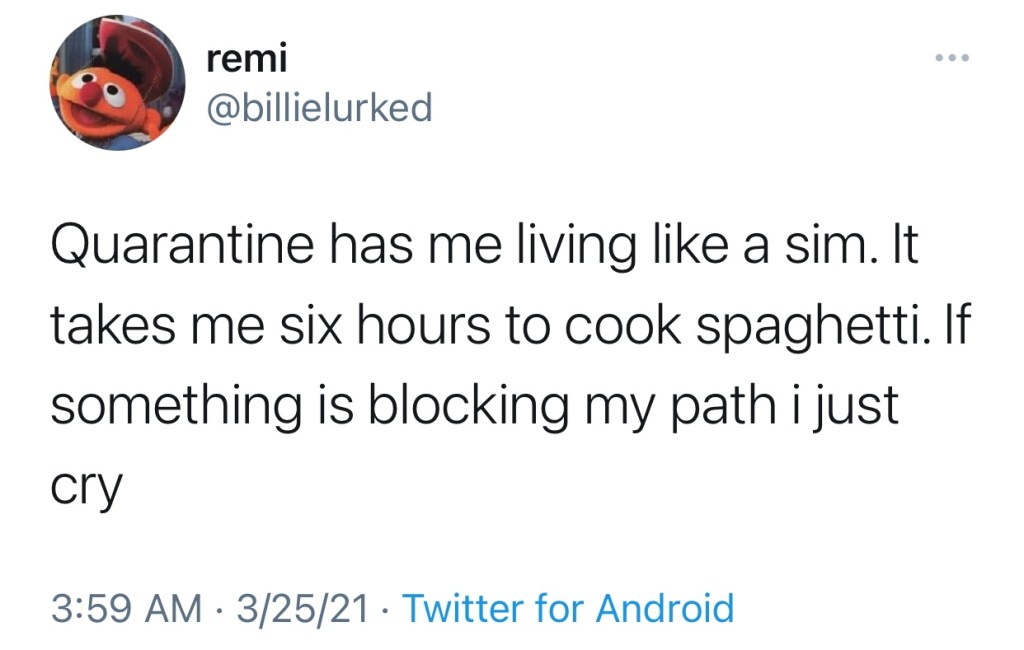
@billielurked: Quarantine has me living like a sim. It takes me six hours to cook spaghetti. If something is blocking my path i just cry
Ah, Sims. I *loved* that game. I was also a bit of a sociopath with it, though. Apologies for the armchair self-diagnosis, but what do you call it when someone makes a Sim-ulacrum (see what I did there?) of someone they know in real life just to sabotage them and ensure they fail in the world you’ve created? You deserved to flunk out of Sim College. You know who you are.
You deserved to flunk out of Sim College. You know who you are.
@danielleweisber: how do astronauts not cry all the time from being scared
I would also like to know the answer to this question. Being in space would be like the mega-souped-up version of when you’re a little kid and you’re staying away from home for the first time and it’s the middle of the night and you don’t want to be a little bitch and admit you want your mom so you sit in the bathroom with the lights on and wait for daybreak. There’s no one you can panic call in the middle of the night from space.
Being in space would be like the mega-souped-up version of when you’re a little kid and you’re staying away from home for the first time and it’s the middle of the night and you don’t want to be a little bitch and admit you want your mom so you sit in the bathroom with the lights on and wait for daybreak.
@bigestaban: RIP to the citizens of Pompeii, they would’ve love that song by Bastille
Would they have, though? Wouldn’t it be kind of like when Stravinsky’s The Rite of Spring caused a riot when it first premiered at the Théâtre des Champs-Élysées in Paris? Would it have been so far outside the listeners’ experience that they couldn’t really appreciate its artistry? I think that’s a question worth asking.
Wouldn’t it be kind of like when Stravinsky’s The Rite of Spring caused a riot when it first premiered at the Théâtre des Champs-Élysées in Paris?
This post was so much fun to write. If you enjoyed it, please let me know and I’ll make more of these in the future.
Thanks as always for being a faithful reader of The Voracious Bibliophile. If you like what you see, please follow, like, comment, and subscribe to my email list to get notified of new posts as soon as they drop. You can also email me at thevoraciousbibliophile@yahoo.com or catch me on Twitter @voraciousbiblog. Keep reading the world, one page (or pixel) at a time.
When a zennial chooses as their moniker the name of one of your favorite characters in modern literature (and cinema), you just know you’re bound to like them.
Enter ELIO, a.k.a. Charlotte Lee. According to an interview she did with Jess Grant for We Are: The Guard, The 1975’s eponymous debut album was life-changing for her, and you can totally hear that influence in her sound. It’s EDM-infused atmospheric pop: contemplative, nostalgic, and anxiety-riddled. And how could it not be all of those things at once? To be young in a world on fire, looking to the Internet (because sometimes it’s the only place) for clarity and community, and knowing with an airtight certainty that you won’t live to be old (because of climate change), sometimes you just have to groove to your own beat.
It’s [her sound] EDM-infused atmospheric pop: contemplative, nostalgic, and anxiety-riddled. And how could it not be all of those things at once?
The first time I listened to “Jackie Onassis”, one of the tracks remixed on this EP, I was transfixed. Like the icons she emulates, ELIO’s style is effortless and unpretentious, which makes it all the more alluring.
We can go to dinner in Paris / And we’ll be trends in fashion like Jackie Onassis / I’ll keep taking antidepressants / And we can drive away from this adolescence
Jackie Onassis by ELIO
My take: If you don’t seat-dance your way through traffic or make a complete fool of yourself in your living room crumping and twerking and bopping while listening to this EP, there’s something wrong with you. I hate to be so frank, but facts are facts.
Rating: ⭐️⭐️⭐️⭐️
Thanks as always for being a faithful reader of The Voracious Bibliophile. If you like what you see, please follow, like, comment, and subscribe to my email list to get notified of new posts as soon as they drop. You can also email me at thevoraciousbibliophile@yahoo.com or catch me on Twitter @voraciousbiblog. Keep reading the world, one page (or pixel) at a time.
I’m always looking for the next thing that’s going to break me open. I use art as emotional catharsis. I never know what the medium is going to be—the truth just has a way of finding me and it never comes unprepared.
I’m always looking for the next thing that’s going to break me open.
That said, One Foot In Front Of The Other is the perfect mixtape for Sad Girl Summer and I am here for it. Bring on The Purge (of feelings, that is). There’s a desperation in Griff’s voice. An overflowing melancholy colors every lyric on every track. But there’s also hope—buckets of it. And resilience. And it overpowers everything else.
It’s somewhat of a disservice to Griff (real name Sarah Griffiths) to compare her to her forebears or contemporaries, but nevertheless her sound is familiar in an endearing, ear-tickling way. There’s some 1989 and reputation-era Taylor Swift here. Some Lorde, though more Melodrama than Pure Heroine. A dollop of Billie Eilish and a sprinkling of Lana Del Rey. Halsey hangs at the edge of the frame of tracks like “Earl Grey Tea”. Some of the production on the last track sounds like Bleachers.
I’ve tried to pray / I’ve bruised my knees / I’ve tried to bring you back to me
Black Hole by Griff
All in all, it’s just a really great time to be an angsty songstress. She brings to mind a couple of noteworthy contemporaries; namely, FLETCHER and ELIO, but also Olivia Rodrigo without all the rage. Her alchemy, though, is all her own.
Rating: ⭐️⭐️⭐️⭐️
Thanks as always for being a faithful reader of The Voracious Bibliophile. If you like what you see, please follow, like, comment, and subscribe to my email list to get notified of new posts as soon as they drop. You can also email me at thevoraciousbibliophile@yahoo.com or catch me on Twitter @voraciousbiblog. Keep reading the world, one page (or pixel) at a time.
Cast: Renée Jeanne Falconetti, Eugène Silvain, André Berley, and Maurice Schutz
Cinematography: Rudolph Maté
Streaming: HBO Max, Amazon Prime Video, and Apple TV
Why I Love It: Renée Jeanne Falconetti’s performance as Joan of Arc is one of the most moving in cinematic history. This silent masterpiece is full of startlingly intimate close-ups in which Falconetti’s face is the only thing in your field of vision. Because there’s no audible dialogue, she has to convey everything in her performance through movement, through her facial expressions—everything is an exercise in the theater of the body.
Because there’s no audible dialogue, she has to convey everything in her performance through movement, through her facial expressions—everything is an exercise in the theater of the body.
The Passion of Joan of Arc is the first silent film I can remember bringing me to tears. At times it is painful to watch, but films like this one are the reason cinema is its own art form. For the true cinephile, the Criterion Collection edition is a must. Along with numerous other extras which add depth and context to the viewing experience, Criterion’s home release comes with two different presentations of the film: the traditional 24 frames per second and another at 20 frames per second.
Also noteworthy is the expressionistic lighting used by cinematographer Rudolph Maté, who later immigrated to the United States and became a director and producer as well. His cinematography credits during his career in Hollywood include such films as Dodsworth (1936), Stella Dallas (1937), Love Affair (1939), and Foreign Correspondent (1940), among many others. You can clearly see the influence of his earlier work in European Expressionism in his later work in American film noir.
You can clearly see the influence of his [Maté] earlier work in European Expressionism in his later work in American film noir.
How does one begin the process of classifying superlatives in art? Once you start drawing lines of demarcation and establishing hierarchies, it is inevitable that some works just as worthy as those classified as “The Greatest” will be pushed to the margins, relegated to the corners—all but forgotten. But then again, if everything is great then nothing is great.
Once you start drawing lines of demarcation and establishing hierarchies, it is inevitable that some works just as worthy as those classified as “The Greatest” will be pushed to the margins, relegated to the corners—all but forgotten.
So we have experts. We have aestheticians. We have people who spend their entire lives studying one particular subject so we can go to them when we need a professional’s opinion. As in science, so in art. We look to the learned, the credentialed, and the eloquent. We look outside our own limited experiences and perceptions for something that rings true.
We look to the learned, the credentialed, and the eloquent. We look outside our own limited experiences and perceptions for something that rings true.
Why did I say all that? So I could then say this: The Passion of Joan of Arc is one of the greatest films of all time. So say the film scholars, the cineastes, the commentators, and the iconoclasts. And so say I. Don’t trust me. See it for yourself.
I hope you’ve enjoyed the first post in my new series. Check back soon for more of my Favorite Films.
Thanks as always for being a faithful reader of The Voracious Bibliophile. If you like what you see, please follow, like, comment, and subscribe to my email list to get notified of new posts as soon as they drop. You can also email me at thevoraciousbibliophile@yahoo.com or catch me on Twitter @voraciousbiblog. Keep reading the world, one page (or pixel) at a time.


















 The Voracious Bibliophile