You are reading the first blog post from The Voracious Cinephile, the second blog in the Voracious family. I have toyed with the idea of having two completely separate blogs, but for now I think I’ll just post my film-related blogs with the above logo to differentiate them from those written for The Voracious Bibliophile.
Film poster for The Left Handed Gun (1958); directed by Arthur Penn.
Review
The Left Handed Gun was the first directorial effort of Arthur Penn, who would become famous for ushering in the New Hollywood movement with Bonnie and Clyde (1967). It was also only the seventh film featuring screen siren and Hollywood heartthrob Paul Newman, just a few months before he would receive rave reviews for the role of “Brick” Pollitt in Cat on a Hot Tin Roof.
Newman plays William Bonney, more famously known as Billy the Kid. I didn’t know this before watching this film, but William Bonney was also an alias of Billy the Kid’s. His birth name was Henry McCarty, and he lives on in infamy due to his part in New Mexico’s Lincoln County War, which you can read more about here.
Paul Newman as Billy the Kid in The Left Handed Gun.
While lacking in the pomp and circumstance surrounding bigger-budget Western fare of the era, The Left Handed Gun still stands above the serialized radio and television Western shows released in the late 50s. This is due in no small part to the excellent performances given by Newman and John Dehner, who imbues the role of Pat Garrett with a rugged stoicism that pairs well with Newman’s brash and sensitive Kid. It’s my opinion that only Newman could have pulled off a Billy the Kid who is so tender, yet ultimately too caught up in his own violent passion for revenge to let his softer nature win. So who cares if he was too old for the role? If we allow ourselves to get overly legalistic in our desire for realism, the magic of the cinema loses its potency. For me, of course, the same sentiment doesn’t apply to George Cukor’s 1936 adaptation of Romeo and Juliet with Norma Shearer and Leslie Howard, but that’s a matter for another blog post.
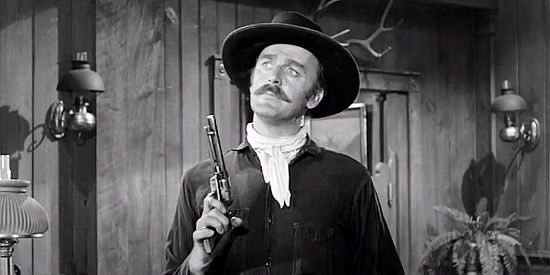
John Dehner as Pat Garrett in The Left Handed Gun.
The Left Handed Gun may have been a box office bomb in the United States, but the Belgians were a lot more discerning and appreciative of the film, awarding it with the 1961 Grand Prix of the Belgian Film Critics Association. Other winners of the prize include such classics as 12 Angry Men, Dr. Strangelove, and Cabaret.
While I of course always recommend owning physical media, you can stream The Left Handed Gun on HBO Max.
Thanks as always for being a faithful reader of The VoraciousCinephile. If you like what you see, please like, comment, follow, and subscribe to my email list to get notified of new posts as soon as they drop. Keep watching the world, one frame at a time.
The Power of the Dogwas Netflix’s latest and greatest (so far) attempt to secure an Oscar for Best Picture. It had to sting to lose to another streaming player, Apple TV+, which took home the gleaming statuette for crowd-favorite CODA. In addition to Best Picture, CODA also won in the categories of Best Adapted Screenplay (Sian Heder) and Best Supporting Actor (Troy Kotsur, who is now the first Deaf man to win an acting Oscar). For the longest time in the campaigns leading up to the big night, it was The Power of the Dog’snight to shine. With 12 nominations across the board, how could it lose? But it did. In fact, Netflix’s powerhouse Western only took home one statuette on Oscars night — for Best Director (Jane Campion).
But let us not judge a film by its accolades. The truth is, The Power of the Dogis an incredibly powerful yet extremely subtle film, its brilliance easily overlooked if one isn’t paying close enough attention.
…The Power of the Dog is an incredibly powerful yet extremely subtle film, its brilliance easily overlooked if one isn’t paying close enough attention.
Jane Campion’s searing portrait of toxic masculinity and repressed sexuality, set against the backdrop of Montana in the 1920s, is in my opinion one of the greatest films of the 21st-century so far, though it’ll probably be years down the line before the majority of cinephiles agree with me. In it, Benedict Cumberbatch gives what is perhaps his most unsympathetic performance yet. It’s arguably his best. As Phil Burbank, Cumberbatch is ruthless, sardonic, and haunted. Campion, who made history at this year’s Oscars ceremony for being the first woman to be nominated for two directing Oscars (winning this year), is a master at creating atmosphere. The vast and wide-open spaces of Montana make for an interesting canvas upon which she paints her tale. Each character, from Cumberbatch’s Phil Burbank to Kirsten Dunst’s beleaguered Rose Gordon, is given more than enough room to explore their respective neuroses, their own private darknesses that spill over into their interactions with each other and with the land itself.
Each character, from Cumberbatch’s Phil Burbank to Kirsten Dunst’s beleaguered Rose Gordon, is given more than enough room to explore their respective neuroses, their own private darknesses…
What makes The Power of the Dog so interesting as a Western is its multilayered exploration of queerness. Now, if you ask any historian worth their salt, they’ll tell you there was all kinds of gay stuff going down in the American West. Put frankly, cowboys were riding each other just as often as they were riding broncos. If you ask a heterosexual purist, they’ll tell you John Wayne would never. And Wayne probably wouldn’t have. But John Wayne wasn’t a real cowboy. He was mostly a fiction. An idealized idol. A paean to hyper-masculinity. Cumberbatch isn’t a real cowboy, either, but his portrayal of one is more honest than Wayne’s ever was. Sorry Duke.
Put frankly, cowboys were riding each other just as often as they were riding broncos.
The central conflict at the heart of The Power of the Dog is between Phil and Rose’s son Peter (Kodi Smit-McPhee). In fact, the opening lines of the film (spoken by Peter) speak to this conflict, which the viewer has not yet been made privy to: “For what kind of man would I be if I did not help my mother? If I did not save her?” What kind of man indeed?
When we meet Peter, though, he looks ill-equipped to protect or save anyone. Lanky and effeminate, his first scene in the film shows him making paper flowers for table settings that Phil will soon sneer at. Looking more closely, the paper flowers could very well be a metaphor for Phil’s repressed homosexuality, which is why he views them with such disdain. Where Peter is delicate and precise, Phil is callous and bombastic. Peter moves through the world like every step must be taken gently, as if the slightest deviation may trigger an explosion or perhaps expose him to the world. Phil, however, revels in his contempt for all of humanity, but most especially for Rose, who ends up marrying his brother George (Jesse Plemons).
Peter moves through the world like every step must be taken gently, as if the slightest deviation may trigger an explosion or perhaps expose him to the world.
This isn’t the first mainstream Western film to address themes of homosexuality. The last really good Western we had that did so was Ang Lee’s Brokeback Mountain (2005). But while Brokeback was at its essence a love story, The Power of the Dog is a story of an unhappy family in fractures. Don’t expect the spirits of Jack and Ennis to manifest in Phil and Peter, because that’s not the kind of story Campion is telling. In fact, a viewer not used to looking for queer subtext may miss that element of the film entirely, so subtle is its execution. While Phil’s queerness is thickly-veiled under layers of ostentatious brutality, Peter’s is as wide-open and hyper-visible as the plains which serve as the backdrop to Campion’s film.
While Phil’s queerness is thickly-veiled under layers of ostentatious brutality, Peter’s is as wide-open and hyper-visible as the plains which serve as the backdrop to Campion’s film.
I’m not going to do the film a disservice by spoiling the ending and telling you what happens, but it’s definitely a wow moment. It’s also calculatingly understated, like most of the elements in the film. I love a good film that doesn’t make an exhibition of itself. I like hints and silences and ruminations. Not everything has to explode in order to burn.
Thanks as always for being a faithful reader of The Voracious Bibliophile. If you like what you see, please like, comment, follow, and subscribe to my email list to get notified of new posts as soon as they drop. You can also email me at fred.slusher@thevoraciousbibliophile.com or catch me on Twitter, Instagram, TikTok, and Pinterest @voraciousbiblog. Keep reading the world, one page (or pixel) at a time.





 The Voracious Bibliophile