The Voracious Cinephile Film Review: Black Tuesday (1954); Directed by Hugo Fregonese

Film poster for Black Tuesday (1954); directed by Hugo Fregonese.

Black Tuesday was Eddie Muller’s Noir Alley pick for October 18th, and I just got around to watching it. Edward G. Robinson is one of my favorite actors of all time. His ability to so completely inhabit the characters he plays while also remaining so indistinguishably himself is one of the reasons I love him so much. 

Another reason is that in a career with such an expansive filmography, there’s more than a few hidden gems to be discovered. I would argue that it’s the performances of his that are less talked about that are among his best. I’m talking of course about the little-seen Two Seconds, a pre-Code crime drama from 1932 directed by Mervyn LeRoy, and The Red House, Delmer Daves’s exercise in abject terror from 1947. In both of these, we see Robinson embodying characters who, throughout the course of the film, unravel to reveal their baser selves. It is within this space of raw emotion and a naked psyche that Robinson really shines, and that can certainly be said for Black Tuesday

Directed by Hugo Fregonese and released in 1954, Black Tuesday tells the story of Vincent Canelli (Robinson), a death-row inmate who escapes prison on the night of his execution. Note that he also played a death-row inmate in Two Seconds. As far as prison breaks go, Canelli masterminds the operation with no small amount of ingenuity. For the sake of not spoiling this aspect of the film, I’ll not say anything, but suffice it to say that I was impressed. If you’re going to be a crook, be a successful one. 

Robinson’s Canelli is ruthless, cold-blooded, and misanthropic. His only vestige of humanity is seen in his love for his girlfriend, Hatti (Jean Parker), who helps him execute the details of the break. He has little regard for the feelings of others, and the end always justifies the means. He is violent for the sheer joy of it, and perhaps joy doesn’t even compute into the equation. He is violent simply because he can be, because he’s so full of hate that he can’t help but unleash it on whoever is unlucky enough to get in his way. 

The supporting performances in this film really help bring it over the top, especially those of the aforementioned Jean Parker and Milburn Stone of Gunsmoke fame, who plays Father Slocum, a Catholic priest. 

Black Tuesday can be watched on YouTube here

Thanks as always for being a faithful reader of The Voracious Cinephile. If you like what you see, please like, comment, follow, and subscribe to my email list to get notified of new posts as soon as they drop. Keep watching the world, one frame at a time.
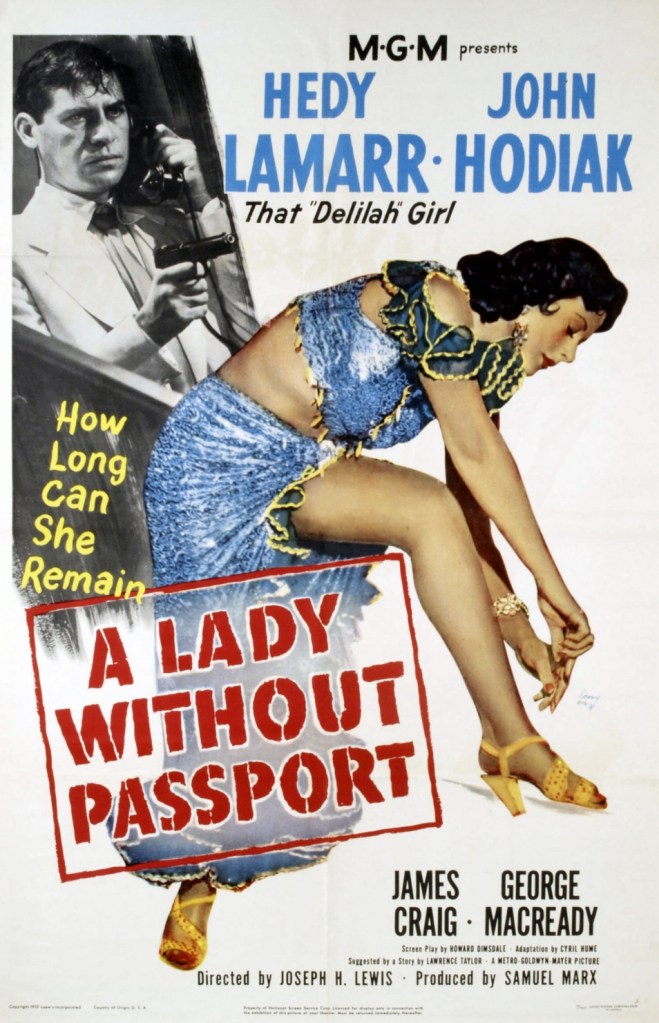
Film Review: A Lady Without Passport (1950); Directed by Joseph H. Lewis

Film poster for A Lady Without Passport (1950); directed by Joseph H. Lewis.

Review

A Lady Without Passport was the Noir Alley selection on TCM for September 14th. For those of you who are unfamiliar with Noir Alley, it is my favorite programming block on TCM (Turner Classic Movies) and it showcases films in the film noir genre. While I’ll fallen off from time to time due to work and school commitments, I’ve been a devout viewer and fan from the beginning. Eddie Muller, the host, is one of my favorite people. His encyclopedic knowledge of film noir as well as his verbose intros and outros, make him an excellent host.

I can’t exactly blame him [Lewis] for bilking the King Brothers for a chance at making a film with the bright lights, big-budget “Tiffany” studio MGM, but there’s something to be said about less money, more creative control, and the way tighter purse strings spur innovation.

One of the best things about Eddie is his straight-shooter, no-nonsense analyses. When something doesn’t quite land or is, to be frank, hot garbage with interesting window dressing, he says so. I’ve taken a few days to digest A Lady Without Passport and to be honest, it’s shocking to the system that this is the film Joseph H. Lewis made directly after Gun Crazy. I can’t exactly blame him for bilking the King Brothers for a chance at making a film with the bright lights, big-budget “Tiffany” studio MGM, but there’s something to be said about less money, more creative control, and the way tighter purse strings spur innovation.

Mostly, I’d say that I concur with what The New York Times had to say about the film*:

Romance is slightly more important than reason in this number and while the scenery, meaning Havana and Florida, is authentic and picturesque, the goings-on are as intriguing as those in any garden variety melodrama. The ring of connivers who are dedicated to smuggling aliens into this country get their come-uppance but it hardly seems worth all the effort.

I’m not disappointed I watched the movie, not least of all because John Hodiak was exceedingly handsome in the picture, but I don’t really think it bears repeat viewing either.

I’m not disappointed I watched the movie, not least of all because John Hodiak was exceedingly handsome in the picture, but I don’t really think it bears repeat viewing either. If you’re looking for a good John H. Lewis film to watch, Gun Crazy is a much better choice (and it does bear repeat viewing).

*The quote was taken from a review in The New York Times titled “Hedy Lamarr as ‘Lady Without Passport’” (linked here).

Thanks as always for being a faithful reader of The Voracious Bibliophile. If you like what you see, please like, comment, follow, and subscribe to my email list to get notified of new posts as soon as they drop. You can also email me at fred.slusher@thevoraciousbibliophile.com or catch me on Twitter, Instagram, TikTok, and Pinterest @voraciousbiblog. Keep reading the world, one page (or pixel) at a time.

Film Review: To Have and Have Not (1944); Directed by Howard Hawks

Film poster for To Have and Have Not (1944).

Review

To Have and Have Not was a landmark film for several reasons, not least of all because it introduced Lauren Bacall to the world and became the backdrop for the beginning of one of Hollywood’s most famous marriages. In fact, I’d say the only Hollywood love affair that topped it would have to be Liz and Dick, but that’s not really a fair comparison. To Have and Have Not is based loosely on the 1937 novel of the same name by Ernest Hemingway. Hemingway was friends with Howard Hawks, the director of the film, and it was during a fishing trip they took together that Hawks told Hemingway he could make a great movie out of Hemingway’s worst novel, which in his estimation was To Have and Have Not.

Whether or not he was successful in his quest is not really up for debate, because anyone that sees the film can’t easily forget it. From the time that Lauren Bacall first explodes onto the screen asking if anyone has a match to her infamous line about whistling (watch the scene with the line here), every frame is a delight.

Garfield’s tortured desperation is more fitting and far more interesting than Bogart’s stalwart stoicism.

I say that even though To Have and Have Not isn’t even my favorite adaptation of Hemingway’s novel. The Breaking Point (1950), directed by Michael Curtiz of Casablanca fame and starring John Garfield (in his penultimate role), Patricia Neal, and Phyllis Thaxter, is the far superior film. I know this statement is sure to arouse a lot of strong feelings in some, and I welcome the discourse. It is only my opinion, but I stand by it wholeheartedly. Garfield’s tortured desperation is more fitting and far more interesting than Bogart’s stalwart stoicism. And while Bacall is truly a revelation in this her first film role, her performance has nothing on Phyllis Thaxter’s pleading anguish when trying to convince Harry (Garfield) to reverse course.

It would be really easy to turn a character like that into a stereotype or a caricature, but Brennan is far too capable to let that happen.

Perhaps one of my favorite parts from the film, aside from Bogie and Bacall, of course, is Walter Brennan’s performance as Eddie. Brennan’s Eddie is really a tragic character, but not an obviously tragic one. His alcoholism makes him vulnerable and is also probably one of the driving forces behind Morgan’s (Bogart’s) de facto adoption of him. He’s the kind of person you want to protect but that is seemingly helpless in the face of their own demons. It would be really easy to turn a character like that into a stereotype or a caricature, but Brennan is far too capable to let that happen.

If you’ve seen the film or are inspired to watch it after reading this post, let me know and we can talk about it.

Production Stills

Thanks as always for being a faithful reader of The Voracious Bibliophile. If you like what you see, please like, comment, follow, and subscribe to my email list to get notified of new posts as soon as they drop. You can also email me at fred.slusher@thevoraciousbibliophile.com or catch me on Twitter, Instagram, TikTok, and Pinterest @voraciousbiblog. Keep reading the world, one page (or pixel) at a time.

Happy Belated 100th Birthday to Lauren Bacall

Bogie and Bacall in The Big Sleep (1946).

She was the kind of person you’d only want to serve your good wine to, because anything less than the best would’ve been an insult.

Although she is no longer with us, yesterday would have been Lauren Bacall’s 100th birthday. She is TCM’s Star of the Month, and they’ve been showcasing some of her best and most iconic performances on Monday nights in September.

Yesterday, they showed the four films she starred in with her first leading man and later husband, Humphrey Bogart: To Have and Have Not (1944) (which was also her film debut), The Big Sleep (1946), Dark Passage (1947), and Key Largo (1948).

I’ve seen Dark Passage twice and Key Largo years ago, but until last night I’d never managed to catch To Have and Have Not and The Big Sleep when they were on. The funny thing about that is I own them both on DVD, but it’s a lot more fun to watch them when they air on TCM (especially if there’s an intro and outro from one of the hosts, who I consider my own personal friends even though I’ve never spoken to any of them).

The thing I love most about Lauren Bacall, aside from her effortless acting ability, is how elegant she was. She classed up a room just by walking into it. She was the kind of person you’d only want to serve your good wine to, because anything less than the best would’ve been an insult.

Thanks as always for being a faithful reader of The Voracious Bibliophile. If you like what you see, please like, comment, follow, and subscribe to my email list to get notified of new posts as soon as they drop. You can also email me at fred.slusher@thevoraciousbibliophile.com or catch me on Twitter, Instagram, TikTok, and Pinterest @voraciousbiblog. Keep reading the world, one page (or pixel) at a time.

Quote for the Day: November 28th, 2021

The Life of Emile Zola (1937); directed by William Dieterle

All my friends have told me that it was insane for a single person to oppose the immense machinery of the law, the glory of the army, and the power of the state. They warned me that my actions would be mercilessly crushed, that I would be destroyed. But what does it matter if an individual is shattered if only justice is resurrected?

The Life of Emile Zola (1937); directed by William Dieterle

Thanks as always for being a faithful reader of The Voracious Bibliophile. If you like what you see, please like, comment, follow, and subscribe to my email list to get notified of new posts as soon as they drop. You can also email me at fred.slusher@thevoraciousbibliophile.com or catch me on Twitter, Instagram, TikTok, and Pinterest @voraciousbiblog. Keep reading the world, one page (or pixel) at a time.

Quote for the Day: November 27th, 2021

The Life of Emile Zola (1937); directed by William Dieterle

Each serves his country in his own way – one with a sword, the other with a pen. Posterity will choose between your name and mine.

The Life of Emile Zola (1937); directed by William Dieterle

Thanks as always for being a faithful reader of The Voracious Bibliophile. If you like what you see, please like, comment, follow, and subscribe to my email list to get notified of new posts as soon as they drop. You can also email me at fred.slusher@thevoraciousbibliophile.com or catch me on Twitter, Instagram, TikTok, and Pinterest @voraciousbiblog. Keep reading the world, one page (or pixel) at a time.