torrin a. greathouse (she/they) is one of the most innovative and startlingly luminous poets we have writing today. I remember reading “On Confinement” the month it first appeared in Poetry and being arrested by the following lines:
The origin of the word prison
is the Latin prehendere— to take.
It follows, then,
that to take your life is to prison
the body beneath dirt.
Everything in their poem suggests a limitation, a box the world would build around the speaker. Whether the prison is literal (the men’s holding cell in solitary confinement) or metaphorical (the actions and assumptions of people with the authority to categorize and strip away the dignity of the speaker), the effect is the same, which is to police and draw lines of demarcation around the ways in which marginalized people, especially in this case people who are queer and disabled, are allowed to express their humanity and exercise agency.
“On Confinement” also brings into stark relief the Othering Trans* people undergo when they try to access basic social services. Any facility serving members of the general public ought to be devoid of the homo- and transphobia greathouse talks about. Historically, the Trans body is often a site of both state-sanctioned and private violence, and for all our high-handed talk of equality and progressiveness, this is still largely true today. Anyone able to bear witness to these acts of dehumanization and look away from them places their seal of approval on the acts themselves. And shame on them. Shame on a world that makes someone live in constant fear of violence because of who they are and calls it justice. Shame on all of us.
*Trans is an umbrella term for anyone whose gender identity and/or expression in any way deviates from what was assigned to them at birth. Trans people may identify as transgender, gender fluid, gender-expansive, bigender, agender, gender non-conforming, nonbinary, etc. These are just a few of the identifying words Trans people may or may not use to express their identity(ies), but regardless of terminology all humans deserve to be treated with dignity and respect. It is NEVER okay to deliberately misgender someone or use their dead name.
Thanks as always for being a faithful reader of The Voracious Bibliophile. If you like what you see, please like, comment, follow, and subscribe to my email list to get notified of new posts as soon as they drop. You can also email me at fred.slusher@thevoraciousbibliophile.com or catch me on Twitter, Instagram, TikTok, and Pinterest @voraciousbiblog. Keep reading the world, one page (or pixel) at a time.
There is nothing wrong with asking for what you deserve.
Alexis Rose
Do I have any Schitt’s Creek fans out there? Alexis is one of my favorite characters from that show. She has such an incredible arc, going from being a very shallow and self-centered person in the first season to being a deeply empathic and grounded woman by the end of the series. Do you have a favorite Schitt’s Creek quote? Let me know.
Thanks as always for being a faithful reader of The Voracious Bibliophile. If you like what you see, please like, comment, follow, and subscribe to my email list to get notified of new posts as soon as they drop. You can also email me at fred.slusher@thevoraciousbibliophile.com or catch me on Twitter, Instagram, TikTok, and Pinterest @voraciousbiblog. Keep reading the world, one page (or pixel) at a time.
The pen tip jabbed in my back, I feel the mark of progress.
I will not dance alone in the municipal graveyard at midnight, blasting sad songs on my phone, for nothing.
I promise you, I was here. I felt things that made death so large it was indistinguishable from air—and I went on destroying inside it like wind in a storm.
The way Lil Peep says I’ll be back in the mornin’ when you know how it ends.
The way I kept dancing when the song was over, because it freed me.
The way the streetlight blinks once, before waking up for its night shift, like we do.
The way we look up and whisper sorry to each other, the boy and I, when there’s teeth.
When there’s always teeth, on purpose.
When I threw myself into gravity and made it work. Ha.
I made it out by the skin of my griefs.
I used to be a fag now I’m lit. Ha.
Once, at a party set on a rooftop in Brooklyn for an “artsy vibe,” a young woman said, sipping her drink, You’re so lucky. You’re gay plus you get to write about war and stuff. I’m just white. [Pause.] I got nothing. [Laughter, glasses clinking.]
Unlike feelings, blood gets realer when you feel it.
Because everyone knows yellow pain, pressed into American letters, turns to gold.
Our sorrow Midas-touched. Napalm with a rainbow afterglow.
I’m trying to be real but it costs too much.
They say the Earth spins and that’s why we fall but everyone knows it’s the music.
It’s been proven difficult to dance to machine gun fire.
Still, my people made a rhythm this way. A way.
My people, so still, in the photographs, as corpses.
My failure was that I got used to it. I looked at us, mangled under the TIME photographer’s shadow, and stopped thinking, Get up, get up.
I saw the graveyard steam in the pinkish dawn and knew the dead were still breathing. Ha.
If they come for me, take me home take me out.
What if it wasn’t the crash that made me, but the debris?
What if it was meant this way: the mother, the lexicon, the line of cocaine on the mohawked boy’s collarbone in an East Village sublet in 2007?
What’s wrong with me, Doc? There must be a pill for this.
Too late—these words already shrapnel in your brain.
Impossible in high school, I am now the ultimate linebacker. I plow through the page, making a path for you, dear reader, going nowhere.
Because the fairy tales were right. You’ll need magic to make it out of here.
Long ago, in another life, on an Amtrak through Iowa, I saw, for a few blurred seconds, a man standing in the middle of a field of winter grass, hands at his side, back to me, all of him stopped there save for his hair scraped by low wind.
When the countryside resumed its wash of gray wheat, tractors, gutted barns, black sycamores in herdless pastures, I started to cry. I put my copy of Didion’s The White Album down and folded a new dark around my head.
The woman beside me stroked my back saying, in a Midwestern accent that wobbled with tenderness, Go on son. You get that out now. No shame in breakin’ open. You get that out and I’ll fetch us some tea. Which made me lose it even more.
She came back with Lipton in paper cups, her eyes nowhere blue and there. She was silent all the way to Missoula, where she got off and said, patting my knee, God is good. God is good.
I can say it was beautiful now, my harm, because it belonged to no one else.
To be a dam for damage. My shittiness will not enter the world, I thought, and quickly became my own hero.
Do you know how many hours I’ve wasted watching straight boys play video games?
Enough.
Time is a mother.
Lest we forget, a morgue is also a community center.
In my language, the one I recall now only by closing my eyes, the word for love is Yêu.
And the word for weakness is Yếu.
How you say what you mean changes what you say.
Some call this prayer. I call it watch your mouth.
When they zipped my mother in a body bag I whispered: Rose, get out of there. Your plants are dying.
Enough is enough.
Body, doorway that you are, be more than what I’ll pass through.
Stillness. That’s what it was.
The man in the field in the red sweater, he was so still he became, somehow, more true, like a knife wound in a landscape painting.
Like him, I caved.
I caved and decided it will be joy from now on. Then everything opened. The lights blazed around me into a white weather
and I was lifted, wet and bloody, out of my mother, screaming
Thanks as always for being a faithful reader of The Voracious Bibliophile. If you like what you see, please like, comment, follow, and subscribe to my email list to get notified of new posts as soon as they drop. You can also email me at fred.slusher@thevoraciousbibliophile.com or catch me on Twitter, Instagram, TikTok, and Pinterest @voraciousbiblog. Keep reading the world, one page (or pixel) at a time.
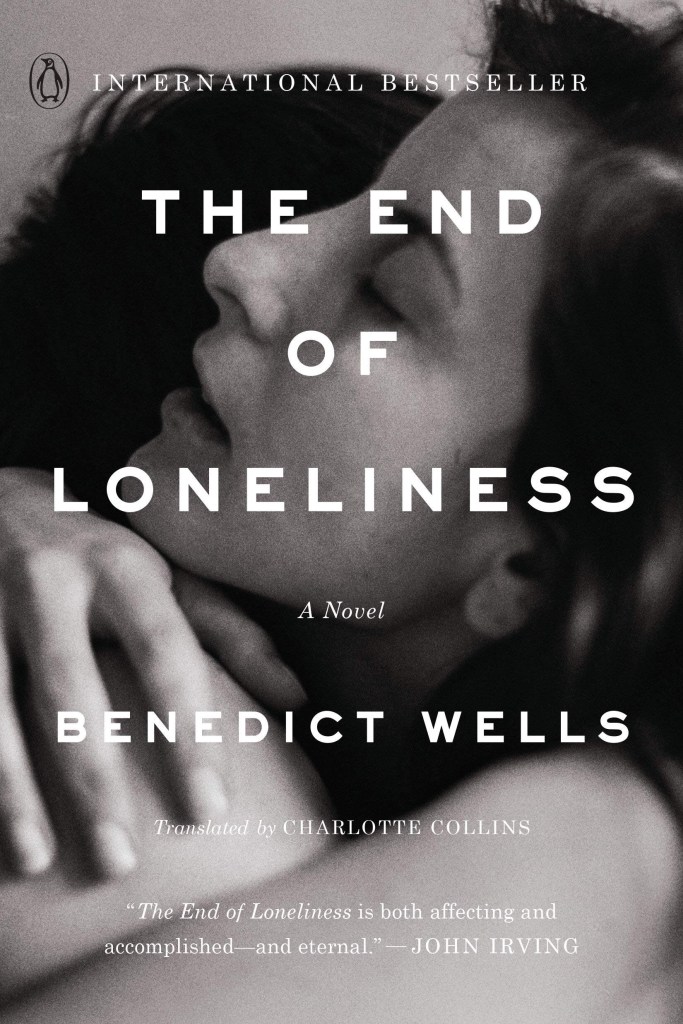
The End of Loneliness: A Novel by Benedict Wells and Charlotte Collins (Translator)
From the moment we’re born we’re on the Titanic. We’re going down, we won’t survive this, it’s already been decided. Nothing can change that. But we can choose whether we’re going to run around screaming in panic, or whether we’re like the musicians who play on, bravely and with dignity, although the ship is sinking.
Benedict Wells and Charlotte Collins (Translator), The End of Loneliness: A Novel
Thanks as always for being a faithful reader of The Voracious Bibliophile. If you like what you see, please like, comment, follow, and subscribe to my email list to get notified of new posts as soon as they drop. You can also email me at fred.slusher@thevoraciousbibliophile.com or catch me on Twitter, Instagram, TikTok, and Pinterest @voraciousbiblog. Keep reading the world, one page (or pixel) at a time.
The clear orange bottle was empty.
It had been empty a day.
It suddenly seemed so costly
and uncalled for anyway.

Two years had passed. They had passed
more or less the way years should.
Maybe he’d changed. Or maybe
the doctors had misunderstood.

It was June. The enormous elm tree
was green again, and the scent
of   hyacinth reached through the window
and followed wherever he went.

And the sky was the firmament!
His life was never better.
Each small white spotless cloud that passed
was like a long-wished-for letter.

But then he remembered his promise.
It came like a mild cramp,
and it sat there all day in the back of   his mind
like a gas bill awaiting a stamp.

He saw three faces that Sunday,
mother, sister, niece,
all with the same kind, brown, scared eyes
that brought him no peace.

The sidewalk sparrows were peeping.
His whole house smelled like a flower.
But he remembered his promise.
The drugstore said one hour.

Back home again, he was tired.
The label said caution, said warning.
He left the clear orange bottle
on the lip of   the sink till morning.

The insert said warning, said caution.
The insert said constipation.
It said insomnia, vivid dreams,
and hypersalivation,
     and increased urination,
     and a spinning sensation.

It also said night sweats, and
agranulocytosis,
and strongly suggested a full glass of   water
be drunk with all doses.

The insert said all this,
the insert he never read.
But he didn’t have to read it
to know what it said.

The bedroom was calm with moonlight
and the breeze through the screen was cooling.
Through the elm leaves the shivery light on the wall
came like quicksilver pooling.

But   just before five, something woke him —
a close whisper — or maybe a far cry —
and the bedroom was queasy with light the color
of   lapis lazuli.

He lay there listening hard
till six, till seven, till eight    ...
At nine he remembered the bottle.
But nine, nine was too late.

“Don’t take me!” cried the Clozapine.
“Don’t take me!” cried the pill.
By ten he was feeling restless,
with a whole day left to kill.

“Don’t take me!” cried the Clozapine.
“Yes, don’t!” cried the medication.
And the bright yellow morning seemed suddenly edged
with a shady fascination.

Why should he go to his workplace?
Who was his supervisor?
He had a sickening feeling
that he was becoming wiser.

His room filled up with interest.
He had begun to think!
He thought of the knives in the kitchen
and the bottles under the sink.

He thought as he switched the stove on
or stood at his shaving mirror,
or reached for his belt in the wardrobe.
Thinking made things clearer.

Even the bedroom window,
the open window full of sun,
continually hinted
at something that should be done.

But he was crooked and useless.
He was a piece of shit.
And so, as everyone knew he would,
he failed to go through with it.

“Don’t take me!” cried the Clozapine.
“Don’t take me!” cried the drug.
Just then, the telephone rang.
Just then, he ripped out the plug.

“Don’t take me!” cried the Clozapine.
“Don’t take me!” cried the poison.
And the door of   the house creaked open,
and the cellar door lilted and murmured,
and the garden gate groaned and yawned
and let a little noise in.

There, just outside his window,
lurked life like a cheap cartoon.
He shut the sash, locked it, and checked it,
and checked it all afternoon.

He lowered the blinds on that world,
no longer an agent of   it,
but then, with one finger, pulled down a slat
and set his eye above it.

At first it was grimly amusing,
at last it was grimly grim,
to watch all those hunched, hurried people,
who made like they weren’t watching him.

The neighbors were thinking out loud.
They knew he was no fucking good.
So he slumped on a stool in the corner
like a bad little snaggletooth should.

They called him a dirty pig, and laughed,
and said he shouldn’t exist.
Sometimes they made a tsking sound,
or oinked at him, or hissed.

They hissed that he was to blame
for everything, and everyone knew it,
and that if   he weren’t such a pussy
he’d know what to do, and he’d do it.

He lay on his side on the rug
unable to move at all
except for his big right toe,
  which dug and dug at the wall,
     which dug at the wall,
            which dug.

“Don’t take me!” cried the Clozapine.
“Don’t take me!” cried the cure.
And they begged him to sew his mouth shut
just to make goddamn sure.

“Don’t take me!” cried the Clozapine.
“Don’t take me!” cried the poison.
And the gate to the wicked city gaped,
and the gates of the temple screamed and screamed,
and the gates of the garden groaned and yawned,
and the gates of the ziggurat gabbled in grief,
and sucked all life’s sorrows and joys in.

His thoughts were advancing like wolves.
He lay still for an hour and a half,
then reared up onto his rickety legs
like a newborn calf.

Then     rug
                         hall
                                      stairs
porch
             stoop
                         street
and the blacktop humanly warm
on the soles of   his naked feet.

His walk was stiffened by fear,
but it took him where he was going,
into the terrible world
of children and daffodils growing,
       and friendly people helloing,
       and the Super out doing the mowing,
       and the two old sisters out in wool sweaters with their wrinkled
           cheeks pinkly glowing,
      and the pretty lady who would give birth by Christmas barely
          showing but showing,
      and the policeman helping to keep the lazy afternoon traffic
          flowing,
      and time itself slowing,
      and none of them, none of them knowing

that an odious axis was forming,
that it would not be controlled,
that schemes were afoot, that a foot
was a thing for a jackboot to hold,

that the street was a movie set,
that it was not warm and sunny,
that a creditor was calling
who could not be paid with money,

that the world was like a sliver
of   iron held in the hand,
and his mind the lodestone above it
that made it stir or stand,

that the air was slowly changing
to a color they didn’t know,
that he was a famous doctor
on a television show.

But what could he do? Even friends
would take these facts for lies,
and he couldn’t tell who the enemies were,
though he felt the hot breath of their eyes,

so he kept his big mouth shut
and tried to play along,
and plowed down the street toward the coffeeshop
as if nothing at all were wrong.

He tried not to notice the numbers
painted on garbage cans.
He tried and he tried not to look
at the black unmarked sedans.

The coffeeshop smelled like coffee,
but it felt different inside.
A new waitress went by. She winked.
He kept his eyes open wide.

Everything screamed “Run away!”
But he wasn’t really there!
So he stood by the gumball machines
and smiled and tried not to stare.

“The power is yours!” said a T-shirt.
“Look for lightning!” reported the weather.
And the stranger who offered the Sports section said,
“It’s all there, Chief. Just put it together.”

Then wild-eyed out of the kitchen
stormed a small, hard old man,
shouting in a strange language
and waving a frying pan,

shoving him out the door
and into the chattering street,
shoving him, waving, shouting,
and pointing at his feet,
    at his bare, gray feet.

Then came the dark blue uniform,
the badge glinting in the sun,
and the belt jangling like a storm trooper’s
as the boots broke into a run.

“Take that!” cried the patrolman.
“Take that!” cried Johnny Law.
Street, knee, neck —
cuffs, curb, jaw.

And the flatfoot pushed him, bleeding,
into the sleek cruiser,
and he heard all the gawkers thinking
that he was a pig and a loser,

and his chin throbbed,
and the handcuffs ate at his wrist,
and he would be hacked into pieces soon
and would not be missed.

“Don’t take me!” cried the victim.
“Don’t take me!” cried the threat.
But the angry back of a head
was the only response he could get.

Lying on his side like a child
at the end of a big day,
he gazed up through the window
and watched it all slip away.

The little pen where they put him
had a toilet but no stall.
Here and there a message
scarred the gloss-white wall.

Time passed. But you couldn’t tell it
on the trapped fly ticking the ceiling,
or the flickering light overhead,
or the sore on his chin congealing,
      or on the sound of the other pigs in the other pens, squealing.

When the men came, he was ready.
He talked. They took it all down.
And soon they were back in the cruiser,
on their way across town.

Then, into the mirrored building,
over the waxed lobby floors,
down miles of echoing hallways,
through the heavy brown doors,

into a humming beige room
with a bed and a river view,
and an outside lock, and jailers
who wore white instead of blue.

“Take that,” smiled the doctor.
“Take that,” smiled the nurse.
He pressed his lips still tighter,
and things got worse and worse.

“Please!” threatened the nurse.
“Please!” growled the doctor.
He raised his fists to cover his mouth,
but the nurse was too close, and he clocked her.

Now into the room came the big men,
who did not clamor or shout,
but pinned him with ease to the bed,
strapped him down, and went out.

And the doctor was there again, trailing
a spider web of cologne,
and the doctor told what would happen next,
in an expert monotone,

and the nurse took a needle
and emptied it into his arm,
and they both left, content
that he could do no more harm,

and he fought, and the straps cut his shoulders,
and he gnawed at his lip, and it bled,
and he held his bladder for three long hours,
then shivered and pissed the bed.

When the doctor came a fifth time,
it was long past dawn.
They’d found him a room, said the doctor,
gently restraining a yawn.

The next two days were sleep,
and words through a fine white mist.
Then he woke inside a machine
whose motion he couldn’t resist:

       “Tick-tock,” said the clock.
       “Creak, creak,” said the bed.
       “Drip, drip,” said the sink.
        “Throb, throb,” went his head.
       “Ho-hum,” sighed the night nurse.
       “Heh-heh,” said the sicko.
       “Why? Why?” screamed the patient.
       “Howl, howl!” cried the psycho.
       “Wolf! Wolf!” cried the boy.
       “Gobble, gobble!” sang the freaks.
       “Sa, sa!” cried the king.
       “Tick-tock,” went the weeks.
       “Bang, bang,” said the tv.
       “Teeter-totter,” went his brain.
       “Click, click,” went the checkers.
       “Pitter-patter,” went the rain.
        “Bring-bring,” said the pay phone.
        “Snip, snip,” went Fate.
        “Jangle-jingle,” went the keys.
        “Clank-clink,” went the gate.
        “Bye-bye,” said the nurse.
        “Bye-bye,” said the guard.
        “Bar-bar,” said the doctor.
        “Baa-baa,” said the lamb.
        “My, my,” said his mother.
        “Boohoo!” cried Bo Peep.
        “Bow-wow,” said the wolf.
        “Baa-baa,” said the sheep.

In the car away from that place,
the family had a pleasant chat.
He seemed fine again, and humble,
though his speech was oddly flat.

He said that the halfway house
where he would be residing
was located on a quiet block and had
green vinyl siding.

There he met new people
and watched the television,
which did not watch him back
or speak to him with derision,

and he performed certain tasks,
meant to teach certain skills,
and he got small checks from the government
to pay his enormous bills.

Each night he fell asleep,
and each morning he got up,
and he washed down his medicine
and squashed the paper cup,

feeling, in all, much better,
more in touch with common sense,
and also slightly bored
by the lack of consequence.

And the church bells rang
and a dinner bell tinkled
and the school bell tolled
and called all the good girls and boys in.
And all of them brought all their toys in.
And all of them swallowed their poison.
Each person acting in the subject’s welfare is cruelly indifferent towards him, wanting to make him less of a problem instead of helping him to manage his illness(es) and therefore lead a richer and happier life.
I know I don’t usually post long-form poems, but I made an exception for today because I love the way Mehigan evokes the vagaries of mental illness in “The Orange Bottle”. The subject of the poem experiences a brief burst of mania followed by a deep and relentless depression. His erratic behavior, which a compassionate person would interpret as a cry for help and indicate a need for treatment, leads instead to his arrest, imprisonment, and later hospitalization. Each person acting in the subject’s welfare is cruelly indifferent towards him, wanting to make him less of a problem instead of helping him to manage his illness(es) and therefore lead a richer and happier life.
Despite all of our gilded discourse surrounding vulnerability and destigmatization, mental illness is still something that many people don’t understand and probably don’t even want to.
Despite all of our gilded discourse surrounding vulnerability and destigmatization, mental illness is still something that many people don’t understand and probably don’t even want to. I myself come from a long line of severely mentally-ill people. Generational trauma, complex PTSD, and substance abuse disorders exacerbated by abject poverty and a lack of proper treatment have wreaked havoc on both sides of my family line. It doesn’t help that the Evangelical bootstraps rhetoric that generations of my people have been subjected to has caused many of them to see their illnesses as symptoms of a spiritual malady and not a chemical imbalance in the brain.
We deserve to live out in the open, wounds visible.
I want better for them. I want better for all of us. And that all starts by telling our stories, by refusing to be cowed by convention or silenced by stigma. We deserve to live out in the open, wounds visible. That’s the first step to getting better.
Thanks as always for being a faithful reader of The Voracious Bibliophile. If you like what you see, please like, comment, follow, and subscribe to my email list to get notified of new posts as soon as they drop. You can also email me at fred.slusher@thevoraciousbibliophile.com or catch me on Twitter, Instagram, TikTok, and Pinterest @voraciousbiblog. Keep reading the world, one page (or pixel) at a time.
Lie With Me: A Novel by Philippe Besson and Molly Ringwald (Translator)
Later I will write about this longing, the intolerable deprivation of the other. I will write about the sadness that eats away at you, making you crazy. It will become the template for my books, in spite of myself. I wonder sometimes if I have ever written of anything else. It’s as if I never recovered from it: the inaccessible other, occupying all my thoughts.
Philippe Besson and Molly Ringwald (Translator), Lie With Me: A Novel
There’s nothing in the entire world more painful than unrequited love, or love given then taken inexplicably away. It’s maddening, truly. You never forget it, and for the rest of your life the hundred thousand scenarios called forth from the interrogative haunt you like a bad dream you see every time you think of the one you lost.
The only real cure for this kind of heartache is love, and it needn’t necessarily come from a romantic relationship. It turns out you can give yourself the love you deserve. You just have to be willing to put it in the work.
Thanks as always for being a faithful reader of The Voracious Bibliophile. If you like what you see, please like, comment, follow, and subscribe to my email list to get notified of new posts as soon as they drop. You can also email me at fred.slusher@thevoraciousbibliophile.com or catch me on Twitter, Instagram, TikTok, and Pinterest @voraciousbiblog. Keep reading the world, one page (or pixel) at a time.
Lie With Me: A Novel by Philippe Besson and Molly Ringwald (Translator)
I discover that absence has a consistency, like the dark water of a river, like oil, some kind of sticky dirty liquid that you can struggle and perhaps drown in. It has a thickness like night, an indefinite space with no landmarks, nothing to bang against, where you search for a light, some small glimmer, something to hang on to and guide you. But absence is, first and foremost, silence. A vast, enveloping silence that weighs you down and puts you in a state where any unforeseeable, unidentifiable sounds can make you jump.
Philippe Besson and Molly Ringwald (Translator), Lie With Me: A Novel
Lie With Me was one of the best books I read in 2019. It first came to my attention months before it was released in English, lauded as the next Call Me by Your Name. Side note: Can we stop doing this? By this, I mean using one work of LGBT art as the reference for its successors ad nauseam until something else captures the attention of the mainstream crowd. Okay? Thank you! Anyway, I was immediately attracted to the gorgeous black-and-white cover and when I saw that it was translated from the French by Molly Ringwald (yes, that one!), I knew I had to get my hands on it.
Even in 2021, even in progressive areas of the world, the simple fact of existing as an LGBT person can invite stigma, ostracism, and violence.
Luckily, it did not disappoint. No spoilers, but Besson’s novel is not an easy read. Because of the world LGBT people are forced to inhabit, so much of our lives are lived under a veil of secrecy, which engenders both shame and repression, neither of which are healthy. If not for love, we would all perish. Even in 2021, even in progressive areas of the world, the simple fact of existing as an LGBT person can invite stigma, ostracism, and violence. My hope is that one day everyone will wake up and realize that love is valid and should be celebrated in whatever configuration it expresses itself.
Thanks as always for being a faithful reader of The Voracious Bibliophile. If you like what you see, please like, comment, follow, and subscribe to my email list to get notified of new posts as soon as they drop. You can also email me at fred.slusher@thevoraciousbibliophile.com or catch me on Twitter, Instagram, TikTok, and Pinterest @voraciousbiblog. Keep reading the world, one page (or pixel) at a time.
Thanks as always for being a faithful reader of The Voracious Bibliophile. If you like what you see, please like, comment, follow, and subscribe to my email list to get notified of new posts as soon as they drop. You can also email me at fred.slusher@thevoraciousbibliophile.com or catch me on Twitter, Instagram, TikTok, and Pinterest @voraciousbiblog. Keep reading the world, one page (or pixel) at a time.
We rip out so much of ourselves to be cured of things faster than we should that we go bankrupt by the age of thirty and have less to offer each time we start with someone new. But to feel nothing so as not to feel anything – what a waste!
André Aciman, Call Me by Your Name: A Novel
I know that if I allowed myself the space and energy to honor all of my feelings, I’d never get anything else done.
Arguably the most powerful moment in either the novel or its film adaptation, this exchange between Elio and his father provides CMBYN with its emotional and philosophical core. It also begs the question: is it possible to live authentically without eventually becoming jaded? How do we honor our feelings without suppressing them and still carry on with the daily grind of life? I know that if I allowed myself the space and energy to honor all of my feelings, I’d never get anything else done.
Life, after all, is not just one singular experience or expression of selfhood. It is so many different things, sometimes all at once.
These are naturally questions without easy answers. Perhaps there is no answer. Life, after all, is not just one singular experience or expression of selfhood. It is so many different things, sometimes all at once. The truth, it seems, must lie somewhere in the middle. What do you think?
God, what a stylish man….anyway, see you next time!
Thanks as always for being a faithful reader of The Voracious Bibliophile. If you like what you see, please like, comment, follow, and subscribe to my email list to get notified of new posts as soon as they drop. You can also email me at fred.slusher@thevoraciousbibliophile.com or catch me on Twitter, Instagram, TikTok, and Pinterest @voraciousbiblog. Keep reading the world, one page (or pixel) at a time.
You may write me down in history
With your bitter, twisted lies,
You may trod me in the very dirt
But still, like dust, I'll rise.

Does my sassiness upset you?
Why are you beset with gloom?
’Cause I walk like I've got oil wells
Pumping in my living room.

Just like moons and like suns,
With the certainty of tides,
Just like hopes springing high,
Still I'll rise.

Did you want to see me broken?
Bowed head and lowered eyes?
Shoulders falling down like teardrops,
Weakened by my soulful cries?

Does my haughtiness offend you?
Don't you take it awful hard
’Cause I laugh like I've got gold mines
Diggin’ in my own backyard.

You may shoot me with your words,
You may cut me with your eyes,
You may kill me with your hatefulness,
But still, like air, I’ll rise.

Does my sexiness upset you?
Does it come as a surprise
That I dance like I've got diamonds
At the meeting of my thighs?

Out of the huts of history’s shame
I rise
Up from a past that’s rooted in pain
I rise
I'm a black ocean, leaping and wide,
Welling and swelling I bear in the tide.

Leaving behind nights of terror and fear
I rise
Into a daybreak that’s wondrously clear
I rise
Bringing the gifts that my ancestors gave,
I am the dream and the hope of the slave.
I rise
I rise
I rise.
Her singular sonorous voice echoes with the shared promise and potential of humanity, especially those who are downtrodden, maligned, and marginalized.
I love the imagery in this poem. It gives me chills every time I read it, and I can hear Maya Angelou’s voice in my head when I do. Her singular sonorous voice echoes with the shared promise and potential of humanity, especially those who are downtrodden, maligned, and marginalized. Inside also is a reclamation, a refusal to be shaped or cowed by the words and deeds of others. After reading “Still I Rise”, the only appropriate response is amen. Amen amen amen.
Maya Angelou Reciting “Still I Rise”
Thanks as always for being a faithful reader of The Voracious Bibliophile. If you like what you see, please like, comment, follow, and subscribe to my email list to get notified of new posts as soon as they drop. You can also email me at fred.slusher@thevoraciousbibliophile.com or catch me on Twitter, Instagram, TikTok, and Pinterest @voraciousbiblog. Keep reading the world, one page (or pixel) at a time.











 The Voracious Bibliophile