Quote for the Day: November 29th, 2021

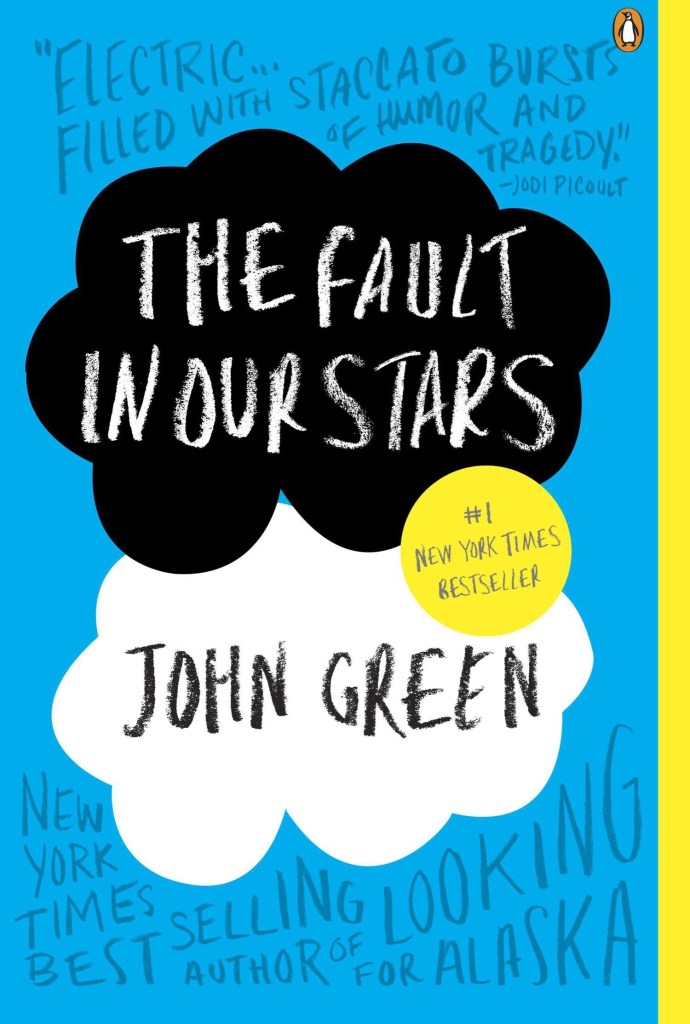
The Fault in Our Stars by John Green

As he read, I fell in love the way you fall asleep: slowly, and then all at once.

John Green, The Fault in Our Stars

My love for this book dwindled with its increased popularity. I don’t know why that happened even though I know I’m not the only one to experience it, that fateful lessening. It had, of course, nothing to do with the book itself and everything to do with the fact that when I first read it, it felt like this delicious secret shared only between myself and the author. Even the author was an afterthought, as if the book had materialized fully-formed from the ether. Once every other lovelorn teenager went gaga over it, it fell in my esteem. If the masses also saw it the way I did, could it really be that special?

There’s an impulse that exists when you love something or someone to both keep that love to yourself and to proclaim it loudly from the rooftops.

I guess the answer is both yes and no. There’s an impulse that exists when you love something or someone to both keep that love to yourself and to proclaim it loudly from the rooftops. Sometimes these impulses, opposite though they may be, exist in tandem. Dichotomous and fretful, they war with one another. Do I whisper or do I scream? Do I hold on or simply let go?

It is possible to have your own relationship with a work of art that is separate from the rest of the world.

Now, after several years of living, I can see that I was wrong to let anything interfere with my own experience. It is possible to have your own relationship with a work of art that is separate from the rest of the world. It is not easy, mind you. Only possible. And I’m glad I came across today’s quote because it reminded me of when I first read The Fault in Our Stars sitting in a lawn chair in Kroger and ignoring the rest of the world. I made it through about 40 pages before my parents found me and told me it was time to leave. I bought the book and brought it home with me, anxious to soak in more. Those were good times.

Thanks as always for being a faithful reader of The Voracious Bibliophile. If you like what you see, please like, comment, follow, and subscribe to my email list to get notified of new posts as soon as they drop. You can also email me at fred.slusher@thevoraciousbibliophile.com or catch me on Twitter, Instagram, TikTok, and Pinterest @voraciousbiblog. Keep reading the world, one page (or pixel) at a time.
Poem for the Day: November 28th, 2021

There Will Come Soft Rains by Sara Teasdale

(War Time)

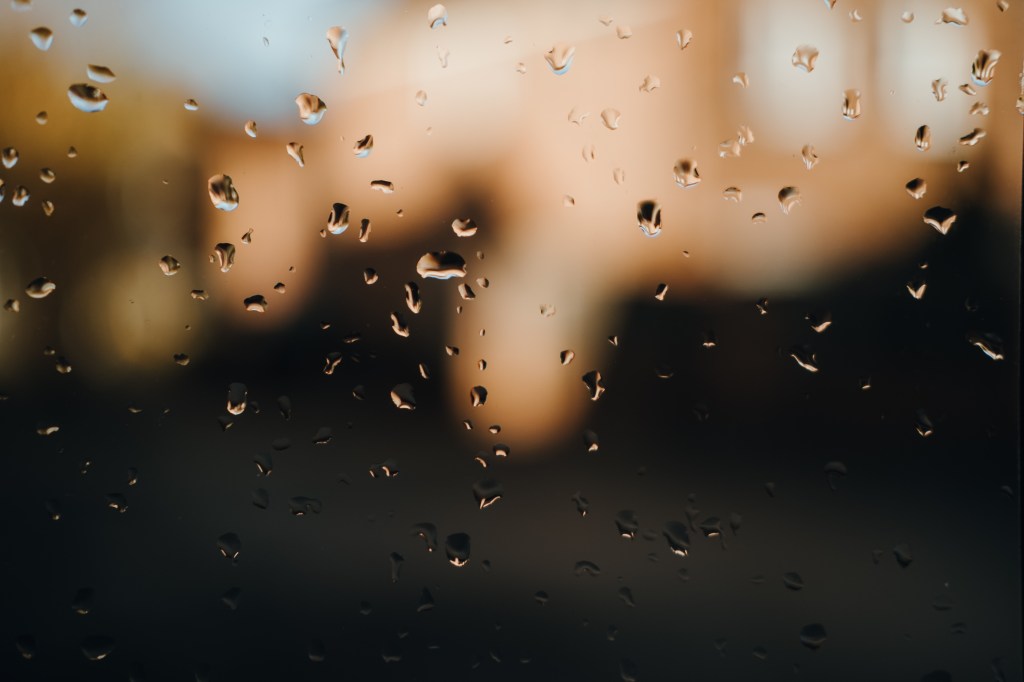
There will come soft rains and the smell of the ground,
And swallows circling with their shimmering sound;

And frogs in the pools singing at night,
And wild plum trees in tremulous white,

Robins will wear their feathery fire
Whistling their whims on a low fence-wire;

And not one will know of the war, not one
Will care at last when it is done.

Not one would mind, neither bird nor tree
If mankind perished utterly;

And Spring herself, when she woke at dawn,
Would scarcely know that we were gone.

Sara Teasdale (1884-1933), while frequently excluded from mention in conversations surrounding early twentieth century American poetry, was critically acclaimed and lauded by both her peers and the public alike during her lifetime. Her deeply personal and heartfelt poems charted the changing inner landscape of a woman living through one of the most turbulent periods in American history, and we would do well to re-examine her impact on her contemporaries as well as her successors. You can read more about her life and work here.

Thanks as always for being a faithful reader of The Voracious Bibliophile. If you like what you see, please like, comment, follow, and subscribe to my email list to get notified of new posts as soon as they drop. You can also email me at fred.slusher@thevoraciousbibliophile.com or catch me on Twitter, Instagram, TikTok, and Pinterest @voraciousbiblog. Keep reading the world, one page (or pixel) at a time.

Quote for the Day: November 28th, 2021

The Life of Emile Zola (1937); directed by William Dieterle

All my friends have told me that it was insane for a single person to oppose the immense machinery of the law, the glory of the army, and the power of the state. They warned me that my actions would be mercilessly crushed, that I would be destroyed. But what does it matter if an individual is shattered if only justice is resurrected?

The Life of Emile Zola (1937); directed by William Dieterle

Thanks as always for being a faithful reader of The Voracious Bibliophile. If you like what you see, please like, comment, follow, and subscribe to my email list to get notified of new posts as soon as they drop. You can also email me at fred.slusher@thevoraciousbibliophile.com or catch me on Twitter, Instagram, TikTok, and Pinterest @voraciousbiblog. Keep reading the world, one page (or pixel) at a time.

Poem for the Day: November 27th, 2021

Patronage by Solmaz Sharif

They say
willingness is what one needs
to succeed.

They say one needs to succeed.

*

Our poets do not imagine
a screaming

audience.

Our poets are used to padding,

vinyl, on the foldable chairs,
bookshelves on casters
moved aside
to make space for them

A world polite
for their words

A well-­behaved.
A world’s behavior

malformed and they step
in as one steps in
to a nursery and

quiet

calms the tantrum
attempts not to wake
the sleeping, the milk-­drunk

and burped babe.

Our poets coo.

And beg their feet be placed in a large room.

*

Prize ring. Bull ring. Lion
through the ring of flames.

Poets convinced they are ringmaster
when it is with big brooms and bins, in fact,
they enter to clear the elephant scat.

*

There was an inlet
I pulled over once to watch the sunset, which
was still another hour or so away, the light
just low enough there to begin to change.
I should’ve stayed. I should’ve stayed.

*

A life of idle, with money

doing the work. A life beholden,
but bestowed. To make reformists of us all,

even the fascists.
Especially

of the fascists.

*

But he’s a patron.
But he makes a star of us,
he makes us of rank.

But he’s a churchgoer

and they place their hands on him and pray and bountiful
grow their wives’ bellies, a bully
for each family. Exponential doom.

Singing to each other in the private gazebo of their youth.

*

Now sing.

*

I said what I meant
but I said it

in velvet. I said it in feathers.
And so one poet reminded me


Remember what you are to them.

Poodle, I said.

And remember what they are to you.

*

Meat.

© 2021 Solmaz Sharif. “Patronage” originally appeared in The Yale Review on May 19th, 2021. Solmaz Sharif is the author of two collections of poetry: Look: Poems, which was published by Graywolf Press in July 2016 and was a finalist for the 2016 National Book Award; and Customs: Poems, which is forthcoming from Graywolf Press in March 2022 and is available to preorder wherever books are sold.

Thanks as always for being a faithful reader of The Voracious Bibliophile. If you like what you see, please like, comment, follow, and subscribe to my email list to get notified of new posts as soon as they drop. You can also email me at fred.slusher@thevoraciousbibliophile.com or catch me on Twitter, Instagram, TikTok, and Pinterest @voraciousbiblog. Keep reading the world, one page (or pixel) at a time.

Quote for the Day: November 27th, 2021

The Life of Emile Zola (1937); directed by William Dieterle

Each serves his country in his own way – one with a sword, the other with a pen. Posterity will choose between your name and mine.

The Life of Emile Zola (1937); directed by William Dieterle

Thanks as always for being a faithful reader of The Voracious Bibliophile. If you like what you see, please like, comment, follow, and subscribe to my email list to get notified of new posts as soon as they drop. You can also email me at fred.slusher@thevoraciousbibliophile.com or catch me on Twitter, Instagram, TikTok, and Pinterest @voraciousbiblog. Keep reading the world, one page (or pixel) at a time.

Poem for the Day: November 26th, 2021

Diving into the Wreck: Poems 1971-1972 by Adrienne Rich

Diving into the Wreck by Adrienne Rich

First having read the book of myths,
and loaded the camera,
and checked the edge of the knife-blade,
I put on
the body-armor of black rubber
the absurd flippers
the grave and awkward mask.
I am having to do this
not like Cousteau with his
assiduous team
aboard the sun-flooded schooner
but here alone.

There is a ladder.
The ladder is always there
hanging innocently
close to the side of the schooner.
We know what it is for,
we who have used it.
Otherwise
it is a piece of maritime floss
some sundry equipment.

I go down.
Rung after rung and still
the oxygen immerses me
the blue light
the clear atoms
of our human air.
I go down.
My flippers cripple me,
I crawl like an insect down the ladder
and there is no one
to tell me when the ocean
will begin.

First the air is blue and then
it is bluer and then green and then
black I am blacking out and yet
my mask is powerful
it pumps my blood with power
the sea is another story
the sea is not a question of power
I have to learn alone
to turn my body without force
in the deep element.

And now: it is easy to forget
what I came for
among so many who have always
lived here
swaying their crenellated fans
between the reefs
and besides
you breathe differently down here.

I came to explore the wreck.
The words are purposes.
The words are maps.
I came to see the damage that was done
and the treasures that prevail.
I stroke the beam of my lamp
slowly along the flank
of something more permanent
than fish or weed

the thing I came for:
the wreck and not the story of the wreck
the thing itself and not the myth
the drowned face always staring
toward the sun
the evidence of damage
worn by salt and sway into this threadbare beauty
the ribs of the disaster
curving their assertion
among the tentative haunters.

This is the place.
And I am here, the mermaid whose dark hair
streams black, the merman in his armored body.
We circle silently
about the wreck
we dive into the hold.
I am she: I am he

whose drowned face sleeps with open eyes
whose breasts still bear the stress
whose silver, copper, vermeil cargo lies
obscurely inside barrels
half-wedged and left to rot
we are the half-destroyed instruments
that once held to a course
the water-eaten log
the fouled compass

We are, I am, you are
by cowardice or courage
the one who find our way
back to this scene
carrying a knife, a camera
a book of myths
in which
our names do not appear.

© 1973 Adrienne Rich and W.W. Norton & Company, Inc. “Diving into the Wreck” originally appeared as part of Rich’s collection Diving into the Wreck: Poems 1971-1972, which was published in 1973 by W.W. Norton & Company, Inc. Rich was awarded the National Book Award for Poetry in 1974 for this collection.

Thanks as always for being a faithful reader of The Voracious Bibliophile. If you like what you see, please like, comment, follow, and subscribe to my email list to get notified of new posts as soon as they drop. You can also email me at fred.slusher@thevoraciousbibliophile.com or catch me on Twitter, Instagram, TikTok, and Pinterest @voraciousbiblog. Keep reading the world, one page (or pixel) at a time.

Quote for the Day: November 26th, 2021

Maybe looking forward to things isn’t so much about planning a perfect future but about practicing hope.

Morgan Harper Nichols

Thanks as always for being a faithful reader of The Voracious Bibliophile. If you like what you see, please like, comment, follow, and subscribe to my email list to get notified of new posts as soon as they drop. You can also email me at fred.slusher@thevoraciousbibliophile.com or catch me on Twitter, Instagram, TikTok, and Pinterest @voraciousbiblog. Keep reading the world, one page (or pixel) at a time.
Poem for the Day: November 25th, 2021

Kindness by Naomi Shihab Nye

Before you know what kindness really is
you must lose things,
feel the future dissolve in a moment
like salt in a weakened broth.
What you held in your hand,
what you counted and carefully saved,
all this must go so you know
how desolate the landscape can be
between the regions of kindness.
How you ride and ride
thinking the bus will never stop,
the passengers eating maize and chicken
will stare out the window forever.

Before you learn the tender gravity of kindness
you must travel where the Indian in a white poncho
lies dead by the side of the road.
You must see how this could be you,
how he too was someone
who journeyed through the night with plans
and the simple breath that kept him alive.

Before you know kindness as the deepest thing inside,
you must know sorrow as the other deepest thing.
You must wake up with sorrow.
You must speak to it till your voice
catches the thread of all sorrows
and you see the size of the cloth.
Then it is only kindness that makes sense anymore,
only kindness that ties your shoes
and sends you out into the day to gaze at bread,
only kindness that raises its head
from the crowd of the world to say
It is I you have been looking for,
and then goes with you everywhere
like a shadow or a friend.

© 1995 Naomi Shihab Nye. “Kindness” originally appeared as part of Nye’s collection Words Under the Words: Selected Poems, which was published by Eighth Mountain Press in 1995.

Thanks as always for being a faithful reader of The Voracious Bibliophile. If you like what you see, please like, comment, follow, and subscribe to my email list to get notified of new posts as soon as they drop. You can also email me at fred.slusher@thevoraciousbibliophile.com or catch me on Twitter, Instagram, TikTok, and Pinterest @voraciousbiblog. Keep reading the world, one page (or pixel) at a time.

Quote for the Day: November 25th, 2021

You still have a lot of time to make yourself be what you want.

S.E. Hinton

Thanks as always for being a faithful reader of The Voracious Bibliophile. If you like what you see, please like, comment, follow, and subscribe to my email list to get notified of new posts as soon as they drop. You can also email me at fred.slusher@thevoraciousbibliophile.com or catch me on Twitter, Instagram, TikTok, and Pinterest @voraciousbiblog. Keep reading the world, one page (or pixel) at a time.

Poem for the Day: November 24th, 2021

Stopping by Woods on a Snowy Evening by Robert Frost

Whose woods these are I think I know.
His house is in the village though;
He will not see me stopping here
To watch his woods fill up with snow.

My little horse must think it queer
To stop without a farmhouse near
Between the woods and frozen lake
The darkest evening of the year.

He gives his harness bells a shake
To ask if there is some mistake.
The only other sound's the sweep
Of easy wind and downy flake.

The woods are lovely, dark and deep.
But I have promises to keep,
And miles to go before I sleep,
And miles to go before I sleep.

This poem is in the public domain. “Stopping by Woods on a Snowy Evening” is one of Robert Frost’s best-known and most-loved poems. It was written in 1922 and included in his Pulitzer Prize-winning collection New Hampshire, which was published by Henry Holt in 1923.

Thanks as always for being a faithful reader of The Voracious Bibliophile. If you like what you see, please like, comment, follow, and subscribe to my email list to get notified of new posts as soon as they drop. You can also email me at fred.slusher@thevoraciousbibliophile.com or catch me on Twitter, Instagram, TikTok, and Pinterest @voraciousbiblog. Keep reading the world, one page (or pixel) at a time.