Books with Buzz: New and Forthcoming in November 2021

I feel like publishers really stack the deck (or TBR pile, if you will) with November releases. They know the season for gift-giving is just around the bend and therefore the biggest titles of the year usually release in the weeks leading up to Hanukkah and Christmas. Below are some of the titles I’m most looking forward to picking up myself this season or considering getting as gifts. Links are included. Happy reading!

The Family: A Novel by Naomi Krupitsky

The Family: A Novel by Naomi Krupitsky

Publication Date: November 2nd, 2021

Publisher: Putnam

Page Count: 368

A Book of the Month Club pick as well as Jenna Bush Hager’s Read With Jenna selection for November 2021, The Family couldn’t have been released at a better time. For one thing, The Many Saints of Newark: A Sopranos Story, a prequel film to HBO’s The Sopranos, just came out on October 1st. While its theater performance was lackluster, it was a steaming hit on HBO Max and reignited interest in the original series as well as all things mafia in general.

Now, yours truly really appreciates the font on the cover, which serves as a none-too-subtle nod to Mario Puzo’s The Godfather. After all, it’s what made me pick up the book in the first place. There are some who would say that stories centering the families of organized crime had their heyday long ago, and who am I to tell someone they’re wrong? The Voracious Bibliophile, that’s who! For God’s sake, let us have our mobsters!!!

The Family tells the story of Sofia Colicchio and Antonia Russo, two Italian-American women raised in an insular Brooklyn community where their families’ business interests force them to hold the rest of the world at bay, forging them together into a bond not easily broken. The secrets of their world threaten that bond as they grow up, though, and only time will tell if the threads of their friendship will knit back together or fray past the point of repair.

Kirkus gave The Family a lukewarm-at-best review, calling it “a little too facile” and “readable but somewhat shallow”. Kruptisky’s novel is also negatively compared to the work of Elena Ferrante, but it’s not really fair to measure anyone in comparison to Ferrante, whose Neapolitan Novels quite literally changed my life. This was one of my Book of the Month Club picks for November and my box came the other day, so I will let you know my thoughts when I’m able to dig into it.

Win Me Something: A Novel by Kyle Lucia Wu

Win Me Something: A Novel by Kyle Lucia Wu

Publication Date: November 2nd, 2021

Publisher: Tin House

Page Count: 280

The Adriens are a manifestation of Willa’s wildest dreams, embodying the ideal family dynamic she always wanted but never had and living out a version of upper-middle-class life she has always craved but to which she never had access.

Win Me Something tells the story of Willa Chen, who while working as a waitress in Brooklyn gets the opportunity to work as a nanny for the Adrien family. The Adriens are a manifestation of Willa’s wildest dreams, embodying the ideal family dynamic she always wanted but never had and living out a version of upper-middle-class life she has always craved but to which she never had access.

As the mixed-race daughter of a Chinese immigrant father and white American mother, Willa longs for an uncomplicated history, one devoid of the racism she experiences due to her biracial identity and the bifurcations that always accompany being a child of divorce shuffled between two families, neither of which fully belong to her. Once she starts working for the Adriens, she begins to learn more about herself and the life she’s led up until now, finding that even when life is imperfect it can still be good.

Don’t expect any big reveals or melodramatics characteristic of “nanny fiction”. No husband-nanny adultery or child murder. No long-held secrets bubbling to the surface. If you’re looking for something more salacious like that, check out my Nefarious Nannies Reading List.

I Hope This Finds You Well: Poems by Kate Baer

I Hope This Finds You Well: Poems by Kate Baer

***Note: I was lucky enough to receive a free digital review copy of this book courtesy of NetGalley and the publisher. You can read my review here.***

Publication Date: November 9th, 2021

Publisher: Harper Perennial

Page Count: 96

It’s a beacon of light as well as a sea of middle fingers raised high. Don’t miss it.

Kate Baer’s newest collection is nothing short of a reclamation. The “found poems” herein are crafted from missives sent to Baer online by detractors and fans alike. The detractors range from the annoying and intrusive to the outright abusive, and Baer takes no prisoners in transforming their vitriol into their vanquishment, their viciousness into her own sweet victory.

The detractors range from the annoying and intrusive to the outright abusive, and Baer takes no prisoners in transforming their vitriol into their vanquishment, their viciousness into her own sweet victory.

Baer’s experiences online are as old as the Internet itself. I’m sure the behaviors, if not the platforms themselves, date back much farther. The women living in the 21st century are dealing with the same crap that the women dealt with who were alive before Christopher Columbus sailed the ocean blue. The simple fact is men don’t like women who dare to be complex people in the public sphere. They prefer them to be silent and demure, to cow and coo, to be healthy but thin, outgoing yet deferential, smart yet never sassy, and above all, subservient. Well, pardon my French, but to hell with all of that!

Baer’s collection is perfect for anyone who has ever been subjected to unsolicited feedback about their words, their body, or their very existence. It’s a beacon of light as well as a sea of middle fingers raised high. Don’t miss it.

Bonus: Midtown Scholar Bookstore of Harrisburg, Pennsylvania is hosting a livestream discussion between Kate Baer and Maggie Smith about Baer’s new book. It’s free and open to the public but requires registration, so if you’re interested, I’m posting the link below:

https://www.midtownscholar.com/calendar/2021/11/11/kate-baer-in-conversation-with-maggie-smith-i-hope-this-finds-you-well

Please note that while the event itself is free, Midtown is also selling signed copies of Baer’s book, which you can order here.

The Perishing: A Novel by Natashia Deón

The Perishing: A Novel by Natashia Deón

Publication Date: November 9th, 2021

Publisher: Counterpoint

Page Count: 320

Natashia Deón’s dazzling new novel was an early release pick for the Book of the Month Club and to be perfectly honest, the cover alone was enough for me to have it included in my box. The Perishing tells the story of Lou, an immortal Black woman who wakes up in an alley with no memory in 1930s Los Angeles. She has visions of a man’s face which she draws as she tries to make sense of who she is and where she came from. The premise immediately made me think of NBC’s Blindspot, as well any of a number of 40s films noir.

During the course of the novel, Lou also becomes the first female journalist for the LA Times, breaking stories of crime and vice during the era of Prohibition, which when you add in the fantasy elements make The Perishing a very intriguing read.

I am so giddily excited for this book and Natashia Deón in general. Is anyone else already casting the screen adaptation? Someone call Shonda Rhimes already and let’s get this going! *coughs* Janelle Monáe *coughs*

Bonus: Read Natashia Deón’s ‘The Perishing’ Takes Us on a Ride Through Time, Love, and Reckoning in America, an interview with Natashia Deón by Sarah Nelson for Shondaland

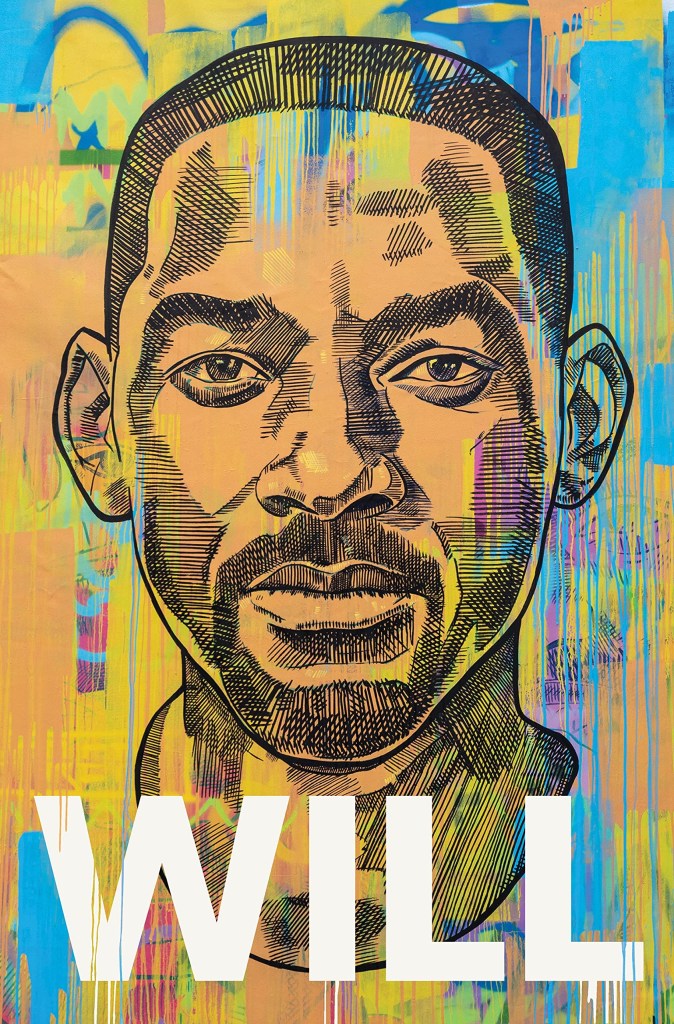
Will by Will Smith and Mark Manson
Will by Will Smith and Mark Manson

Publication Date: November 9th, 2021

Publisher: Penguin Press

Page Count: 432

🎤 West Philadelphia, born and raised 🎤

If you start singing this and the person you’re with doesn’t start singing it with you, that is a warning sign from God that you’d be remiss to ignore.

Will Smith first rose to prominence through his starring role on NBC’s The Fresh Prince of Bel-Air. The show ran for six seasons and after its conclusion, Smith was able to transition from television to blockbuster films rather seamlessly. Now, in addition to being a producer and one of Hollywood’s most bankable stars, the Grammy Award winner and Academy Award nominee can add author to his CV.

Co-written with Mark Manson, the #1 New York Times bestselling author of The Subtle Art of Not Giving a F*ck, Will is a celebrity memoir I’m very much looking forward to reading.

Bonus: Read The Fresh Prince of Belles-Lettres? Will Smith Has a Memoir. by Alexandra Jacobs for The New York Times

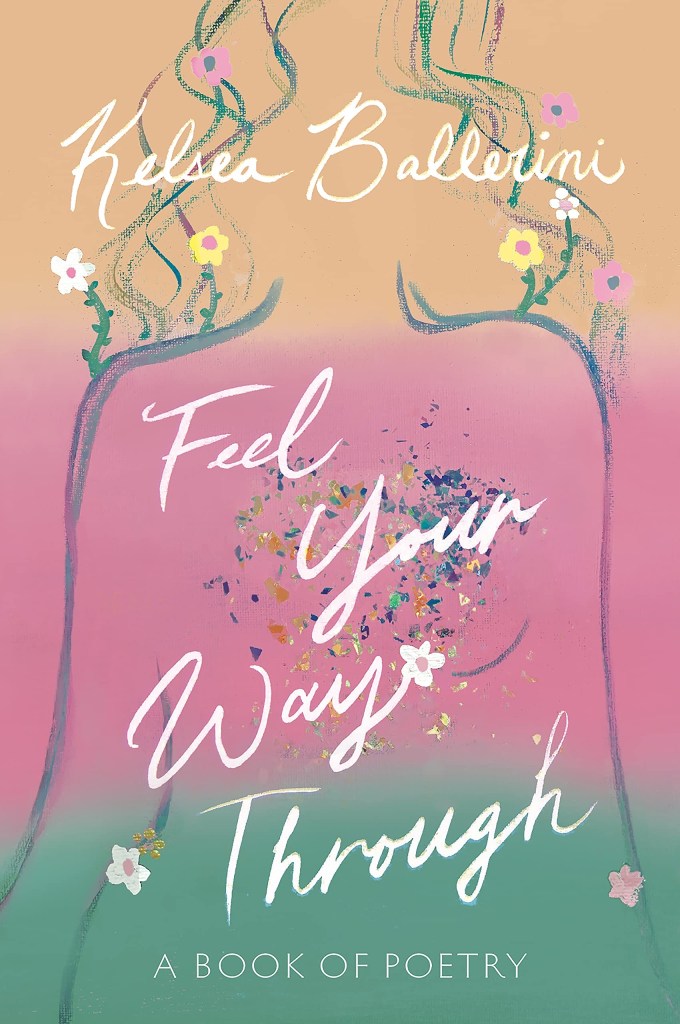
Feel Your Way Through: A Book of Poetry by Kelsea Ballerini

***Note: I was lucky enough to receive a free digital review copy of this book courtesy of NetGalley and the publisher. You can read my review here.***
Feel Your Way Through: A Book of Poetry by Kelsea Ballerini

Publication Date: November 16th, 2021

Publisher: Ballantine Books

Page Count: 144

Anyone familiar with Kelsea Ballerini’s music knows she’s a gifted storyteller, and her abilities shine through just as strong in her poetry as they do in her songcraft. Following a recent spate of singer-celebrity poetry collections, Ballerini’s Feel Your Way Through is fearsome and original, baring her soul on every page. Is this collection going to win (or even be nominated) for a Pulitzer Prize? Of course not. But you don’t have to be Walt Whitman to say something worthwhile and true about the human experience. Honestly, the elitism and pedantry surrounding what qualifies as poetry, especially “good” poetry, is a crock of 🐴 💩 anyway. Herein, Ballerini tells the truth as she sees it, and that’s more than good enough for me.

These Precious Days: Essays by Ann Patchett

These Precious Days: Essays by Ann Patchett

Publication Date: November 23rd, 2021

Publisher: Harper

Page Count: 336

She is, in my opinion, one of the greatest living American nonfiction writers.

Publisher’s Weekly calls Ann Patchett’s newest book a “moving collection not easily forgotten,” but I don’t know if I have the emotional capacity to withstand a new essay collection by Ann Patchett, especially since Red (Taylor’s Version) drops on the 14th and 30 by Adele drops just five days later on the 19th. Ann Patchett’s writing always makes me feel some kind of way and judging from the snippets I’ve gleaned from These Precious Days, it will not be the exception to the rule.

Consider the first two sentences of this excerpt furnished to CBS News:

Did I tell you I loved my father, that he loved me? Contrary to popular belief, love does not need understanding to thrive.

Ann Patchett, These Precious Days: Essays

She has such an inimitable way of pulling the reader in, pushing them back, allowing them to flail for a little while, and then pulling them back in again. She is, in my opinion, one of the greatest living American nonfiction writers. In fact, the only writer I can currently think of who surpasses her in reticent emotional resonance is Joan Didion, long may she live.

Bonus: Read my review of Truth & Beauty, which I called “an exquisitely written and heartfelt evocation of a friendship”.

Don’t judge me if I don’t pick this one up until mid-December, although you can pretty much guarantee I’ll own it before then.

Thanks as always for being a faithful reader of The Voracious Bibliophile. If you like what you see, please like, comment, follow, and subscribe to my email list to get notified of new posts as soon as they drop. You can also email me at fred.slusher@thevoraciousbibliophile.com or catch me on Twitter, Instagram, TikTok, and Pinterest @voraciousbiblog. Keep reading the world, one page (or pixel) at a time.

Poem for the Day: November 11th, 2021

The End of a Beautiful Era by Joseph Brodsky

Since the stern art of poetry calls for words, I, morose,
deaf, and balding ambassador of a more or less
insignificant nation that’s stuck in this super
power, wishing to spare my old brain,
hand myself my own topcoat and head for the main
street: to purchase the evening paper.

Wind disperses the foliage. The dimness of old bulbs in these
sorry quarters, whose motto’s “The mirror will please,”
gives a sense of abundance supported by puddles.
Even thieves here steal apples by scratching the amalgam first.
Yet the feeling one gets, from one’s own sweet reflection—this feeling I’ve lost.
That’s what really puzzles.

Everything in these parts is geared for winter: long dreams,
prison walls, overcoats, bridal dresses of whiteness that seems
snowlike. Drinks. Kinds of soap matching dirt in dark corners.
Sparrow vests, second hand of the watch round your wrist,
puritanical mores, underwear. And, tucked in the violinists’
palms, old redwood hand warmers.

This whole realm is just static. Imagining the output of lead
and cast iron, and shaking your stupefied head,
you recall bayonets, Cossack whips of old power.
Yet the eagles land like good lodestones on the scraps.
Even wicker chairs here are built mostly with bolts and with nuts,
one is bound to discover.

Only fish in the sea seem to know freedom’s price.
Still, their muteness compels us to sit and devise
cashier booths of our own. And space rises like some bill of fare.
Time’s invented by death. In its search for the objects, it deals
with raw vegetables first That’s why cocks are so keen on the bells
chiming deafly somewhere.

To exist in the Era of Deeds and to stay elevated, alert
ain’t so easy, alas. Having raised a long skirt,
you will find not new wonders but what you expected.
And it’s not that they play Lobachevsky’s ideas by ear,
but the widened horizons should narrow somewhere, and here—
here’s the end of perspective.

Either old Europe’s map has been swiped by the gents in plain clothes,
or the famous five-sixths of remaining landmass has just lost
its poor infamous colleague, or a fairy casts spells over shabby
me, who knows—but I cannot escape from this place;
I pour wine for myself (service here’s a disgrace),
sip, and rub my old tabby.

Thus the brain earned a slug, as a spot where an error occurred
earns a good pointing finger. Or should I hit waterways, sort
of like Christ? Anyway, in these laudable quarters,
eyes dumbfounded by ice and by booze
will reproach you alike for whatever you choose:
traceless rails, traceless waters.

Now let’s see what they say in the papers about lawsuits.
“The condemned has been dealt with.” Having read this, a denizen puts
on his metal-rimmed glasses that help to relate it
to a man lying flat, his face down, by the wall;
though he isn’t asleep. Since dreams spurn a skull
that has been perforated.

The keen-sightedness of our era takes root in the times
which were short, in their blindness, of drawing clear lines
twixt those fallen from cradles and fallen from saddles.
Though there are plenty of saucers, there is no one to turn tables with
to subject you, poor Rurik, to a sensible quiz;
that’s what really saddens.

The keen-sightedness of our days is the sort that befits the dead end
whose concrete begs for spittle and not for a witty comment.
Wake up a dinosaur, not a prince, to recite you the moral!
Birds have feathers for penning last words, though it’s better to ask.
All the innocent head has in store for itself is an ax
plus the evergreen laurel.

[December] 1969
Leningrad

© 2000 The Estate of Joseph Brodsky. “The End of a Beautiful Era” is taken from Collected Poems in English, 1972-1999, which was published by Farrar, Straus and Giroux in 2000. Brodsky was the recipient of the 1987 Nobel Prize in Literature and was appointed the United States Poet Laureate in 1991.

Thanks as always for being a faithful reader of The Voracious Bibliophile. If you like what you see, please like, comment, follow, and subscribe to my email list to get notified of new posts as soon as they drop. You can also email me at fred.slusher@thevoraciousbibliophile.com or catch me on Twitter, Instagram, TikTok, and Pinterest @voraciousbiblog. Keep reading the world, one page (or pixel) at a time.
Poem for the Day: November 10th, 2021

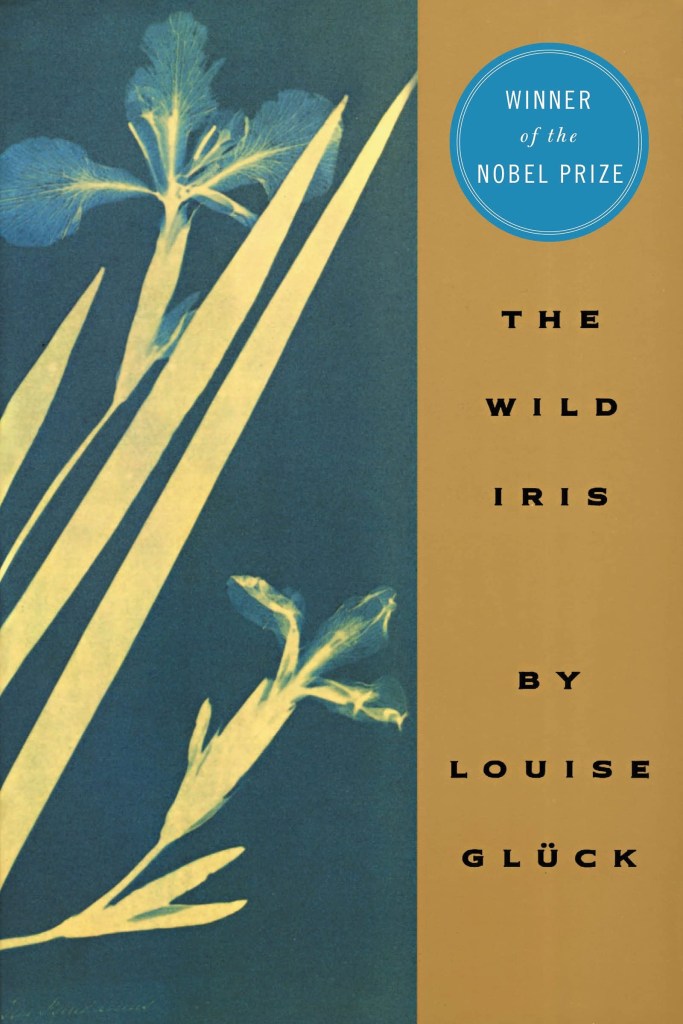
The Wild Iris by Louise Glück

End of Winter by Louise Glück

Over the still world, a bird calls
waking solitary among black boughs.

You wanted to be born; I let you be born.
When has my grief ever gotten
in the way of your pleasure?

Plunging ahead
into the dark and light at the same time
eager for sensation

as though you were some new thing, wanting
to express yourselves

all brilliance, all vivacity

never thinking
this would cost you anything,
never imagining the sound of my voice
as anything but part of you—

you won't hear it in the other world,
not clearly again,
not in birdcall or human cry,

not the clear sound, only
persistent echoing
in all sound that means good-bye, good-bye—

the one continuous line
that binds us to each other.

© 1992 Louise Glück. “End of Winter” is taken from The Wild Iris, for which she won the Pulitzer Prize for Poetry in 1993. Louise Glück is one of the most celebrated American poets of her generation. She was awarded the Nobel Prize in Literature in 2020 “for her unmistakable poetic voice that with austere beauty makes individual existence universal.”

Thanks as always for being a faithful reader of The Voracious Bibliophile. If you like what you see, please like, comment, follow, and subscribe to my email list to get notified of new posts as soon as they drop. You can also email me at fred.slusher@thevoraciousbibliophile.com or catch me on Twitter, Instagram, TikTok, and Pinterest @voraciousbiblog. Keep reading the world, one page (or pixel) at a time.
Poem for the Day: November 9th, 2021

…the way Corral repeats and inverts the imagery of thorns and honey in the first and last lines of the poem lend it a freshness and vivacity not always seen in (unrequited) love poems.

Autobiography of My Hungers by Eduardo C. Corral

His beard: an avalanche of   honey,
an avalanche
of  thorns. In a bar too close to the Pacific,
he said, “I don’t love you,
but not because I
couldn’t be attracted to you.” Liar—
even my soul
is potbellied. Thinness,
in my mind, equals the gay men
on the nightly news.
Kissed by death & public scorn.
The anchorman declaring,
“Weight loss is one
of the first symptoms.” The Portuguese
have a word for imaginary, never-
to-be-experienced love.
Whoop-de-doo.
“I don’t love you,” he said.
The words flung him back—
in his eyes, I saw it—
to another bar
where a woman sidestepped his desire.
Another hunger.
Our friendship.
In tenth grade, weeks after
my first kiss, my mother
said, “You’re looking thinner.”
That evening, I smuggled a cake
into my room.
I ate it with my hands,
licked buttercream off
my thumbs until I puked.
Desire with no future,
bitter longing—
I starve myself  by yearning
for intimacy that doesn’t
& won’t exist.
Holding hands on a ferry. Tracing,
with the tip of my tongue,
a  jawline. In a bar too close
to the Pacific, he said,
“I don’t love you, but not
because I couldn’t be attracted to you.”
His beard:
an avalanche of thorns,
an avalanche of honey.

© 2020 Eduardo C. Corral. “Autobiography of My Hungers” first appeared in the July/August 2020 issue of Poetry Magazine. You can purchase this issue here.

I love the way Corral compares unrequited love to boundless hunger in this poem. Comparing the desire for food with the desire for love or sex is far from new—one need only watch Tom Jones (1963) to see a perfect example—but the way Corral repeats and inverts the imagery of thorns and honey in the first and last lines of the poem lend it a freshness and vivacity not always seen in (unrequited) love poems.

Do you have a favorite poem comparing unrequited love with physical hunger? Let me know in the comments or shoot me an email.

Books by Eduardo C. Corral (With Purchase Links)

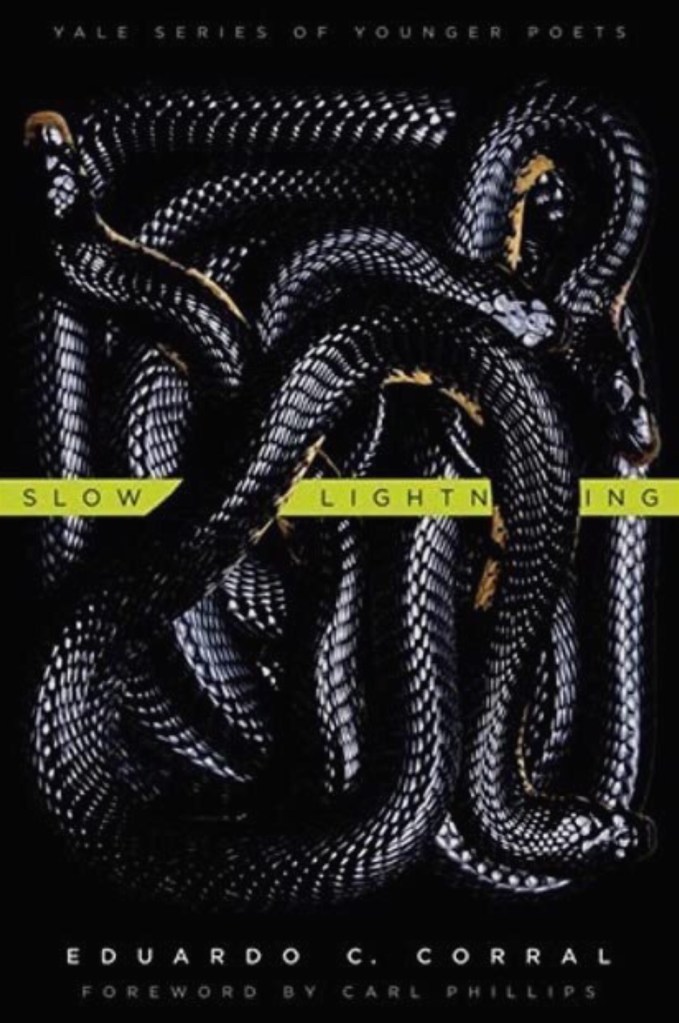
Slow Lightning (Yale Series of Younger Poets) by Eduardo C. Corral and Carl Phillips (Foreword)
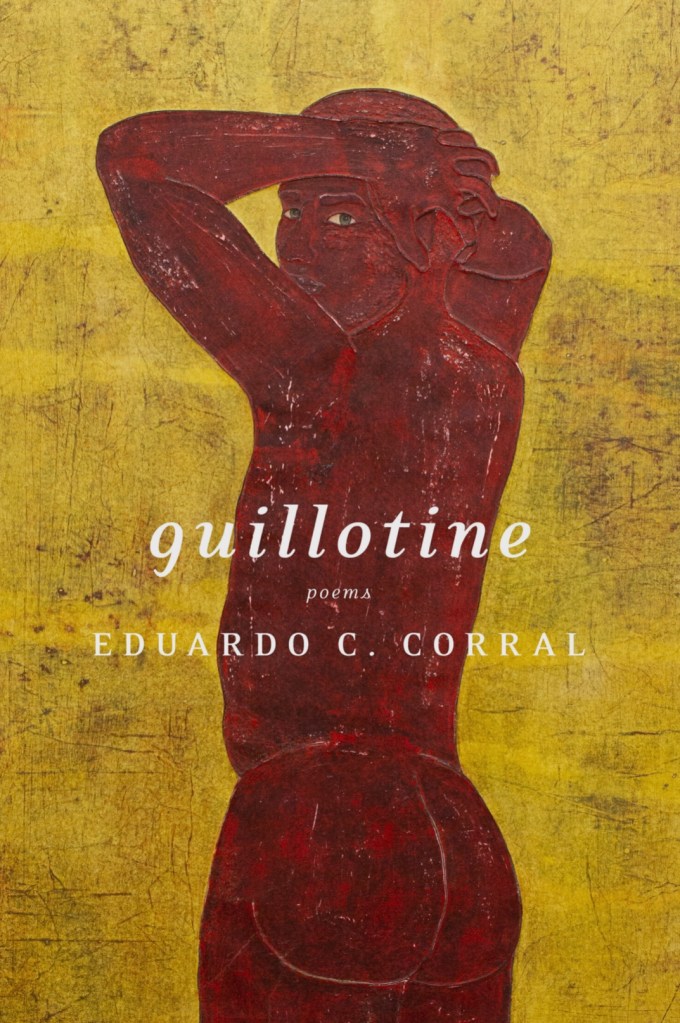
Guillotine: Poems by Eduardo C. Corral

Thanks as always for being a faithful reader of The Voracious Bibliophile. If you like what you see, please like, comment, follow, and subscribe to my email list to get notified of new posts as soon as they drop. You can also email me at fred.slusher@thevoraciousbibliophile.com or catch me on Twitter, Instagram, TikTok, and Pinterest @voraciousbiblog. Keep reading the world, one page (or pixel) at a time.
Poem for the Day: November 8th, 2021

Night Work by Ed Bok Lee

All summer, the city engine's low
roar capsizes our bodies into sleep,
groans,
evacuation—
Lost to a watery
anamnesis so warm it requires a raft
thatched from death's
flotsam to necklace its shore

I swim on, calling your name

In my dreams, something is always deserting

But tonight, no fast shadows of birds
No oceanic flowers disrobing butterflies
or bright beach of child's porridge and bones—

Instead, someone weaving

a net from fallen hair in and around our bed
to catch the breath, blood, and ritual
motions that oiled us
as one candle in a cave

In your dreams, someone is always resisting being saved

My teeth are on fire, you say I said

Don't fly for the labyrinth, once
I thought you were admonishing me to go away
I don't remember most others, a thousand seasons
phonographed in through a wounded window

Everyone can't have a cactus

Just o.k. empty all the rice from my legs

Once I awoke screaming, paws red-hot embers
You opened my mouth and poured a night-cold river in

Once you died and my heart fished all winter

Once we were eating lunch inside a kiln

Once you thought you smelled death,
but the lavender farm was too large to shave

On the fifth straight morning I'd dreamt of water
I stared at your face, its nacreous lids,
and I swear I could see a Glorious Ghost shifting
over your sun-warm waves

Water my birth sign, and one day my mother's death
that protect-fills my love with sadness

There, in words to my coworkers
it was still dripping, in my nods
over a galapagos of pages and forms

All love is immigrant, that autumn apparently
I mumbled

Your reply, after days: Turn off the steam in the trees

Somewhere right now, two lovers are conversing
without even knowing what their lives mean

One's heart gazelle-quick to survey a mountain his dead
father is always vandalizing
The other frequently misplacing her hair, ears, or self-
sabotaging a crime

One usually struggling to stay alive
The other often untethering something

Or is it my mitochondria that powder-sugars the moon?
And you calcifying a promise inside to inscribe?

There is a dominion where inverses
invert until only terror, love, and imagination cling,

heavy, on human branches—enter your vista, phylum
unsequenced, dimmer deeds

Can you hear it tonight?
Wind in iron jars buried inside the living:
Grandmothers, past spouses, cable men, priests

Now! I finally manage
as our train smokes out all the rats on their bed of leaves

All night, I dive
down to the soft structures of some blue civilization's faith

In this myth of life, I keep forgetting whose ideas and
sensations I'm supposed to be

Come morning: rain, trees, silvery
sleet
and daily, this new fresh bounty
we share, side by side
like angels coming home from work at a pearl factory

© 2011 Ed Bok Lee. “Night Work” originally appeared in Lee’s collection Whorled, which was published in 2011 by Coffee House Press and is available to purchase wherever books are sold.

Thanks as always for being a faithful reader of The Voracious Bibliophile. If you like what you see, please like, comment, follow, and subscribe to my email list to get notified of new posts as soon as they drop. You can also email me at fred.slusher@thevoraciousbibliophile.com or catch me on Twitter, Instagram, TikTok, and Pinterest @voraciousbiblog. Keep reading the world, one page (or pixel) at a time.

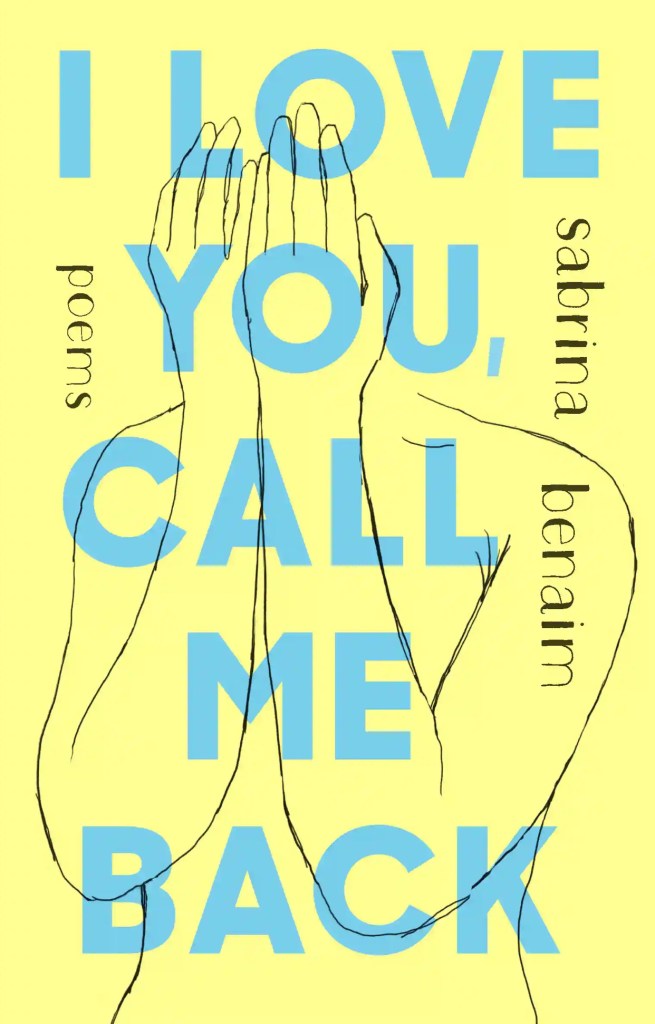
All Aboard the ARC: I Love You, Call Me Back: Poems by Sabrina Benaim

I Love You, Call Me Back: Poems by Sabrina Benaim

***Note: I received a free digital review copy of this book from NetGalley in exchange for an honest review.***

Sabrina Benaim has gifted us with a collection that is both a blueprint for grief and a roadmap to help us find our way out of it.

With I Love You, Call Me Back, Sabrina Benaim has gifted us with a collection that is both a blueprint for grief and a roadmap to help us find our way out of it. It’s not an easy task to meld hope and despair together in the same poem without coming off as maudlin or worse, melodramatic, but Benaim manages to do so with the grace and panache of an assured stylist.

Her voice rings so clear and true that while reading her new collection I felt like I was having a conversation with an old friend, one with whom I could share my highest hopes and biggest fears. After the past nineteen months of dealing with the isolation brought on by the COVID-19 pandemic, finally someone is saying that everything is not okay, but it will be eventually. And in the meantime, we can hold space for small joys, of which I count this poetry collection as one of them.

I Love You, Call Me Back: Poems was released by Plume, a division of Penguin Random House, on October 19th, 2021 and is now available to purchase wherever books are sold.

Thanks as always for being a faithful reader of The Voracious Bibliophile. If you like what you see, please like, comment, follow, and subscribe to my email list to get notified of new posts as soon as they drop. You can also email me at fred.slusher@thevoraciousbibliophile.com or catch me on Twitter, Instagram, TikTok, and Pinterest @voraciousbiblog. Keep reading the world, one page (or pixel) at a time.
Poem for the Day: November 7th, 2021

The Nail by C.K. Williams

Some dictator or other had gone into exile, and now reports were coming about his regime,
the usual crimes, torture, false imprisonment, cruelty and corruption, but then a detail:
that the way his henchmen had disposed of enemies was by hammering nails into their skulls.
Horror, then, what mind does after horror, after that first feeling that you’ll never catch your breath,
mind imagines—how not be annihilated by it?—the preliminary tap, feels it in the tendons of the hand,
feels the way you do with your nail when you’re fixing something, making something, shelves, a bed;
the first light tap to set the slant, and then the slightly harder tap, to em-bed the tip a little more ...

No, no more: this should be happening in myth, in stone, or paint, not in reality, not here;
it should be an emblem of itself, not itself, something that would mean, not really have to happen,
something to go out, expand in implication from that unmoved mass of matter in the breast;
as in the image of an anguished face, in grief for us, not us as us, us as in a myth, a moral tale,
a way to tell the truth that grief is limitless, a way to tell us we must always understand
it’s we who do such things, we who set the slant, embed the tip, lift the sledge and drive the nail,
drive the nail which is the axis upon which turns the brutal human world upon the world.

© 1999 C.K. Williams. “The Nail” appeared as part of the Pulitzer Prize-winning collection Repair, which was published in 1999 by Farrar, Straus & Giroux, LLC. It is available to purchase wherever books are sold.

Thanks as always for being a faithful reader of The Voracious Bibliophile. If you like what you see, please like, comment, follow, and subscribe to my email list to get notified of new posts as soon as they drop. You can also email me at fred.slusher@thevoraciousbibliophile.com or catch me on Twitter, Instagram, TikTok, and Pinterest @voraciousbiblog. Keep reading the world, one page (or pixel) at a time.

Poem for the Day: November 6th, 2021

Autumn by Grace Paley

1

What is sometimes called a
tongue of flame
or an arm extended burning
is only the long
red and orange branch of
a green maple
in early September reaching
into the greenest field
out of the green woods at the
edge of which the birch trees
appear a little tattered tired
of sustaining delicacy
all through the hot summer re-
minding everyone (in
our family) of a Russian
song a story
by Chekhov or my father


2

What is sometimes called a
tongue of flame
or an arm extended burning
is only the long
red and orange branch of
a green maple
in early September reaching
into the greenest field
out of the green woods at the
edge of which the birch trees
appear a little tattered tired
of sustaining delicacy
all through the hot summer re-
minding everyone (in
our family) of a Russian
song a story by
Chekhov or my father on
his own lawn standing
beside his own wood in
the United States of
America saying (in Russian)
this birch is a lovely
tree but among the others
somehow superficial

© 1991 Grace Paley. “Autumn” first appeared in Long Walks and Intimate Talks by Grace Paley and Vera B. Williams, which was published in 1991 by The Feminist Press at the City University of New York. It was later included in Begin Again: The Collected Poems of Grace Paley, which was published in 1999 by The Feminist Press. You can read more about Grace Paley and her life and work here.

Thanks as always for being a faithful reader of The Voracious Bibliophile. If you like what you see, please like, comment, follow, and subscribe to my email list to get notified of new posts as soon as they drop. You can also email me at fred.slusher@thevoraciousbibliophile.com or catch me on Twitter, Instagram, TikTok, and Pinterest @voraciousbiblog. Keep reading the world, one page (or pixel) at a time.

Poem for the Day: November 5th, 2021

the sonnet-ballad by Gwendolyn Brooks

Oh mother, mother, where is happiness?
They took my lover's tallness off to war,
Left me lamenting. Now I cannot guess
What I can use an empty heart-cup for.
He won't be coming back here any more.
Some day the war will end, but, oh, I knew
When he went walking grandly out that door
That my sweet love would have to be untrue.
Would have to be untrue. Would have to court
Coquettish death, whose impudent and strange
Possessive arms and beauty (of a sort)
Can make a hard man hesitate—and change.
And he will be the one to stammer, "Yes."
Oh mother, mother, where is happiness?

Today’s poem is taken from “”Appendix to The Anniad: leaves from a loose-leaf war diary”, which first appeared in Annie Allen, published by Harper in 1949.

Gwendolyn Brooks (1917-2000) published more than twenty books of poetry during her lifetime, as well as works in other genres. She was the first Black woman named as consultant in poetry to the Library of Congress, a post now referred to as Poet Laureate. Among numerous awards and accolades, she was the recipient of a Pulitzer Prize, an American Academy of Arts and Letters Award, and a National Endowment for the Arts Award. You can read more about her life and work here.

Thanks as always for being a faithful reader of The Voracious Bibliophile. If you like what you see, please like, comment, follow, and subscribe to my email list to get notified of new posts as soon as they drop. You can also email me at fred.slusher@thevoraciousbibliophile.com or catch me on Twitter, Instagram, TikTok, and Pinterest @voraciousbiblog. Keep reading the world, one page (or pixel) at a time.

Poem for the Day: November 4th, 2021

A Thousand Vowels by Shuri Kido Translated from the Japanese by Tomoyuki Endo & Forrest Gander

A long slope.
The strong sun dipped, and finally sank.
No matter how long I walked, I stayed in "the middle of the road."
The name torn into pieces.
Just keeping on, climbing higher and higher,
I'd completely forgotten the name.
The west wind shifts the typhoon's course,
the world, for a few hours, is thrown into confusion.
You might name one thing after another,
but each loses its name in that same moment.
Into what we call "nature."
I stood in the middle of nature.
And something was missing, the natural was
draped in a thin shroud.
Vowels scattered,
the name went missing.
When once more the name "nature" was applied
to the desolate-as-ever landscape,
immediately, the name began to weather away.
What is still losing its name,
and what has already lost its name,
those two strands entwine
around the true name.
Those who have wings stay put,
howling out their condition over and over,
"How fragile we are!"
though no one hears them.
Thousands of ripples tell
a story of benthic anguish.
The ripples beach themselves
on the name of each anguish,
vowels scatter by the thousands
over the earth.

© 2021 Tomoyuki Endo and Forrest Gander. All rights reserved. “A Thousand Vowels” is part of the collection Names & Rivers: Poems by Shuri Kido, which is forthcoming from Copper Canyon Press.

Thanks as always for being a faithful reader of The Voracious Bibliophile. If you like what you see, please like, comment, follow, and subscribe to my email list to get notified of new posts as soon as they drop. You can also email me at fred.slusher@thevoraciousbibliophile.com or catch me on Twitter, Instagram, TikTok, and Pinterest @voraciousbiblog. Keep reading the world, one page (or pixel) at a time.