
The Voracious Cinephile Film Review: The Left Handed Gun (1958); Directed by Arthur Penn

You are reading the first blog post from The Voracious Cinephile, the second blog in the Voracious family. I have toyed with the idea of having two completely separate blogs, but for now I think I’ll just post my film-related blogs with the above logo to differentiate them from those written for The Voracious Bibliophile.

Film poster for The Left Handed Gun (1958); directed by Arthur Penn.

Review

The Left Handed Gun was the first directorial effort of Arthur Penn, who would become famous for ushering in the New Hollywood movement with Bonnie and Clyde (1967). It was also only the seventh film featuring screen siren and Hollywood heartthrob Paul Newman, just a few months before he would receive rave reviews for the role of “Brick” Pollitt in Cat on a Hot Tin Roof.

Newman plays William Bonney, more famously known as Billy the Kid. I didn’t know this before watching this film, but William Bonney was also an alias of Billy the Kid’s. His birth name was Henry McCarty, and he lives on in infamy due to his part in New Mexico’s Lincoln County War, which you can read more about here.

Paul Newman as Billy the Kid in The Left Handed Gun.

While lacking in the pomp and circumstance surrounding bigger-budget Western fare of the era, The Left Handed Gun still stands above the serialized radio and television Western shows released in the late 50s. This is due in no small part to the excellent performances given by Newman and John Dehner, who imbues the role of Pat Garrett with a rugged stoicism that pairs well with Newman’s brash and sensitive Kid. It’s my opinion that only Newman could have pulled off a Billy the Kid who is so tender, yet ultimately too caught up in his own violent passion for revenge to let his softer nature win. So who cares if he was too old for the role? If we allow ourselves to get overly legalistic in our desire for realism, the magic of the cinema loses its potency. For me, of course, the same sentiment doesn’t apply to George Cukor’s 1936 adaptation of Romeo and Juliet with Norma Shearer and Leslie Howard, but that’s a matter for another blog post.
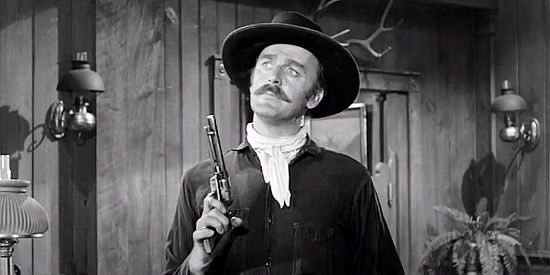
John Dehner as Pat Garrett in The Left Handed Gun.

The Left Handed Gun may have been a box office bomb in the United States, but the Belgians were a lot more discerning and appreciative of the film, awarding it with the 1961 Grand Prix of the Belgian Film Critics Association. Other winners of the prize include such classics as 12 Angry Men, Dr. Strangelove, and Cabaret.

While I of course always recommend owning physical media, you can stream The Left Handed Gun on HBO Max.

Thanks as always for being a faithful reader of The Voracious Cinephile. If you like what you see, please like, comment, follow, and subscribe to my email list to get notified of new posts as soon as they drop. Keep watching the world, one frame at a time.

Film Review: Cool Hand Luke (1967); Directed by Stuart Rosenberg

Film poster for Cool Hand Luke (1967); directed by Stuart Rosenberg.

“What we’ve got here is failure to communicate.”

Captain (Strother Martin)

It might just be me, but this saga of a man named Luke (Paul Newman), crushed but not deterred under the weight of a system designed to deprive him of his body, mind, and soul, is the perfect metaphor for late-stage capitalism and rising fascism in 2025. The circumstances are somewhat different, but still startlingly relevant as it concerns the prison industrial complex, police brutality, and slavery. Some people might call that last one a stretch, but what are prisons if not legal warehouses of forced labor and deprivation of liberty? If your labor creates economic value for someone who isn’t you or your family and you aren’t allowed to leave, are you not a slave? 

I mean, let’s be serious for a moment. Luke was a nonviolent offender sentenced to two years of extremely hard labor in deplorable conditions for destroying some parking meters and stealing the change out of them. And the captain and guards are given free rein to treat the incarcerated men however they see fit, up to and including executing them for trying to escape said conditions. They can even manufacture circumstances ex post facto to justify actions they take in the moment. There are no oversight or accountability mechanisms in place to discourage their violent conduct. One wonders if the wrong people are deprived of their freedom. 

The captain and guards are soldiers in the war of the death of these men’s souls. These violent men (the guards, not the inmates) derive pleasure from and revel in the control they wield over every move the inmates make. It’s sickening and morally reprehensible, but very realistic and apt, even and especially in 2025. 

The captain and guards are soldiers in the war of the death of these men’s souls.

There’s one particularly striking moment in the film where Luke’s mother (Jo Van Fleet) passes away and news of her passing reaches Luke. Rather than let him go and pay his respects to her, they lock him in a wooden shed called The Box, sentencing him to solitary confinement for no reason other than to deter his escape. Let it be noted that up until this point he had given no indication of a desire to escape.

This hot, enclosed shed is dark, dank, and reeking of shit and piss. Right before one of the guards (or bosses, as the inmates refer to them) locks him up in The Box, he says, “Sorry, Luke. I’m just doing my job. You gotta appreciate that.” And Luke responds, “Nah – calling it your job don’t make it right, boss.” 

“Nah – calling it your job don’t make it right, boss.”

Luke (Newman)

That moment hit me like lightning. So many horrific acts of cruelty have been committed by people “just doing their jobs”. Slave catchers were just doing their jobs. The cops who arrested Rosa Parks were just doing their jobs. The SS were just doing their jobs. The same for ICE agents and Republican lawmakers who craft the law in favor of the rich and powerful and punish the poor for the sin of being poor. They’re all just doing their jobs. 

One must have a moral compass, a sense of duty and responsibility to common humanity that transcends legality, convention, and organized religion. I included that last one because so many people use religion (mostly Christianity, in the context of the United States) as a pretext for depriving others of their rights and freedoms. Their moral superiority obfuscates the actual dictates of their prescribed beliefs and therefore gives them a license to ignore those dictates in favor of advancing an agenda of their own creation. They worship power, and reap desolation. 

One must have a moral compass, a sense of duty and responsibility to common humanity that transcends legality, convention, and organized religion.

Paul Newman as Luke.

They worship power, and reap desolation.

Strother Martin as Captain.

The only way to beat the system, to stick it to The Man, is to keep a part of yourself that can’t be touched or corrupted by evil men. They can take your body, but they can’t touch your soul. Just like Luke. 

Thanks as always for being a faithful reader of The Voracious Bibliophile. If you like what you see, please like, comment, follow, and subscribe to my email list to get notified of new posts as soon as they drop. You can also email me at fred.slusher@thevoraciousbibliophile.com or catch me on Twitter, Instagram, TikTok, and Pinterest @voraciousbiblog. Keep reading the world, one page (or pixel) at a time.