Film poster for Sinners (2025); directed by Ryan Coogler.
Well, it’s official: Sinners now holds the record for having the most Oscar nominations for a single film in the Academy’s history with 16 nominations. Ryan Coogler’s (put some RESPECT on his name) film beats the previous record of 14 nominations held by three films: All About Eve (1950), Titanic (1997), and La La Land (2016). Out of those three films, only one of them (La La Land) didn’t win Best Picture. I know everyone is going wild over Paul Thomas Anderson’s One Battle After Another right now and it’s the favorite to win Best Picture, but I’m rooting for Sinners.
Here are the categories in which Sinners is nominated:
Best Picture (Zinzi Coogler, Sev Ohanian and Ryan Coogler)
Directing (Ryan Coogler)
Actor in a Leading Role (Michael B. Jordan)
Cinematography (Autumn Durald Arkapaw)
Visual Effects (Michael Ralla, Espen Nordahl, Guido Wolter and Donnie Dean)
Sound (Chris Welcker, Benjamin A. Burtt, Felipe Pacheco, Brandon Proctor and Steve Boeddeker
Film Editing (Michael P. Shawver)
Production Design (Production Design: Hannah Beachler; Set Decoration: Monique Champagne)
Original Song (“I Lied to You”, Music and Lyric by Raphael Saadiq and Ludwig Goransson)
Costume Design (Ruth E. Carter)
Casting (Francine Maisler)
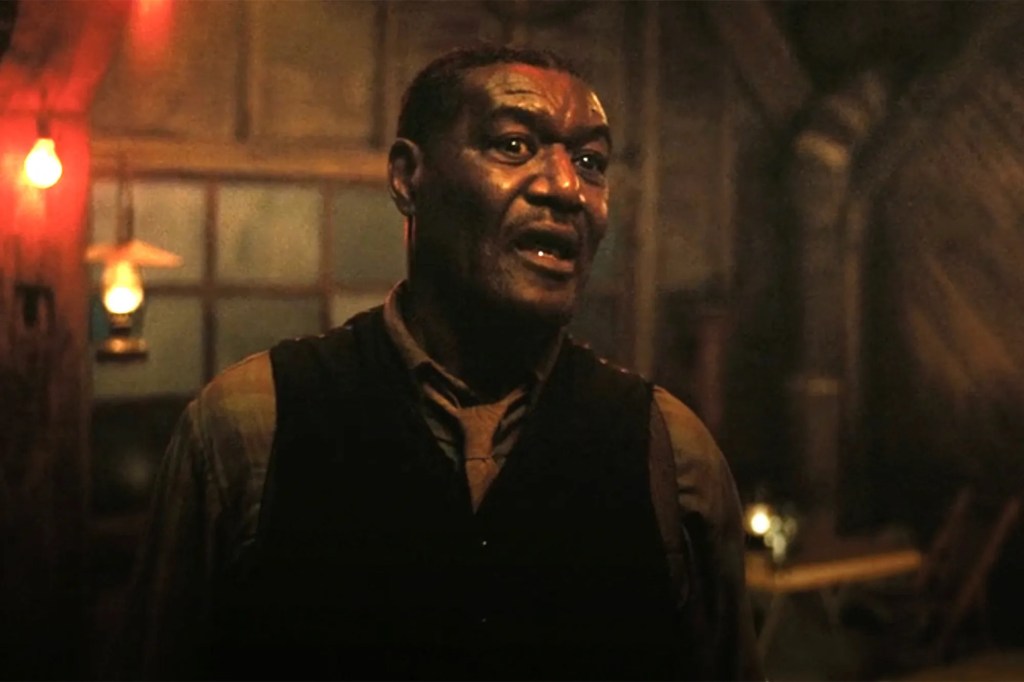
Actor in a Supporting Role (Delroy Lindo)
Original Screenplay (Ryan Coogler)
Original Score (Ludwig Goransson)
Makeup and Hairstyling (Ken Diaz, Mike Fontaine and Shunika Terry)
Actress in a Supporting Role (Wunmi Mosaku)
Sinners was my favorite film of 2025 from the moment I first saw it. I’ve watched it at least seven times now, and it only gets better with each viewing. I was worried that Delroy Lindo and Wunmi Mosaku might get shut out of their respective categories, but I’m happy to see that the Academy got it right. Mr. Lindo is 73 years old and this is his first Oscar nomination. That in itself is a travesty. That man has been turning in excellent performances for decades, and it is way past time for him to receive the accolades due him.
Sinners is now streaming on HBO Max and is available to own on DVD, Blu-ray, and 4K UHD.
Delroy Lindo as Delta Slim in Sinners. Credit: Warner Bros.
All I know is he’s got my vote. #TeamLindo
Thanks as always for being a faithful reader of The Voracious Cinephile. If you like what you see, please like, comment, follow, and subscribe to my email list to get notified of new posts as soon as they drop. Keep watching the world, one frame at a time.
Film poster for Frankenstein (2025); directed by Guillermo del Toro.
In an age when studio heads are looking to slash costs and shorten production schedules by investing in generative AI, Guillermo del Toro’s commitment to traditional film craft cannot be a bigger breath of fresh air. Everything about this film is grounded, gorgeous, and most importantly, genuine. A work of art of this caliber could not be created by an artificially intelligent supercomputer. Computers do not have souls, the wellsprings from which all art is brought forth. Because of this, I would be remiss not to acknowledge what a labor of love Frankenstein obviously was for everyone involved. From the principal cast, to Guillermo del Toro (who wrote, directed, and produced the film), and the incredible cinematographer (Dan Laustsen), costume designer (Kate Hawley), and composer (Alexandre Desplat), everyone who worked on this film did this work like it was the most important of their lives. And perhaps it was.
Everything about this film is grounded, gorgeous, and most importantly, genuine.
Curiously enough, Frankenstein is a timely and apt canvas upon which to analyze the moral dilemmas and questions of both Victor Frankenstein and the culture of our present day. Guillermo del Toro’s filmmaking ethos (the Oscar-winning director recently said he’d “rather die” than use AI in his films) is a scathing indictment of people like Victor Frankenstein (Oscar Isaac). The Creature (Jacob Elordi) is assembled and brought to life by Frankenstein from disparate, stolen parts. Frankenstein can, however, no more claim authorship or ownership of The Creature than the people who “create” AI content from stolen books, films, and other works of art. In The Creature as well as in the works “created” by AI, the theft is so profligate and egregious that one cannot begin to cipher what was taken from whom. Artifice becomes the only truth, and everything else is plunder.
Artifice becomes the only truth, and everything else is plunder.
Frankenstein is the film del Toro has wanted to make since he was 7 years old and first saw the James Whale Frankenstein films, and his vision of the classic story was made for this moment. If it had come any sooner or later than right now, it would be deprived of its enormity and heft. Thank God it languished in production hell for years because the stars aligned when they were supposed to and not a second before. The implications it elucidates for the discerning viewer should fill anyone with not just fear, but mortal terror. Whether it be usurping God or playing with (stolen) fire (Prometheus, anyone?), the end result is the same: destruction.
The implications it [Frankenstein] elucidates for the discerning viewer should fill anyone with not just fear, but mortal terror.
I want to talk for a second about Jacob Elordi’s performance in this film. It moved me to tears. He brought to full power the unrealized humanity behind Karloff’s Frankenstein’s monster, and that is not a negative comment on Karloff’s portrayal. The world was not perhaps ready for a Creature both human and not, both living and not. It may still not be, but Elordi infuses his Creature with as much soul as has ever been seen on celluloid. The sheer physicality the role required would be too much for most actors, but Elordi brought a dedication to the performance that’s nothing short of mind-boggling. It took as much as eleven hours each day just to transform him into The Creature, so he often worked twenty-hour days during filming. His boundless energy and startling gravitas transform a role that easily could have veered into parody or caricature into one of sublime transcendence and beauty. Give him all of his flowers.
His [Elordi’s] boundless energy and startling gravitas transform a role that easily could have veered into parody or caricature into one of sublime transcendence and beauty.
Kate Hawley’s costumes for this film are also beyond breathtaking, especially the ones she designed for Mia Goth. The TikTok video I’m linking to below goes into the costume design in more depth:
Courtesy of @Sarahpop on TikTok. Images from the film are the property of Netflix.
Frankensteinis now available to stream exclusively on Netflix, but you bet your sweet behind my fingers are crossed for a physical release of some kind, preferably from the Criterion Collection.
Thanks as always for being a faithful reader of The VoraciousCinephile. If you like what you see, please like, comment, follow, and subscribe to my email list to get notified of new posts as soon as they drop. Keep watching the world, one frame at a time.
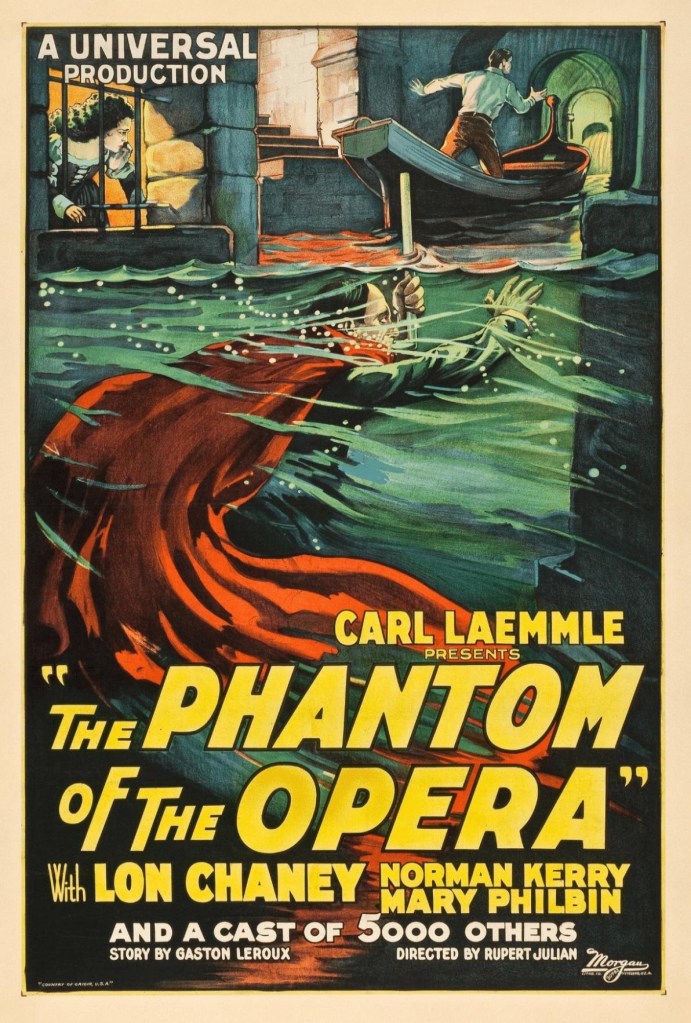
Film poster for The Phantom of the Opera (1925); directed by Rupert Julian.
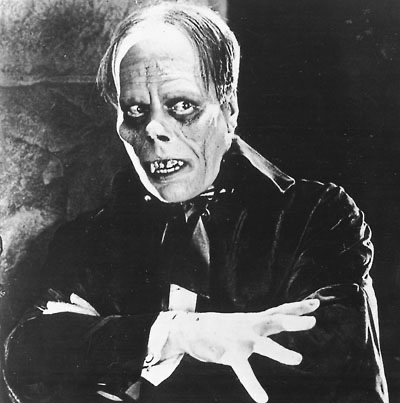
100 years ago today, Rupert Julian’s The Phantom of the Opera premiered in U.S. theaters. It is a silent horror classic starring Lon Chaney as The Phantom. Even today, Lon Chaney’s legacy as one of the first scream kings (even before such distinctions were bestowed) resonates across cinema and the wider culture. Produced by Carl Laemmle, who was the cofounder of Universal Pictures and made hundreds of films between 1909 and 1934, The Phantom of the Opera would help set the standard for horror films for generations to come.
Because the copyright for the film was not renewed in the 28th year after its publication, it entered the public domain in 1953. It is available to view on multiple steaming platforms as well as DVD and Blu-ray.
Thanks as always for being a faithful reader of The VoraciousCinephile. If you like what you see, please like, comment, follow, and subscribe to my email list to get notified of new posts as soon as they drop. Keep watching the world, one frame at a time.
Thanks as always for being a faithful reader of The Voracious Bibliophile. If you like what you see, please like, comment, follow, and subscribe to my email list to get notified of new posts as soon as they drop. You can also email me at fred.slusher@thevoraciousbibliophile.com or catch me on Twitter, Instagram, TikTok, and Pinterest @voraciousbiblog. Keep reading the world, one page (or pixel) at a time.
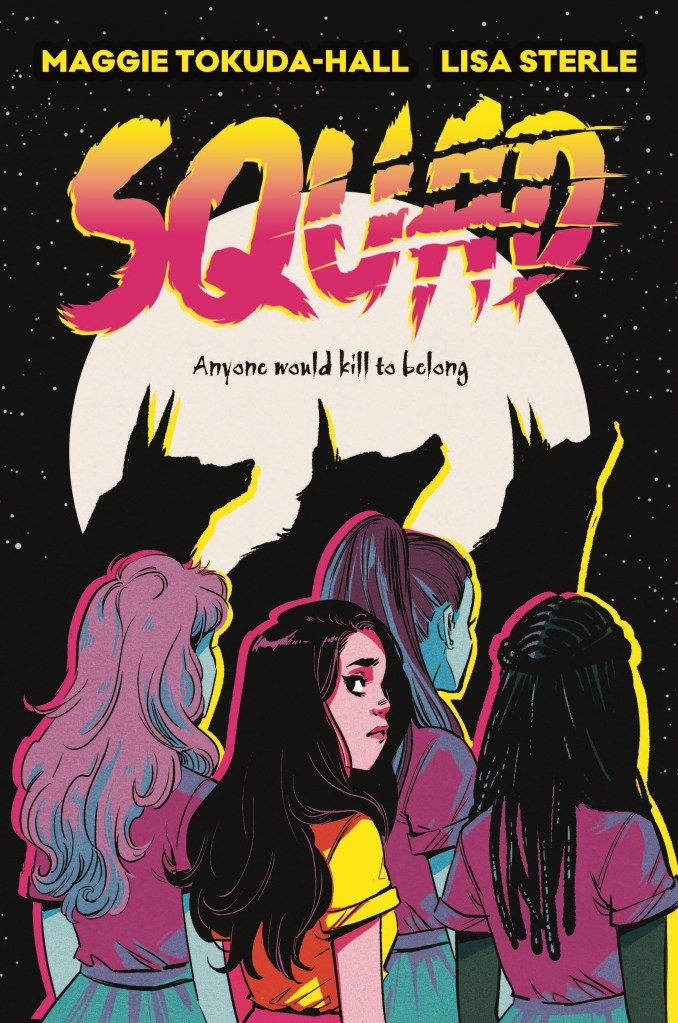
Squadby Maggie Tokuda-Hall (Author) and Lisa Sterle (Illustrator)
***Note: I received a free digital review copy of this book from NetGalley and Greenwillow Books in exchange for an honest review. I have not received compensation for the inclusion of any links found in this review or on any other page of The Voracious Bibliophile which mentions Squad, its creators, or its publisher.***
Rating: ⭐️⭐️⭐️⭐️⭐️
Short Blurb: Maggie Tokuda-Hall takes everything you think you know about werewolves and their lore and gives it a feminist (and sapphic) bent. The result is a graphic novel that’s just a lot of fun to read (and talk about with your squad—no incels allowed, unless of course they’re on the menu).
Review
Maggie Tokuda-Hall’s Squad is a perfect blend of horror, suspense, and believe it or not, romance. It’s sort of like if Mean Girls had a baby with Teen Wolf that grew up to be super freaking gay and not a little sarcastic. Combine that with Lisa Sterle’s vibrant art style reminiscent of the best of the Archie Comics and what you have is a delightful romp just ripe for adaptation. Does anyone have Netflix’s number?
It’s [Squad] sort of like if Mean Girls had a baby with Teen Wolf that grew up to be super freaking gay and not a little sarcastic.
It all starts when Becca moves with her mom from LA to Piedmont in her junior year of high school. Becca has always wanted to fit in, so when a clique of popular girls takes her in, she feels like she has a place for the first time in her life. It turns out though that Becca’s new squad is less of a clique and more of a pack. Of werewolves, that is, with bites far worse than their barks. These werewolves don’t hunt the innocent, though. Their prey are the predators. Sleazy boys oozing generational wealth and privilege who take advantage of girls at parties. Boys who know history and the law is on their side telling them they’ll get away with it because most of the time they do.
Their prey are the predators.
Becca discovers her friends’ secret at a party outside underneath a full moon. A skinny incel named Bart O’Kavanaugh (Tokuda-Hall’s character naming is very tongue in cheek) gets Becca away from the larger group and tries to assault her. Their exchange really is rape culture in a nutshell:
Bart: You’re hella pretty.
Becca: Okay.
Bart moves in to kiss her and Becca squirms away from him.
Bart: Don’t make it weird.
Becca: Don’t make it rapey.
Bart: Why’d you even come with me then?
Becca: Boredom? I don’t know why I even believed you when you said you were gonna show me something cool.
Bart: Yeah, my dick!
Becca tries to turn away from him.
Becca: Let’s go back to the party.
Bart puts his hand on Becca’s shoulder.
Bart: I can tell you want it.
Becca turns again, trying to dislodge his hand off her shoulder, and Bart violently grabs her by the arm while she tries to free herself. She smacks him in the face, tearing up.
Becca: Let me go, dude!
Bart grabs Becca once again and tears are streaming down her face.
Bart: Jesus, don’t be such a bitch!
There’s a rustling nearby. Suddenly Arianna, Marley, and Mandy step into view.
Marley: You know, you gotta be careful around bitches.
The three girls start transforming into wolves, growing fangs, claws, and fur, tongues lolling in anticipation.
Marley: We roll in packs.
You know, you gotta be careful around bitches. We roll in packs.
If that scene isn’t the most patriarchy-toppling in any piece of media ever, I don’t know what is. There’s something extremely satisfying about seeing boys with names like O’Kavanaugh and Weinstein get eaten by girls-turned-werewolves. After they rescue her from Bart, Becca joins the girls’ pack and has to learn to cope with this new aspect of her identity and all it encompasses. Along with being a newly-turned werewolf, Becca also has another secret to keep that’s gurgling just beneath the surface. When you’re young, or any age, really, having to hide part of yourself to stay safe does damage that takes a long time to heal. Sometimes it doesn’t. That’s true for gay people, women, and werewolves.
When you’re young, or any age, really, having to hide part of yourself to stay safe does damage that takes a long time to heal. Sometimes it doesn’t. That’s true for gay people, women, and werewolves.
Fear not, though, dear readers—Squad doesn’t disappoint and isn’t a tragedy by any stretch of the imagination. In this hybrid horror-romance story, the girls get mad, the boys get eaten, and love triumphs over all. And if only for a moment, everyone who’s ever had to say #MeToo feels just a little bit better.
Squad was released by Greenwillow Books on October 5th, 2021 and is available to purchase wherever books are sold.
Thanks as always for being a faithful reader of The Voracious Bibliophile. If you like what you see, please like, comment, follow, and subscribe to my email list to get notified of new posts as soon as they drop. You can also email me at fred.slusher@thevoraciousbibliophile.com or catch me on Twitter, Instagram, TikTok, and Pinterest @voraciousbiblog. Keep reading the world, one page (or pixel) at a time.
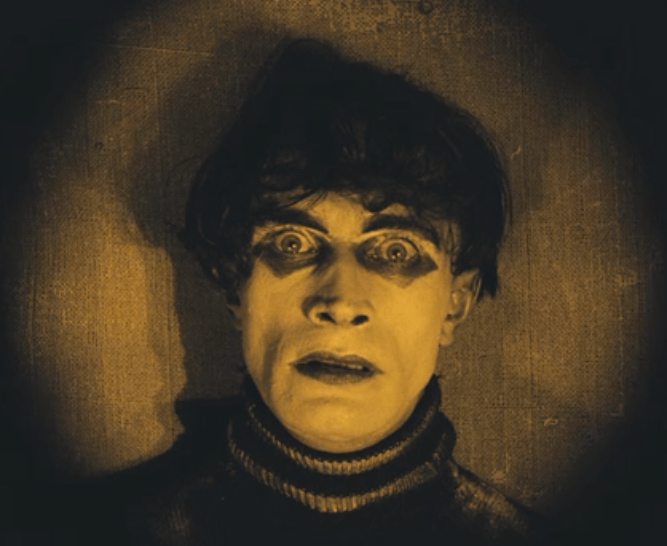
Conrad Veidt in a still from Robert Wiene’s The Cabinet of Dr. Caligari (1920)
We queens are not free to answer the calls of our hearts.
The Cabinet of Dr. Caligari (1920); directed by Robert Wiene
Revolutionary at the time were its sharp lines and angles, its use of shadows and light to heighten the viewer’s anxiety. Caligari quite literally helped to develop the language of cinema.
The Cabinet of Dr. Caligari (1920) is a masterpiece of German Expressionist filmcraft. Perhaps no other film in the history of cinema has received as much scholarly attention because it paved the way for so many films that succeeded it. Revolutionary at the time were its sharp lines and angles, its use of shadows and light to heighten the viewer’s anxiety. Caligari quite literally helped to develop the language of cinema. Without it, there would be no film noir. None of the great horror films made by Universal from the 1930s to the 1950s would exist.
It would be my contention, in fact, that you can draw a direct line that starts with Caligari and goes all the way to films like The Wolf House (2018), Us (2019), and Midsommar (2019). I could talk about it all day, but it’s really something you need to see for yourself to truly appreciate. What are you waiting for?
Thanks as always for being a faithful reader of The Voracious Bibliophile. If you like what you see, please like, comment, follow, and subscribe to my email list to get notified of new posts as soon as they drop. You can also email me at fred.slusher@thevoraciousbibliophile.com or catch me on Twitter, Instagram, TikTok, and Pinterest @voraciousbiblog. Keep reading the world, one page (or pixel) at a time.
***Note: I received a free digital review copy of this book from NetGalley in exchange for an honest review.***
There’s the likeness and the icon itself. The myth and the man behind it. We owe our modern conception of Dracula to Bela Lugosi, who donned the cape of the infamous bloodthirsty count in Tod Browning’s production of Dracula, which premiered in 1931, before the pearl-clutchers would focus their prudish crosshairs on the film industry in the form of the Hays Code, which forced studios to either veil or completely eliminate references to anything the aforementioned pearl-clutchers would consider morally reprehensible. Horror films were a natural target of the Code, so it is to the benefit of the culture at-large and the horror industry in particular that Dracula was released in the pre-Code era.
Horror films were a natural target of the Code, so it is to the benefit of the culture at-large and the horror industry in particular that Dracula was released in the pre-Code era.
Bela Lugosi was a Hungarian émigré who first cut his teeth on the stage in the National Theatre of Hungary. After facing political persecution, he made his move to the promising shores of America. First starring in (as well as producing and directing) shoestring-budget theater productions with other Hungarian émigrés, young Bela soon found himself disheartened, feeling as if he was destined to die a penniless pauper.
His first big break came when he met Henry Barton, a theatrical manager who had been impressed with Lugosi’s performance in one of his Hungarian-language productions. The American impresario hadn’t understood a word of the dialogue, but had been captivated by Lugosi’s command of the stage. He told him he would be perfect in a new play he was producing called The Red Poppy if only his English were better. Never one to give up, Lugosi told Barton he was a quick learner and would be willing to have an English tutor hired with the tutor’s wages deducted from his own.
The Red Poppy’s run was short-lived, a commercial failure. Lugosi, however, was praised for his performance and afterwards he had consistent work in small-budget English-language theater and silent film productions. Once he secured the role of the titular character in Hamilton Deane and John L. Balderston’s Broadway production of Bram Stoker’s Dracula, his fate was sealed. The rest, as they say, is history.
Koren Shadmi does an excellent job bringing Bela Lugosi to life. Penning a pictorial biography of one of the world’s most iconic actors is a daunting task, certainly not for the faint of heart, but Shadmi deftly illuminates the man behind the myth, waking him from his coffin for a whole new generation.
Penning a pictorial biography of one of the world’s most iconic actors is a daunting task, certainly not for the faint of heart, but Shadmi deftly illuminates the man behind the myth, waking him from his coffin for a whole new generation.
Shadmi’s book is just as perfect for the longtime Lugosi acolyte as it is for those who only know him through his image as Dracula. It is evocative and daring and sobering. I honestly can’t recommend it highly enough.
Shadmi’s book is just as perfect for the longtime Lugosi acolyte as it is for those who only know him through his image as Dracula.
Thanks as always for being a faithful reader of The Voracious Bibliophile. If you like what you see, please follow, like, comment, and subscribe to my email list to get notified of new posts as soon as they drop. You can also email me at thevoraciousbibliophile@yahoo.com or catch me on Twitter @voraciousbiblog. Keep reading the world, one page (or pixel) at a time.







 The Voracious Bibliophile