I don’t know what I really expected going into Elvis, the recent biopic about the world-famous and best-selling solo musician of all time, Elvis Presley. Knowing that Baz Luhrmann was the director was certainly a big draw. If nothing else, his films are stylistic dreamscapes: lush, ostentatious, and to be quite frank, extremely pretty. The Australian auteur is no stranger to the telling of epic stories, and I don’t think any other director could have tackled the story of Elvis Presley with more grace, grit, passion, or panache. His respect for his subject is evident in every frame, as is his love for glitter and bombast. The man loves his pyrotechnics, and any film about the King of Rock and Roll would be remiss without them.
If nothing else, his [Luhrmann’s] films are stylistic dreamscapes: lush, ostentatious, and to be quite frank, extremely pretty.
Austin Butler’s Elvis is no caricature. It would have been extremely easy to allow a performance such as this one to veer into mockumentary territory, but Butler has the acting chops to steer the ship in a much more honest and human direction. His Elvis is wholly real. His dreams and ambitions, choked and stymied by the pressures of fame and the realities of being the biggest star in the world, take a back burner to maintaining the image of Elvis, the moneymaker and icon as opposed to the man himself. He’s not only playing Elvis; for 2 hours and 39 minutes, he is Elvis.
His dreams and ambitions, choked and stymied by the pressures of fame and the realities of being the biggest star in the world, take a back burner to maintaining the image of Elvis, the moneymaker and icon as opposed to the man himself.
Butler’s universally-acclaimed performance already has many talking about him as the front-runner for next year’s Oscar for the Best Actor in a Leading Role. I agree. It goes without saying that he will be nominated, and unless I see another performance that is so riveting it takes my breath away, I will safely assume he’ll be walking away with a golden statue that night. The film also benefits from strong supporting performances from everyman Tom Hanks, who plays Presley’s slimy manager/promoter Colonel Tom Parker; and Olivia DeJonge, in her mainstream debut as Priscilla Presley. According to DeJonge in an interview she did with British Vogue, she found out she had landed the role some four months after her audition in a text message from Luhrmann’s team. Needless to say, I think we’ll be seeing much more from her.
Finally, I want to talk about the costumes in this film. With a style icon like Elvis Presley as the subject matter, any costume designer would have more than a full plate’s worth of work ahead of them in recreating the entertainer’s iconic looks. Catherine Martin, a four-time Oscar winner and the wife of Baz Luhrmann, has worked on a slew of his previous films: Romeo + Juliet (1996), Moulin Rouge! (2001), Australia (2008), and The Great Gatsby (2013). Her work in Elvis is nothing short of spectacular, somehow managing to take the familiar and making it fresh, vivacious, and exciting. I think she’ll be adding another Oscar to her shelf come next year.
Her [Martin’s] work in Elvis is nothing short of spectacular, somehow managing to take the familiar and making it fresh, vivacious, and exciting.
All in all, I really enjoyed Elvis. Was it a perfect film? No, but I don’t think there is such a thing as a perfect film, at least not when you’re recreating the lives of real people, some of whom are still living. I think it captured the spirit of Elvis and what he’s meant to American culture. I also think it managed to illuminate who he was as a person apart from the bright lights and big stages he graced while on Earth. The pain is there, sure, but so is the passion. The love and devotion, the heartache, the beauty and the fame. The flame snuffed out far too soon. That’s more than anyone could ask.
The pain is there, sure, but so is the passion. The love and devotion, the heartache, the beauty and the fame. The flame snuffed out far too soon. That’s more than anyone could ask.
Elvis was released in the United States on June 24th, 2022 by Warner Bros. Pictures and is now available to stream on HBO Max as well as other streaming and video on demand platforms.
Thanks as always for being a faithful reader of The Voracious Bibliophile. If you like what you see, please like, comment, follow, and subscribe to my email list to get notified of new posts as soon as they drop. You can also email me at fred.slusher@thevoraciousbibliophile.com or catch me on Twitter, Instagram, TikTok, and Pinterest @voraciousbiblog. Keep reading the world, one page (or pixel) at a time.
Warning: Please note that the following review may contain plot spoilers for The Lost City. If you’ve not yet seen the film and don’t want any aspects of the plot to be spoiled for you, stop reading now. Actually, bookmark the page, go watch the movie, and then come back and read my review. Enjoy!
I think I really needed something as purely fun, entertaining, and heartwarming as The Lost City. It was like a bag of Skittles in movie form: full of color, variety, and sweet but with just enough of a bite to keep you on the edge of your seat until the very end. Movies like this give you a guaranteed HEA (Happily Ever After for the uninitiated among you) so you don’t have to worry about having your heart ripped out of your chest while it’s still beating. To be honest, that’s usually my schtick—sad mumblecore indie movies with little-to-no plot, lots of philosophical rumination on the human condition, and confusing endings that may or may not be happy. Sometimes they don’t even really end at all, they just sort of fizzle out until the credits roll.
It [The Lost City] was like a bag of Skittles in movie form: full of color, variety, and sweet but with just enough of a bite to keep you on the edge of your seat until the very end.
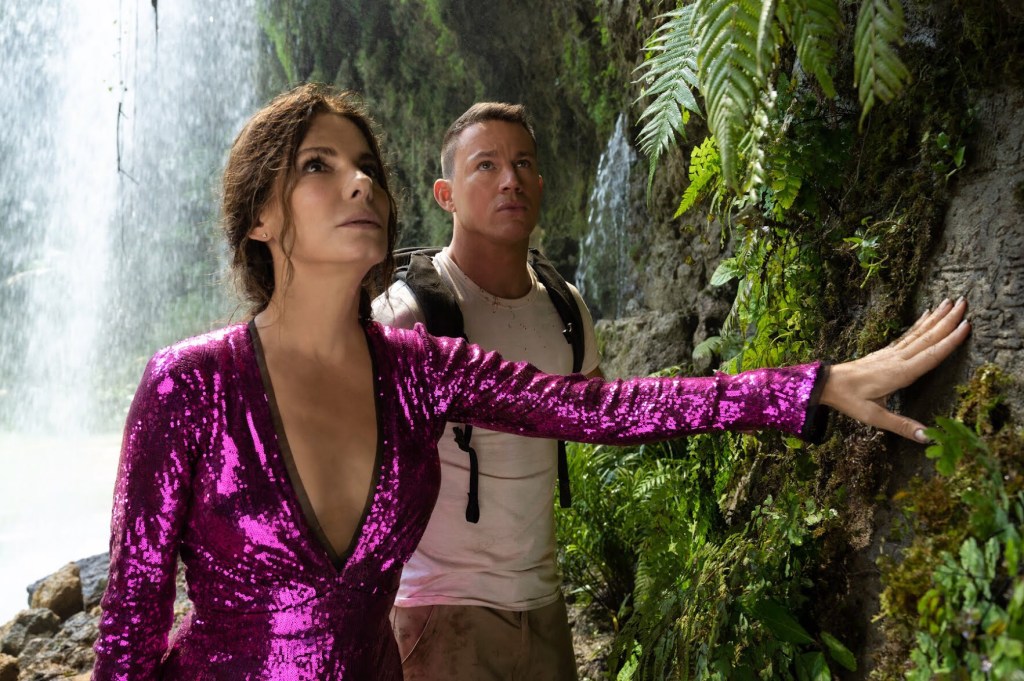
The Lost City starts off with Loretta Sage (Sandra Bullock), romance author extraordinaire, receiving a call from her publisher (Da’Vine Joy Randolph) about her upcoming book tour for the latest book in her wildly successful series starring Dr. Angela Lovemore and Dash McMahon, Dr. Lovemore’s hunky, dyed-in-the-wool-of-Fabio love interest. As part of the book tour, Loretta has to appear with the cover model who has portrayed Dash on all of Loretta’s book covers in the series, Alan Caprison (Channing Tatum).
Loretta is not up for a book tour and hasn’t wanted anything to do with the limelight since her husband passed away. She’s much happier sinking into a bubble bath and sipping an iced Chardonnay, away from the rest of the world. Her publisher is insistent, however, and her reader-fans themselves are insatiable. During the first Q&A promoting the latest Lovemore adventure, it’s apparent that the fans are much more enamored with the cover model fantasy of Dash than they are with anything Loretta has to say about the book. Even Alan/Dash himself seems to have a hard time separating his actual self from the fictional representation made popular by Loretta’s books. He answers to Dash and poses for pictures with fans as Dash. Loretta sees him as nothing more than another obstacle keeping her from going back into seclusion and sinking into her tub.
Loretta sees him as nothing more than another obstacle keeping her from going back into seclusion and sinking into her tub.
When Loretta makes it out of the venue and has a car summoned to take her home, she’s instead picked up by the henchmen of Abigail Fairfax (Daniel Radcliffe), a madcap billionaire who’s discovered that a lot of the lore and events that take place in Loretta’s novels are based on research she conducted with her deceased archaeologist husband. He believes that a priceless treasure, the “Crown of Fire” mentioned in Loretta’s novels, is located in a lost city on an island in the Atlantic. He kindly asks Loretta to help him (by “help” of course he means he needs her to do all of the work) in deciphering the meaning of some words on a piece of old parchment. Fairfax believes that the message on the parchment will lead him to the treasure and bring him fame and accolades to surpass that of his favored brother. A tale as old as time really, with some minor adjustments. When she declines his request, he knocks her out with chloroform and takes her to the island against her will.
Fairfax believes that the message on the parchment will lead him to the treasure and bring him fame and accolades to surpass that of his favored brother.
Meanwhile, Alan/Dash (hereinafter referred to solely as Alan) witnessed Loretta being kidnapped. It is apparent to the viewer that he has somewhat of a crush on her and so intends to do anything and everything in his power to bring her back. After talking to Loretta’s publisher Beth and her social media manager Allison (Patti Harrison), Alan contacts Jack Trainer (Brad Pitt), a former Navy SEAL, for help. Jack is able to help them locate her whereabouts by using the “Find My” feature for Loretta’s smart watch on her phone, which Beth luckily has. Jack agrees to go to the island to rescue Loretta. In Alan’s mind, he believes this will be a cooperative venture in which Jack assists him in rescuing Loretta but he still gets to be the fabled knight in shining armor.
In Alan’s mind, he believes this will be a cooperative venture in which Jack assists him in rescuing Loretta but he still gets to be the fabled knight in shining armor.
When they meet up at the island, it becomes clear that Alan is more of an obstacle to retrieving Loretta than an assistant, but that doesn’t stop him from trying. Jack is able to breech the place Loretta is being held but is shot in the head before the trio can make it back to the airport and hightail it out of Dodge. Loretta escapes (still tied to a chair, I might add) with Alan and the parchment Fairfax wanted her to translate, and then off into the jungle they go.
Loretta escapes (still tied to a chair, I might add) with Alan and the parchment Fairfax wanted her to translate, and then off into the jungle they go.
You can only imagine the hijinks that ensue as Loretta and Alan are chased and tracked by Fairfax and his goons. The Lost City is both tenderhearted and hilarious in equal measure, and that of course can be chalked up in no small part to the incredible chemistry between Bullock and Tatum. My favorite part of the film has to be the scene where the pair wades through a river while trying to outrun Fairfax and Co. and once they’re out of it, Loretta notices that Alan is covered in leeches that she has to pick off from him, including several on his voluptuous buttocks. Yes, I said voluptuous. If you can look at Channing Tatum’s rear end and come up with a better descriptor, be my guest.
The Lost City is both tenderhearted and hilarious in equal measure, and that of course can be chalked up in no small part to the incredible chemistry between Bullock and Tatum.
As you know, I don’t really like to spoil endings here on The Voracious Bibliophile, but I do promise that this movie has a happy one. Loretta and Alan both learn that sometimes miracles (and love) come from unexpected places and that we don’t always know people as well as we think we do. People (and books, for that matter) are almost always more than they appear to be on the surface.
Loretta and Alan both learn that sometimes miracles (and love) come from unexpected places and that we don’t always know people as well as we think we do.
Before I leave you, I’d also like to note that I love the age-gap at play in this movie. Channing Tatum is Sandra Bullocks’ love interest in this movie and in real life he is fifteen years her junior. Way to go for making a big-budget Hollywood picture where the woman is significantly older than the man and it’s never even mentioned. How’s that for progress?
The Lost City was released theatrically in the United States on March 25th, 2022 and is available to stream on several different video on-demand platforms.
Thanks as always for being a faithful reader of The Voracious Bibliophile. If you like what you see, please like, comment, follow, and subscribe to my email list to get notified of new posts as soon as they drop. You can also email me at fred.slusher@thevoraciousbibliophile.com or catch me on Twitter, Instagram, TikTok, and Pinterest @voraciousbiblog. Keep reading the world, one page (or pixel) at a time.
The Power of the Dogwas Netflix’s latest and greatest (so far) attempt to secure an Oscar for Best Picture. It had to sting to lose to another streaming player, Apple TV+, which took home the gleaming statuette for crowd-favorite CODA. In addition to Best Picture, CODA also won in the categories of Best Adapted Screenplay (Sian Heder) and Best Supporting Actor (Troy Kotsur, who is now the first Deaf man to win an acting Oscar). For the longest time in the campaigns leading up to the big night, it was The Power of the Dog’snight to shine. With 12 nominations across the board, how could it lose? But it did. In fact, Netflix’s powerhouse Western only took home one statuette on Oscars night — for Best Director (Jane Campion).
But let us not judge a film by its accolades. The truth is, The Power of the Dogis an incredibly powerful yet extremely subtle film, its brilliance easily overlooked if one isn’t paying close enough attention.
…The Power of the Dog is an incredibly powerful yet extremely subtle film, its brilliance easily overlooked if one isn’t paying close enough attention.
Jane Campion’s searing portrait of toxic masculinity and repressed sexuality, set against the backdrop of Montana in the 1920s, is in my opinion one of the greatest films of the 21st-century so far, though it’ll probably be years down the line before the majority of cinephiles agree with me. In it, Benedict Cumberbatch gives what is perhaps his most unsympathetic performance yet. It’s arguably his best. As Phil Burbank, Cumberbatch is ruthless, sardonic, and haunted. Campion, who made history at this year’s Oscars ceremony for being the first woman to be nominated for two directing Oscars (winning this year), is a master at creating atmosphere. The vast and wide-open spaces of Montana make for an interesting canvas upon which she paints her tale. Each character, from Cumberbatch’s Phil Burbank to Kirsten Dunst’s beleaguered Rose Gordon, is given more than enough room to explore their respective neuroses, their own private darknesses that spill over into their interactions with each other and with the land itself.
Each character, from Cumberbatch’s Phil Burbank to Kirsten Dunst’s beleaguered Rose Gordon, is given more than enough room to explore their respective neuroses, their own private darknesses…
What makes The Power of the Dog so interesting as a Western is its multilayered exploration of queerness. Now, if you ask any historian worth their salt, they’ll tell you there was all kinds of gay stuff going down in the American West. Put frankly, cowboys were riding each other just as often as they were riding broncos. If you ask a heterosexual purist, they’ll tell you John Wayne would never. And Wayne probably wouldn’t have. But John Wayne wasn’t a real cowboy. He was mostly a fiction. An idealized idol. A paean to hyper-masculinity. Cumberbatch isn’t a real cowboy, either, but his portrayal of one is more honest than Wayne’s ever was. Sorry Duke.
Put frankly, cowboys were riding each other just as often as they were riding broncos.
The central conflict at the heart of The Power of the Dog is between Phil and Rose’s son Peter (Kodi Smit-McPhee). In fact, the opening lines of the film (spoken by Peter) speak to this conflict, which the viewer has not yet been made privy to: “For what kind of man would I be if I did not help my mother? If I did not save her?” What kind of man indeed?
When we meet Peter, though, he looks ill-equipped to protect or save anyone. Lanky and effeminate, his first scene in the film shows him making paper flowers for table settings that Phil will soon sneer at. Looking more closely, the paper flowers could very well be a metaphor for Phil’s repressed homosexuality, which is why he views them with such disdain. Where Peter is delicate and precise, Phil is callous and bombastic. Peter moves through the world like every step must be taken gently, as if the slightest deviation may trigger an explosion or perhaps expose him to the world. Phil, however, revels in his contempt for all of humanity, but most especially for Rose, who ends up marrying his brother George (Jesse Plemons).
Peter moves through the world like every step must be taken gently, as if the slightest deviation may trigger an explosion or perhaps expose him to the world.
This isn’t the first mainstream Western film to address themes of homosexuality. The last really good Western we had that did so was Ang Lee’s Brokeback Mountain (2005). But while Brokeback was at its essence a love story, The Power of the Dog is a story of an unhappy family in fractures. Don’t expect the spirits of Jack and Ennis to manifest in Phil and Peter, because that’s not the kind of story Campion is telling. In fact, a viewer not used to looking for queer subtext may miss that element of the film entirely, so subtle is its execution. While Phil’s queerness is thickly-veiled under layers of ostentatious brutality, Peter’s is as wide-open and hyper-visible as the plains which serve as the backdrop to Campion’s film.
While Phil’s queerness is thickly-veiled under layers of ostentatious brutality, Peter’s is as wide-open and hyper-visible as the plains which serve as the backdrop to Campion’s film.
I’m not going to do the film a disservice by spoiling the ending and telling you what happens, but it’s definitely a wow moment. It’s also calculatingly understated, like most of the elements in the film. I love a good film that doesn’t make an exhibition of itself. I like hints and silences and ruminations. Not everything has to explode in order to burn.
Thanks as always for being a faithful reader of The Voracious Bibliophile. If you like what you see, please like, comment, follow, and subscribe to my email list to get notified of new posts as soon as they drop. You can also email me at fred.slusher@thevoraciousbibliophile.com or catch me on Twitter, Instagram, TikTok, and Pinterest @voraciousbiblog. Keep reading the world, one page (or pixel) at a time.
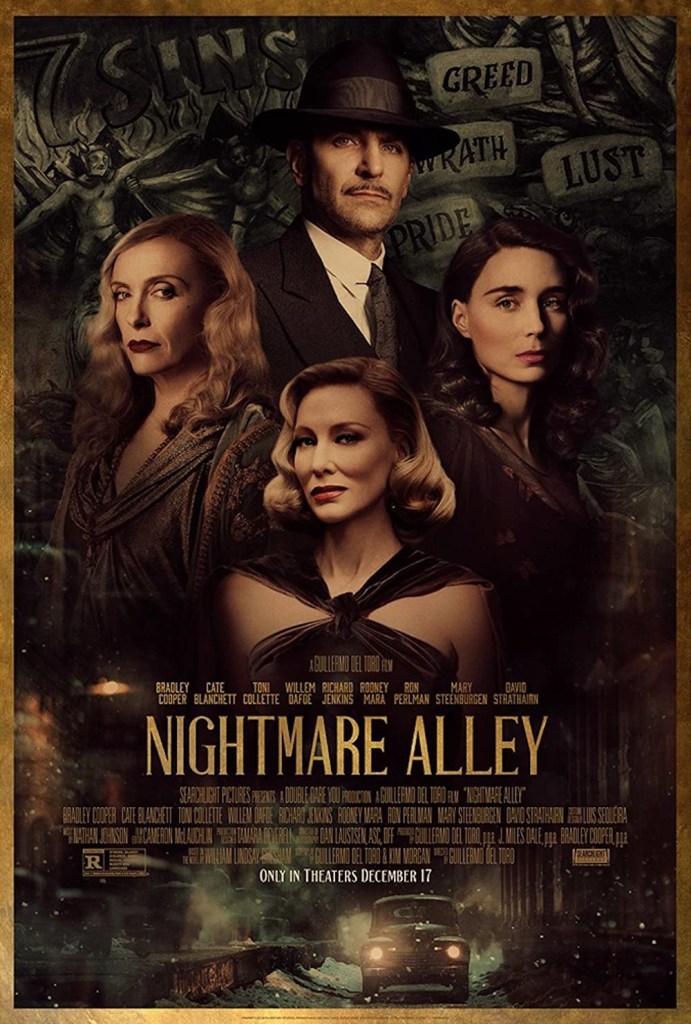
Nightmare Alley (2021); directed by Guillermo del Toro
Warning: This review contains plot spoilers. If you have not already seen Nightmare Alley and don’t like spoilers, please don’t read any further (but feel free to bookmark this page to read later).
I think it’s safe to say that 2021 was most definitely The Year of the Remake. Out of the ten films nominated for the Academy Award for Best Picture this year, four of them fall squarely into that category: CODA, Dune, Nightmare Alley, and West Side Story. Nightmare Alley was previously adapted in 1947 from the 1946 novel of the same name by William Lindsay Gresham. The original adaptation, while not a financial success upon its initial release, has since grown in estimation and is now considered a classic of the film noir genre.
For readers unfamiliar with film noir, the term generally applies to crime films made during the 1940s and 1950s. These mostly black-and-white films were usually made on shoestring budgets with short production schedules to turn a quick profit for cash-strapped studios. Most of the time, they weren’t meant to be dazzling works of art. They were created as a form of popular entertainment for the masses of working-class moviegoers who were desperate to see people who looked and lived like them on the big screen.
These mostly black-and-white films were usually made on shoestring budgets with short production schedules to turn a quick profit for cash-strapped studios.
Film noirs tell stories of men and women who, for various reasons, find themselves in dire straits. These pictures are populated by rough characters from the wrong side of the tracks, or simply good people who’ve made the wrong decisions. Sometimes, they’re just people caught in the wrong place at the wrong time clutching a smoking gun. More often than not, their stories end unhappily.
Dripping with sin and vice, these films exposed the dark underbelly of post-World War II America and the glaring hypocrisy of its storied institutions. One thing that made them so brilliant is that they exposed the lies masquerading as truth on the sunnier sides of the street. They showed that life, at least real life, was lived in the shadows. And every shadow was a man with a gun.
Dripping with sin and vice, these films exposed the dark underbelly of post-World War II America and the glaring hypocrisy of its storied institutions.
Personally, I owe most of my noir education to TCM’s programming block Noir Alley, which is hosted by Eddie Muller (aka “The Czar of Noir”) and first launched in March 2017. Through Eddie’s intros and outros, I’ve learned that any good noir has several elements: a hero (or antihero) trying to outrun something from his past or present that is trying to bring about his destruction; a pervading sense of hopelessness in the face of insurmountable odds; a femme fatale who makes the hero feel safe until she doesn’t; and an event which seals the hero’s fate for all time. Nightmare Alley (both of them) has all of these.
When Nightmare Alley first opens, we meet Stanton Carlisle (Bradley Cooper) placing a bagged body beneath the floorboards of what we can presume is his own home and then lighting the joint on fire and splitting. As far as noir openers go, you can’t really do much better than that. At this point, we already know that Stanton (hereinafter referred to simply as Stan) is a desperate man trying to outrun something sinister. Who was burned along with the house? Why did Stan kill them? Or was he even the guilty party? Is it possible that he simply discovered them and disposed of the body to avoid being implicated in a crime for which he was innocent? In noir, anything is possible and nightmares usually come true.
In noir, anything is possible and nightmares usually come true.
Stan happens upon a traveling carnival and witnesses a geek show. For those of you who aren’t familiar with geek shows, a geek show was a carnival side show both separate from and part of the main festivities. It most often consisted of a single man, the “geek”, chasing live chickens around the inside of an enclosure. The climax of the show occurred when the geek caught the chicken or chickens and bit their heads off to the shock and awe of the audience. This grotesque spectacle was often used as a warm-up act for a larger “freak show” wherein people with visible disabilities or physical abnormalities were exploited for their labor and entertainment value. Many of these people, because of discrimination and prejudice, were forced to work in carnivals because there was no other work to be had for them. In order to provide for themselves, they were forced to participate in their own denigration.
Many of these people, because of discrimination and prejudice, were forced to work in carnivals because there was no other work to be had for them. In order to provide for themselves, they were forced to participate in their own denigration.
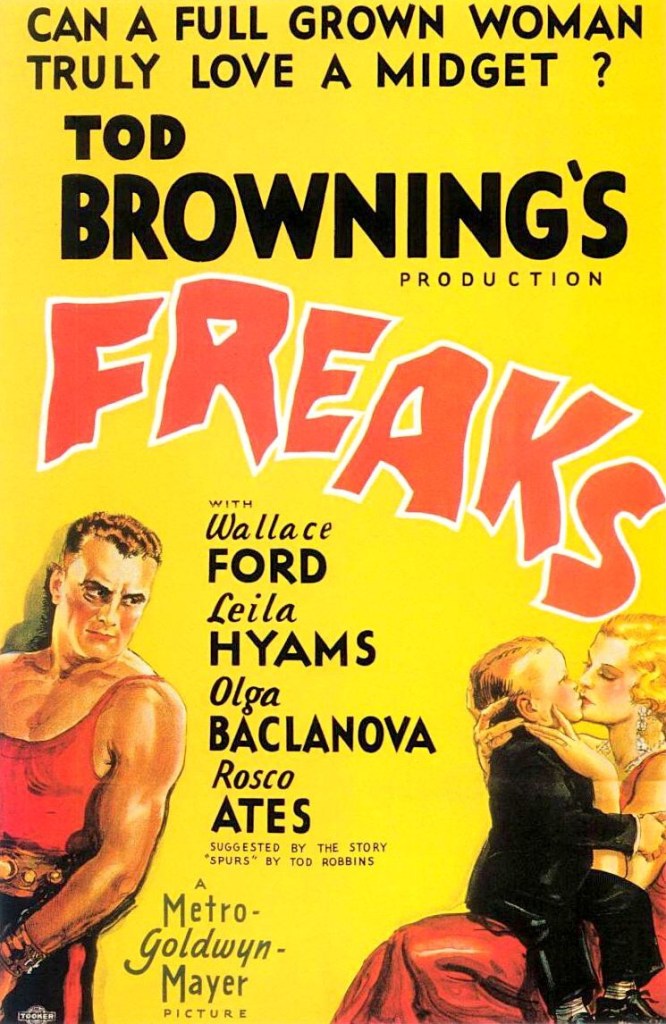
Freaks (1932); directed by Tod Browning
Side note: Tod Browning’s 1932 pre-Code horror film Freaks is perhaps the most honest and humane cultural document featuring people with disabilities who work or have worked in sideshow carnivals. While it was lambasted upon its initial release and even banned in some places for being too grotesque, it is now studied as a landmark film for its examination of carnival culture, its use of actual people with disabilities in on-screen roles, and even its Depression-era class politics. It is a cult classic and frequently appears in lists of the greatest films ever made. While its original intent is up for debate, watching it now evokes empathy rather than disgust, at least for yours truly.
Although it is evident how visibly disturbed Stan is at what he sees, he nonetheless secures a job with the carnival. It doesn’t pay much, but then again Stan doesn’t really need much. A man on the run really only needs one thing: to keep moving. The life of a carny provides him with just that. When the current geek becomes sick, Clem (Willem Dafoe) the carnival owner has Stan help him dump him in front of a clinic. It is then that Clem explains part of his racket to Stan. He finds men who have no money, no resources, no family to speak of, men who are chemically-dependent on alcohol, to be his geeks. He asks them no questions and promises them nothing but a temporary job and gives them alcohol laced with opium. He exploits their new dependence on the drug, giving it and withholding it as he sees fit, to debase and animalize them. All of this is done for the sake of the show.
A man on the run really only needs one thing: to keep moving. The life of a carny provides him with just that.
Stan befriends Madame Zeena (Toni Collette), a clairvoyant, and her husband Peter (David Strathairn), and assists with their act. He learns all he can from Peter and the gears inside his head begin turning for a show he can create of his own. He finds a partner for his future plans in the beautiful and alluring Molly (Rooney Mara), a fellow performer with whom he becomes infatuated and then falls in love. He convinces Molly to run away with him and craft a two-person act with which they can travel the world and behold all its wonders. She buys this pie-in-the-sky rhetoric much like any doe-eyed noir dame, and those of us in the audience (wherever we may be) are already shaking our heads in disapproval. We are screaming at her not to go but she doesn’t listen. They never do. The catalyst for their exit comes one night when Pete asks Stan to get him some liquor, and Stan (whether accidentally or not) gives him wood alcohol, which is poisonous and kills him. When a team of officers attempting to shut down the carnival arrive and Stan is able to cold-read one of them, convincing the man that his dead mother would want him to show mercy on them, we know that Stan and Molly are all but gone.
She buys this pie-in-the-sky rhetoric much like any doe-eyed noir dame, and those of us in the audience (wherever we may be) are already shaking our heads in disapproval. We are screaming at her not to go but she doesn’t listen. They never do.
Flash forward two years later and Stan has crafted quite the act as a mentalist, with Molly as his embittered and disillusioned assistant. The wealthy attendees of their Buffalo shows buy the lines Stan feeds them as if they’re candy. But where is the line between entertainer and charlatan? Better yet, who draws that line? If we harken back to the beginning parts of the film, we’ll remember Madame Zeena and Pete cautioning Stan against using the cold reading and coded language skills he’s acquiring to lead people on when they want to know about their dead loved ones.
But where is the line between entertainer and charlatan? Better yet, who draws that line?
It’s during one of their Buffalo performances that we meet Dr. Lilith Ritter (Cate Blanchett). She knows right away that Stan is nothing but a con, using sleights-of-hand and cheap parlor tricks to convince people he’s in touch with the beyond. She attempts to expose him for the charlatan he is, but she underestimates his skills. To punish her for lambasting him in front of his paying customers, he humiliates her by making accurate guesses about her childhood, the gun in her purse, and her utter lack of the power and agency she believes she possesses.
We find out that Dr. Ritter was under the employ of Judge Kimball (Peter MacNeill), who hired her to expose Stan. Now believing him to be a legitimate psychic, Judge Kimball offers him a large sum of money to act as a medium for him and his wife, allowing them to communicate with their deceased son. Molly is completely against it but Stan agrees anyway, and so he begins on the path of no return. Dr. Ritter invites Stan to her office (she is a psychiatrist/psychoanalyst), where she reveals to him her extensive recordings obtained during therapy sessions, all of which detail the deepest secrets of Buffalo’s elite. She tells him what he needs to know to make his session with the Kimballs successful, and all goes according to plan.
This is noir, though, so there’s always a flaw in the mechanism or a fly in the butter. Stan, not wanting Molly to discover the money he’s obtained through scamming Buffalo’s wealthy and powerful, takes it back to Dr. Ritter’s office and offers to split it with her. Dr. Ritter doesn’t want or need the money, it would seem, but agrees to keep it for him to help him avoid making Molly suspicious. No, instead she asks Stan to sit for a session with her, where she can probe the mysteries of his brain. It doesn’t take a genius (or psychic, for that matter) to guess what happens next.
Stan begins an affair with Dr. Ritter. In their analysis sessions, he spills his guts to her, admitting his guilt over Pete’s death as well as his father’s, whom he did in fact murder. We learn that his father was an alcoholic and we can deduce the level of abuse and neglect Stan suffered while growing up. At one point, Dr. Ritter offers Stan a drink of whisky, which he refuses and tells her that he never drinks. Ever.
Judge Kimball, being a satisfied customer, refers Stan to a dark and powerful man named Ezra Grindle. We learn that Grindle’s lover Dorrie died from the complications of a coerced back-alley abortion. Grindle is a tortured man forced to live with the consequences of his actions, and Dr. Ritter cautions Stan against engaging with him. Of course, Stan doesn’t listen and begins scamming Grindle. He delivers all sorts of fake missives from Dorrie, coming of course from the beyond. But Grindle isn’t satisfied with these placations. He wants Stan to conjure her physical form for him to see and talk to, ostensibly to beg for her forgiveness.
Stan’s plan is to involve Molly in the farce, having her play the part of Dorrie for Grindle’s catharsis. When she learns of the affair between Stan and Dr. Ritter, she leaves him. He begs her to stay, but she only agrees to help him one last time, in one more act. What Stan doesn’t plan for is the fact that Grindle won’t be satisfied with merely speaking to Dorrie (who is actually Molly), but will instead come ever closer to her until he embraces her. Before that, though, he unburdens himself of all his sins, revealing that he’s abused more women since Dorrie, citing his guilt as the motivator.
In a brief but telling aside, Anderson (Holt McCallany), Grindle’s faithful henchman, hears a news report on the radio telling about the gruesome murder-suicide of Judge and Mrs. Kimble. Having been told by Stan that they would all be reunited in death, Mrs. Kimble hastens the reunion with a gun.
Once Grindle embraces Dorrie, he discovers that the woman in front of him is not Dorrie at all, but someone he doesn’t know. He hits Molly viciously before he is brutally beaten to death by Stan. When Anderson attempts to come to Grindle’s rescue, Stan runs over him with their getaway car. When they get far enough away, Stan damages the car to make it appear as if it was stolen and it’s there that Molly leaves him, this time for good.
Stan makes his way to Dr. Ritter’s office to get his share of the money. A man on the run, after all, needs some cash to make his way. To his shock and dismay, Stan learns that Dr. Ritter has stolen the entirety of the money they earned together and is prepared to use the tapes of their sessions to prove he is a deranged individual. She tells him that she doesn’t need the money but that a man with his outsized ego needed to be taken down a peg. That’s not exactly how she phrases it, mind you, but you get the picture. Stan sees that all along he was merely a piece in a game he thought was his own.
Stan sees that all along he was merely a piece in a game he thought was his own.
In the climax of the film, Dr. Ritter shoots Stan in the ear, mocking him by shouting, “Am I powerful enough for you now, Stan?” bringing him back to their first meeting, where Stan told her how powerless she was in a room full of onlookers. Now, if only for herself, and if only in this small way, she reclaims her power. It’s a shame that she had to break doctor-patient privilege and violate every code of ethics to which a psychiatrist adheres to to do so, but we won’t quibble over semantics here. Dr. Ritter was the femme fatale all along, and Stan fell squarely into her clutches.
Now, if only for herself, and if only in this small way, she reclaims her power. It’s a shame that she had to break doctor-patient privilege and violate every code of ethics to which a psychiatrist adheres to to do so, but we won’t quibble over semantics here.
At this point, Dr. Ritter notifies security of an intruder. Stan attempts to strangle Dr. Ritter with a telephone cord but he’s unable to finish the job before security arrives on the scene. He manages to escape and makes his way onto a boxcar full of chickens. He becomes a vagrant, a homeless alcoholic. In the final scene, the pieces of the film come hauntingly together. We see Stan engage the proprietor of a carnival, one not unlike the one we saw him at in the beginning. He tries to sell himself as a mentalist, a clairvoyant. Perhaps he thinks he can make a living doing an act like Madame Zeena’s. The proprietor is disgusted by Stan, disgusted by his unkempt appearance and body odor, by the aura of shame and humiliation which covers him like a cloud. He nonetheless gives him a drink and offers him a job, a temporary job as a fake geek. It is at this point that Stan’s journey comes full circle. Buckling under the weight and magnitude of his piteous circumstances, he cries and laughs in a mixture of relief and hysteria, saying, “Mister, I was born for it.”
Buckling under the weight and magnitude of his piteous circumstances, he cries and laughs in a mixture of relief and hysteria, saying, “Mister, I was born for it.”
Very rarely do all the elements of a film work so effortlessly in concert together to make such an entertaining and artistic final product, but I think that can be said of Nightmare Alley. It avoids the pithy moralizations and heartfelt musings that would taint it (this, after all, is not a morality picture), and instead shows us a portrait of a soul set off on the wrong path toward a perilous and damned end. I enjoyed every minute of it.
It avoids the pithy moralizations and heartfelt musings that would taint it (this, after all, is not a morality picture), and instead shows us a portrait of a soul set off on the wrong path toward a perilous and damned end.
Nightmare Alley was released by Searchlight Pictures on December 17th, 2021 and is available to own, stream, or rent from various platforms and retailers.
Thanks as always for being a faithful reader of The Voracious Bibliophile. If you like what you see, please like, comment, follow, and subscribe to my email list to get notified of new posts as soon as they drop. You can also email me at fred.slusher@thevoraciousbibliophile.com or catch me on Twitter, Instagram, TikTok, and Pinterest @voraciousbiblog. Keep reading the world, one page (or pixel) at a time.
Warning: This review contains plot spoilers. If you have not already seen Cruella and don’t like spoilers, please don’t read any further (but feel free to bookmark this page to read later).
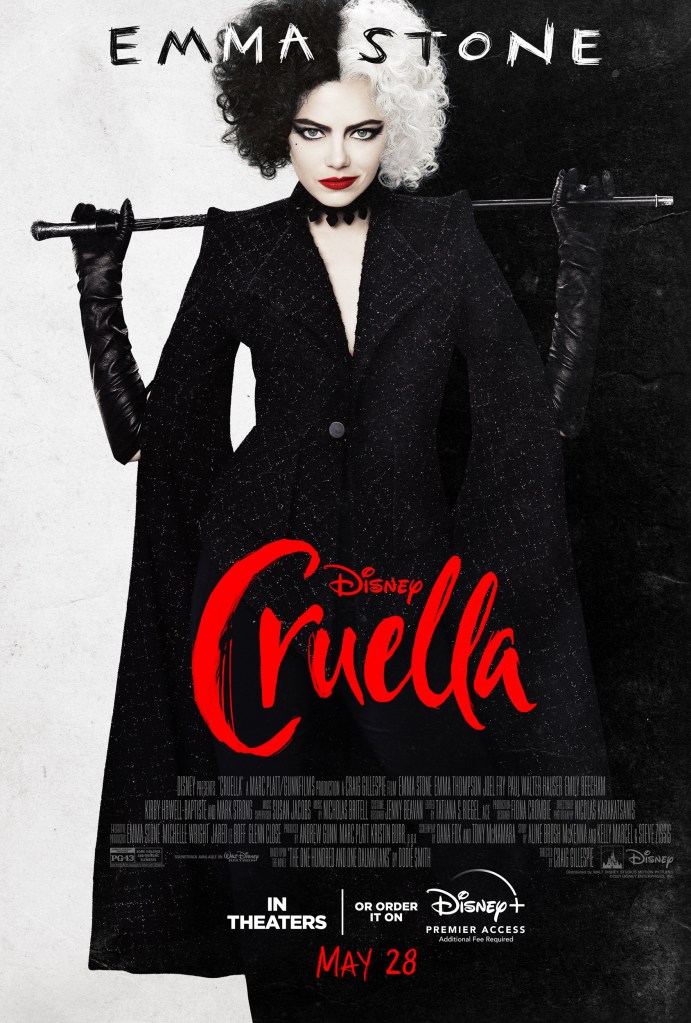
It’s not an easy feat to take a character as iconic as Cruella de Vil and breathe new life into her, but Emma Stone does so with vim and vigor. It also takes a not-insignificant amount of chutzpah to fill shoes (quite stylish shoes, I might add) once worn by Glenn Close. While Emma Stone’s Cruella is sly and sardonic like her celluloid predecessor, she also has this controlled sort of manic energy that just simmers on the screen. Also, I can’t remember the last time I saw someone have so much fun in a role and that alone is probably the highest compliment anyone could pay any actor in any role ever. In my opinion, Emma Stone was born to play Cruella de Vil, and if you disagree with me…well, let’s just say you should make sure I don’t have access to a cliffside balcony and a trio of Dalmatian attack dogs.
While Emma Stone’s Cruella is sly and sardonic like her celluloid predecessor, she also has this controlled sort of manic energy that just simmers on the screen.
When the film begins, we see young Estella Miller struggling to fit in. Her half-white, half-black hair makes her a favorite target of the schoolyard bullies who are always ready to pounce on anyone who deviates from the norm in any way whatsoever. To her credit, she fights back with the same level of passion and fortitude that she will later bring to her work in fashion design. Not everyone appreciates her fighting spirit, though, least of all her school’s headmaster. Once Estella racks up several demerits, her mother Catherine is called in for a conference. The headmaster intends on telling Catherine that Estella is being expelled, but she withdraws her before that can happen (let’s just say it was a horse race).
On their way to London and a fresh start for them both, Catherine stops at a sprawling manse to ask someone (The Baroness, we later learn) for money. Catherine implores Estella to stay inside the car (read: out of trouble), but all of us know what it’s like to be young and boisterous, chomping at the bit to explore. Estella leaves the car and sneaks into the party where she is quickly made the target of The Baroness’s three large Dalmatians. They chase Estella outside and across the grounds, ending by pushing Catherine over the edge of the cliffside balcony to her death.
Alone, motherless, and wracked with guilt over her role (or what she thinks was her role) in her mother’s gruesome death, Estella finishes making her way to London and inadvertently makes friends with two other street kids, Horace (Paul Walter Hauser) and Jasper (Joel Fry). The three youngsters, bound together by their mutual hard luck, poverty, and orphan status, become a chosen family for one another. They also become world-class pickpockets. If grifting were a professional sport, Estella, Horace, and Jasper would win Olympic gold.
The three youngsters, bound together by their mutual hard luck, poverty, and orphan status, become a chosen family for one another.
Years later, all grown up, the three lovable vagrants are still making a living together thieving and scheming. Estella, more stylish than ever, hones her craft by designing the group’s disguises. For her birthday, Horace and Jasper secure Estella a job at Liberty’s, an upper crust department store that caters exclusively to wealthy clientele. Their motto may as well be, “If you have to ask the price, darling, you can’t afford it.” Estella is simply bursting with creative energy, but her talents go unseen and she is relegated to doing janitorial work. It’s honest work and someone has to do it, but Estella was born to be a designer. Some might say it’s in her blood.
Estella is simply bursting with creative energy, but her talents go unseen and she is relegated to doing janitorial work. It’s honest work and someone has to do it, but Estella was born to be a designer.
Fed up and surly, Estella stays in Liberty’s overnight after her shift and drunkenly redecorates a window display in punk rock couture. It is avant-garde, edgy, and completely offensive to her manager, who fires her on the spot. However, in a bit of luck for Estella, The Baroness (Emma Thompson) makes a visit to the department store just as she is quite literally being given the boot.
The Baroness informs the manager that she loves the window display and that it’s the first truly innovative bit of merchandising she’s seen from them in some time. Those aren’t her exact words but you get the picture. She finds out that Estella is responsible for the display and offers her a job. The dreams that you dare to dream really do come true.
Estella excels in her new position and manages to impress The Baroness, who is notorious for having impeccable taste and impossibly high standards. If this were a different sort of film and not an origin story for one of Disney’s most iconic villains, Estella might continue impressing The Baroness and making waves in the fashion world. She’d completely disavow a life of crime and vice and move on up the ladder to become one of the most highly-regarded figures in fashion. Perhaps she may even venture over into fashion journalism and enjoy a life and career similar to that of Anna Wintour. Who knows? But things don’t work out quite that way.
If this were a different sort of film and not an origin story for one of Disney’s most iconic villains, Estella might continue impressing The Baroness and making waves in the fashion world. She’d completely disavow a life of crime and vice and move on up the ladder to become one of the most highly-regarded figures in fashion…But things don’t work out quite that way.
One day while Estella is acting in the capacity of The Baroness’s gopher, she notices her wearing a necklace that she distinctly remembers as having belonged to her mother, Catherine. When Estella inquires about it, The Baroness claims that a former employee had previously stolen it. Knowing better and incensed at The Baroness, Estella enlists Horace and Jasper to help her steal it back, for in all honesty it does rightfully belong to her. Estella makes plans to steal it back at The Baroness’s Black and White Ball. To conceal her true identity from The Baroness, Estella creates an alter-ego: Cruella. And thus a star is born.
To conceal her true identity from The Baroness, Estella creates an alter-ego: Cruella. And thus a star is born.
She wears a vintage design (in red, so subversive!) of The Baroness’s that she purchases from a vintage clothing store and upstages The Baroness at her own event. While she’s wowing the crowd and intimidating The Baroness, Horace and Jasper are playing their parts to retrieve Catherine’s necklace from the vault. What they didn’t plan for, but the audience should have guessed, is that The Baroness is wearing the necklace at the Ball.
[A brief aside: Artie (John McCrea), the proprietor of the vintage clothing store where Estella buys her outfit for the Black and White Ball, is gayer than a picnic basket and I am holding my breath for Disney to make it canon.]
Jasper, thinking quickly on his feet, sets free a mischief of rats which throw the crowd into a state of pandemonium. Amidst the confusion, Estella/Cruella swipes the necklace from The Baroness’s throat. When The Baroness notices her necklace is gone, she summons her Dalmatians with a dog whistle. This triggers a memory for Estella, and the revelation that follows changes everything she thought she knew about her life, her deceased mother, and The Baroness. This is the part of the movie where the lines between Estella and Cruella really begin to blur. Originally, Cruella was just a costume, an assumed identity. Estella never meant for Cruella to become all that she became. But I’m getting a little ahead of myself.
When The Baroness notices her necklace is gone, she summons her Dalmatians with a dog whistle. This triggers a memory for Estella, and the revelation that follows changes everything she thought she knew about her life, her deceased mother, and The Baroness.
Needless to say, The Baroness is upset by Cruella’s stunt at her Ball and even more upset that some nubile neophyte would be audacious enough to try to claim her throne. No industry veteran likes to have their position threatened by a talented young upstart, and in this regard The Baroness is no exception. She is vicious, conniving, and glamorous, and she will do anything to maintain her place at the top. As I was watching Cruella, Emma Thompson’s Baroness kept giving me Miranda Priestly in Devil Wears Prada vibes. Not for nothing, since I later did some research and saw that Aline Brosh McKenna, who wrote the screenplay for The Devil Wears Prada, also wrote the original screenplay for Cruella. Cruella’s script went through a couple rounds of revisions and the final screenplay is credited to Dana Fox and Tony McNamara, but at least some of that Prada energy infused by McKenna made it into the shooting script because Emma Thompson is like Meryl Streep’s equally ruthless and disdainful cousin.
No industry veteran likes to have their position threatened by a talented young upstart, and in this regard The Baroness is no exception. She is vicious, conniving, and glamorous, and she will do anything to maintain her place at the top.
It’s really fun to watch the power play between Estella and The Baroness unfold. The more Estella-as-Cruella is able to get away with without being detected, the more emboldened and powerful she feels. This power manifests itself in her stunning creations, and with each new piece she gets better and better. There’s something about losing your fears and shedding your inhibitions that makes your wildest dreams possible. When you aren’t afraid, nothing can really hurt you. The deeper in she gets, though, the more Estella starts to figure out. And there’s one revelation in particular that will break her open, and may even cost her life.
There’s something about losing your fears and shedding your inhibitions that makes your wildest dreams possible. When you aren’t afraid, nothing can really hurt you.
Cruella was released by Walt Disney Studios Motion Pictures on May 28th, 2021 and is available to own, stream, or rent from various platforms and retailers.
Thanks as always for being a faithful reader of The Voracious Bibliophile. If you like what you see, please like, comment, follow, and subscribe to my email list to get notified of new posts as soon as they drop. You can also email me at fred.slusher@thevoraciousbibliophile.com or catch me on Twitter, Instagram, TikTok, and Pinterest @voraciousbiblog. Keep reading the world, one page (or pixel) at a time.
Did I really go through all of the nominations for this year’s Oscars to figure out which films received the most nominations? I did. This year, 53 different films have been recognized by the Academy of Motion Picture Arts and Sciences for their cinematic excellence.
One question I ponder quite often when it comes to film is, “What separates a good film from a great film? A great film from an epic film?”
One question I ponder quite often when it comes to film is, “What separates a good film from a great film? A great film from an epic film?” Some of it boils down to personal taste, yes, but most cinephiles (yours truly included) would argue there are certain elements which comprise any film worth its stock, pun very much intended. The first and most important of these elements is cohesiveness. All the parts of a film must work in conjunction with one another to tell a certain story. You can have a great script but it’s worthless if you have mediocre actors reciting lines from it. You can have GOATs like Meryl Streep acting in your movie but if your script is subpar, no amount of Streeping will save it.
For me, a great film is a film where everything is not only in balance but complementary. There’s subtlety, nuance, and most important of all—craft.
For me, a great film is a film where everything is not only in balance but complementary. There’s subtlety, nuance, and most important of all—craft. A great actor can make you experience several different emotions in the same scene. A great set can transport you back through time. A great cinematographer can transcend time and space to make you see things in ways you’ve never seen them before. A score, crafted just so to ebb and flow within a film’s narrative, can emphasize elements that might otherwise have gone unnoticed.
An epic film not only has all of the elements of a great film, but a certain je ne sais quoi that elevates it above the pack, that makes it timeless. An epic film is larger than life even when the story it’s telling is small in scope.
And an epic film? An epic film not only has all of the elements of a great film, but a certain je ne sais quoi that elevates it above the pack, that makes it timeless. An epic film is larger than life even when the story it’s telling is small in scope. It has a universality that makes it resonate with people from all walks of life, from all places and all times. When I think of epic films, I think of The Godfather. The Wizard of Oz. Gone with the Wind. Sunset Boulevard. Titanic. All of these have elements working in conjunction with one another, and all have not a small amount of magic cooked in for good measure. They quite possibly will outlast time, and rightfully so.
See below for a list of all the films nominated for an Academy Award this year. The number in parentheses beside each film indicates how many nominations it has received this Oscars season.
The Power of the Dog (12)
Dune (10)
Belfast (7)
West Side Story (7)
King Richard (6)
Don’t Look Up (4)
Drive My Car (4)
Nightmare Alley (4)
Being the Ricardos (3)
CODA (3)
Encanto (3)
Flee (3)
Licorice Pizza (3)
The Lost Daughter (3)
No Time to Die (3)
The Tragedy of Macbeth (3)
Cruella (2)
The Eyes of Tammy Faye (2)
Parallel Mothers (2)
tick, tick…Boom! (2)
The Worst Person in the World (2)
Affairs of the Art (1)
Ala Kachuu – Take and Run (1)
Ascension (1)
Attica (1)
Audible (1)
Bestia (1)
Boxballet (1)
Coming 2 America (1)
Cyrano (1)
The Dress (1)
Four Good Days (1)
Free Guy (1)
The Hand of God (1)
House of Gucci (1)
Lead Me Home (1)
The Long Goodbye (1)
Luca (1)
Lunana: A Yak in the Classroom (1)
The Mitchells vs. the Machines (1)
On My Mind (1)
Please Hold (1)
The Queen of Basketball (1)
Raya and the Last Dragon (1)
Robin Robin (1)
Shang-Chi and the Legend of the Ten Rings (1)
Spencer (1)
Spider-Man: No Way Home (1)
Summer of Soul (…Or, When the Revolution Could Not Be Televised) (1)
Three Songs for Benazir (1)
When We Were Bullies (1)
The Windshield Wiper (1)
Writing with Fire (1)
The 94th Academy Awards ceremony will take place at the Dolby Theatre in Hollywood, Los Angeles, California, on March 27th, 2022.
Thanks as always for being a faithful reader of The Voracious Bibliophile. If you like what you see, please like, comment, follow, and subscribe to my email list to get notified of new posts as soon as they drop. You can also email me at fred.slusher@thevoraciousbibliophile.com or catch me on Twitter, Instagram, TikTok, and Pinterest @voraciousbiblog. Keep reading the world, one page (or pixel) at a time.
First of all, I’d like to thank the Academy for choosing to reveal this year’s Oscar nominees on my birthday. It was truly a fantastic way to begin the celebrations. Overall, I’d say I’m happy with the choices this year. I was holding my breath when they announced the nominees for Best Actress because I was so afraid Kristen Stewart was going to be snubbed. Thankfully, she pulled out a nomination and who knows? Bella Swan may be walking away with an Oscar come March 27th.
Now I’d like to compare my personal choices in eight major categories with the choices made by the Academy. Without further ado, here they are:
My Choices: Best Picture
Belfast
CODA
Drive My Car
Dune
King Richard
Licorice Pizza
The Lost Daughter
The Power of the Dog
The Tragedy of Macbeth
West Side Story
Official Nominations: Best Picture
Belfast
CODA
Don’t Look Up
Drive My Car
Dune
King Richard
Licorice Pizza
Nightmare Alley
The Power of the Dog
West Side Story
It looks like the Academy agreed with me on all but two films: The Lost Daughter and The Tragedy of Macbeth. I knew The Lost Daughter was a long shot but I’m really offended about Macbeth. In place of the films I picked, the Academy chose Don’t Look Up and Nightmare Alley. All of the films are worthy of the distinction but there can only be so many nominees.
My Choices: Best Director
Paul Thomas Anderson, Licorice Pizza
Kenneth Branagh, Belfast
Jane Campion, The Power of the Dog
Maggie Gyllenhaal, The Lost Daughter
Ryûsuke Hamaguchi, Drive My Car
Official Nominations: Best Director
Kenneth Branagh, Belfast
Ryûsuke Hamaguchi, Drive My Car
Paul Thomas Anderson, Licorice Pizza
Jane Campion, The Power of the Dog
Steven Spielberg, West Side Story
So I overshot on Maggie Gyllenhaal. Sue me. Four out of five isn’t bad.
My Choices: Best Actor
Benedict Cumberbatch, The Power of the Dog
Peter Dinklage, Cyrano
Andrew Garfield, tick, tick… Boom!
Will Smith, King Richard
Denzel Washington, The Tragedy of Macbeth
Official Nominations: Best Actor
Javier Bardem, Being the Ricardos
Benedict Cumberbatch, The Power of the Dog
Andrew Garfield, tick, tick… Boom!
Will Smith, King Richard
Denzel Washington, The Tragedy of Macbeth
Switch Dinklage and Bardem and I nailed it. I’m not surprised Bardem secured a nomination given how much the Academy loves movies about show business, but I still remain unimpressed with his performance. I may need to watch Being the Ricardos again and reevaluate my opinion. If I do, you all will be the first to know.
My Choices: Best Supporting Actor
Bradley Cooper, Licorice Pizza
Ciarán Hinds, Belfast
Troy Kotsur, CODA
Jesse Plemons, The Power of the Dog
Kodi Smit-McPhee, The Power of the Dog
Official Nominations: Best Supporting Actor
Ciarán Hinds, Belfast
Troy Kotsur, CODA
Jesse Plemons, The Power of the Dog
J.K. Simmons, Being the Ricardos
Kodi Smit-McPhee, The Power of the Dog
I’m not surprised about J.K. Simmons. For one thing, he’s already won the Oscar for Best Actor in a Supporting Role once and the Academy tends to reward industry veterans. Combined with that, he was a very convincing William Frawley. Up until now, the award has all but sat atop Kodi Smit-McPhee’s mantle. Now, it’s anyone’s guess who will walk away with Oscar gold. One thing that’s working against Kodi Smit-McPhee is that his costar Jesse Plemons is competing against him in the same category. Greater odds have been surmounted but now that Simmons is in the ring, we’ll have to wait until the night of the ceremony to see who will win.
My Choices: Best Actress
Jessica Chastain, The Eyes of Tammy Faye
Olivia Colman, The Lost Daughter
Nicole Kidman, Being the Ricardos
Frances McDormand, The Tragedy of Macbeth
Kristen Stewart, Spencer
Official Nominations: Best Actress
Jessica Chastain, The Eyes of Tammy Faye
Olivia Colman, The Lost Daughter
Penélope Cruz, Parallel Mothers
Nicole Kidman, Being the Ricardos
Kristen Stewart, Spencer
Frances McDormand is usually a safe bet, but I guess the Academy has decided she’s been recognized enough in the past several years. At any rate and once again, four out of five isn’t bad.
My Choices: Best Supporting Actress
Caitríona Balfe, Belfast
Jessie Buckley, The Lost Daughter
Ariana DeBose, West Side Story
Ann Dowd, Mass
Kathryn Hunter, The Tragedy of Macbeth
Official Nominations: Best Supporting Actress
Jessie Buckley, The Lost Daughter
Ariana DeBose, West Side Story
Judi Dench, Belfast
Kirsten Dunst, The Power of the Dog
Aunjanue Ellis, King Richard
I’m the most angry about Kathryn Hunter being snubbed. Did the Academy voters even watch The Tragedy of Macbeth?
My Choices: Best Original Screenplay
Belfast
Don’t Look Up
The French Dispatch of the Liberty, Kansas Evening Sun
King Richard
Licorice Pizza
Official Nominations: Best Original Screenplay
Belfast
Don’t Look Up
King Richard
Licorice Pizza
The Worst Person in the World
Four out of five. That appears to be how I’m trending.
My Choices: Best Adapted Screenplay
CODA
Dune
The Lost Daughter
The Power of the Dog
The Tragedy of Macbeth
Official Nominations: Best Adapted Screenplay
CODA
Drive My Car
Dune
The Lost Daughter
The Power of the Dog
Well, that’s it. Let me know what you think. Like the rest of you, I’ve got a lot of movies to watch.
Thanks as always for being a faithful reader of The Voracious Bibliophile. If you like what you see, please like, comment, follow, and subscribe to my email list to get notified of new posts as soon as they drop. You can also email me at fred.slusher@thevoraciousbibliophile.com or catch me on Twitter, Instagram, TikTok, and Pinterest @voraciousbiblog. Keep reading the world, one page (or pixel) at a time.
Elena Ferrante is one of my favorite writers, so you can imagine how nervous I was when I first heard that The Lost Daughter (2008) was being adapted as a feature film. To give you some context, I have yet to watch a single episode of HBO’s My Brilliant Friend, which is based off Ferrante’s Neapolitan Novels. The series, which includesMy Brilliant Friend (2012), The Story of a New Name(2013), Those WhoLeave and Those Who Stay(2014), and The Story of the Lost Child (2015), follows two friends, Elena and Lila, from the time they are little girls to when they are elderly women, through love, marriage, heartbreak, and not least of all the changing sociopolitical landscape of their neighborhood in Naples, Italy.
I tried to watch an episode when it first came out, but those books mean too much to me to have them sullied by a less-than-sensational adaptation. There’s a chance it’s decent, yes, but I am not that much of a gambler.
There is no better marriage than that between literature and film, but only when it’s done right.
Then I found out that Maggie Gyllenhaal would be helming the ship as both director and screenwriter of The Lost Daughter, and quelle intrigue, I was starting to feel a little hopeful. There is no better marriage than that between literature and film, but only when it’s done right. Finally, I heard that Olivia Colman was starring as the lead and that sold me. Colman, who won an Oscar for her portrayal of Queen Anne in Yorgos Lanthimos’s 2018 film The Favourite, is a fierce, intelligent, and inimitable talent. She’s nearly unmatched.
Colman, who won an Oscar for her portrayal of Queen Anne in Yorgos Lanthimos’s 2018 film The Favourite, is a fierce, intelligent, and inimitable talent. She’s nearly unmatched.
I mean, how many actors do you know who can hold their own (much less shine, as she did) when paired with someone like Sir Anthony Hopkins? The answer is not many, of course.
The idyllic scene is almost too idyllic, as if something dark and primordial is lurking just beneath the surface, waiting for the veil of darkness to ensnare whom it may.
In The Lost Daughter, Colman plays Leda Caruso, a professor and scholar of comparative Italian literature on holiday in Greece. The idyllic scene is almost too idyllic, as if something dark and primordial is lurking just beneath the surface, waiting for the veil of darkness to ensnare whom it may. The bowl of fruit in Leda’s rented apartment, at first sight so inviting, conceals rot. The gentle breezes blowing through her bedroom carry an insect to her pillow which startles her awake and stains her pillow with its blood.
The shifting tectonics of the fractured idyll create an atmosphere of unease which pervades the entire island.
The shifting tectonics of the fractured idyll create an atmosphere of unease which pervades the entire island. One day, a boisterous family interrupts Leda on the beach and asks her to move her lounge chair so they can all sit close together, unbroken. Owing them nothing and caught off-guard by their crassness, Leda (at first politely) tells them no. She is not interested in moving. Some viewers might watch this scene and think, Why doesn’t she just move? It’s not that big a deal, right? But it’s not really that simple, either. Some people’s lived experiences socialize them to be protective of any space they’re able to carve out for themselves. Naturally, they become fiercely protective of that space and those boundaries. As they should. As we all should.
Some people’s lived experiences socialize them to be protective of any space they’re able to carve out for themselves. Naturally, they become fiercely protective of that space and those boundaries. As they should. As we all should.
After her initial run-in with some of the members of the family, Leda makes a connection with Nina (Dakota Johnson) after Leda finds Nina’s daughter Elena when she goes missing on the beach. Then Leda does something that at the time seems strange—she steals Elena’s doll. Nina and the rest of her family search high and low for the doll, even going so far as to offer a reward for its safe return. Nina is worn threadbare. Elena is fractious and inconsolable. All the while, Leda is surreptitiously caring for the doll—cleaning it, buying it clothes, and caressing it much like one would an infant.
Nina is worn threadbare. Elena is fractious and inconsolable. All the while, Leda is surreptitiously caring for the doll—cleaning it, buying it clothes, and caressing it much like one would an infant.
Intermittent flashbacks show Leda as a young mother interacting with her daughters, Bianca and Martha. Anyone can see that she loves her daughters fiercely but lacks the mothering instinct often idolized in the popular culture. She feels smothered, bombarded. Every plea and poke strips her of something she’d much rather keep exclusively for herself. She’s like a beachcomber dodging scores of dive-bombing pelicans, a trapeze artist balancing on an ever-thinning wire. She cycles through irritation, rage, and agony like they’re outfits picked for different days of the week. When she begins getting recognized for her scholarship, she feels the pull toward escape like an iron filing to a magnet. Once a successful and handsome colleague (Peter Sarsgaard) gives her the professional validation she seeks as well as the sensual adulation she craves, the frayed apron strings are all but severed entirely.
She feels smothered, bombarded. Every plea and poke strips her of something she’d much rather keep exclusively for herself. She’s like a beachcomber dodging scores of dive-bombing pelicans, a trapeze artist balancing on an ever-thinning wire.
I won’t spoil the ending, mostly because I want everyone who reads this blog and everyone I know in real life to watch this film. Maggie Gyllenhaal and Olivia Colman have gifted us with one of the most honest depictions of motherhood ever seen in any medium. Many scholars have waxed poetic about the divided feminine for years, as anyone who’s had to listen to a lecture on the Madonna-whore complex can tell you. But, Gyllenhaal moves the dial beyond this simplistic dichotomy to encompass all the parts of womanhood seldom spoken about in tandem with motherhood. And she does so, with the help of Colman and Johnson, of course, without placing a value judgment on any of these planes of existence. These women are simply allowed to be, in all of their glorious complexity. That in itself is a tremendous achievement.
The Lost Daughterreceived a limited theatrical release beginning on December 17th, 2021 and began streaming on Netflix on December 31st, 2021.
Thanks as always for being a faithful reader of The Voracious Bibliophile. If you like what you see, please like, comment, follow, and subscribe to my email list to get notified of new posts as soon as they drop. You can also email me at fred.slusher@thevoraciousbibliophile.com or catch me on Twitter, Instagram, TikTok, and Pinterest @voraciousbiblog. Keep reading the world, one page (or pixel) at a time.
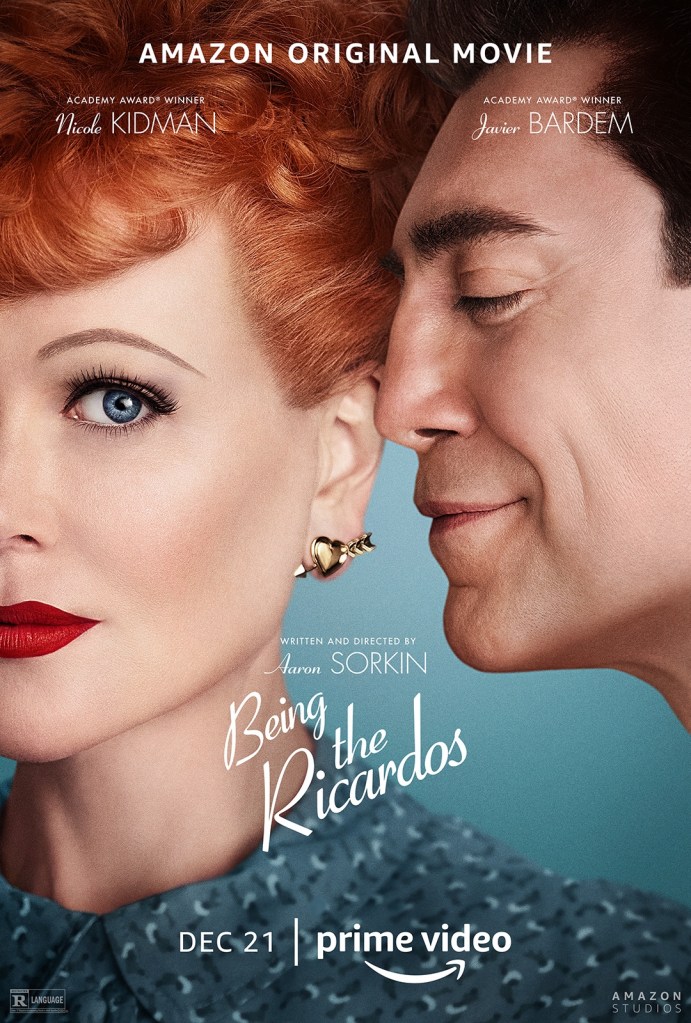
Promotional poster for Aaron Sorkin’s Being the Ricardos. Copyright 2021 Amazon Studios.
In Being the Ricardos, Kidman lends her talents for transformation to her portrayal of Lucille Ball, almost inarguably the greatest television comedienne to ever work in the medium.
If I hit him in the face until he is bleeding, does our insurance cover that?
Lucille Ball (Nicole Kidman), to her husband Desi Arnaz (Javier Bardem), about an irksome director
By now, American moviegoers are well-acquainted with Nicole Kidman and her talent for transformation. Woe unto the would-be cinephile who neglects to study her performance as Virginia Woolf in Stephen Daldry’s The Hours, for which she was awarded the 2002 Academy Award for Best Actress. In Being the Ricardos, Kidman lends her talents for transformation to her portrayal of Lucille Ball, almost inarguably the greatest television comedienne to ever work in the medium. You have to give props to pioneers Carol Burnett and Betty White as well, but I would argue that they were not possible without Lucille Ball paving the way for them with her grape-stained feet. Javier Bardem stars alongside Kidman as Desi Arnaz, Lucille’s real-life and television husband. Being the Ricardos also benefits from its stellar supporting cast, including Academy Award-winning actor J.K. Simmons as William Frawley, Tony Award-winning actress Nina Arianda as Vivian Vance, and Alia Shawkat as Madelyn Pugh. Linda Lavin portrays an older Pugh in mockumentary-style interviews interspersed throughout the film, and it should be said that any production benefits from Lavin’s inclusion.
Far from being an overarching biopic of Ball’s life or the marriage of Lucy and Desi, Being the Ricardos instead focuses in on one turbulent week during the filming of I Love Lucy.
Far from being an overarching biopic of Ball’s life or the marriage of Lucy and Desi, Being the Ricardos instead focuses in on one turbulent week during the filming of I Love Lucy. I have to mention here that parts of the film are blatantly ahistorical. Desi’s ousting as a philanderer, Lucy’s Communism debacle, and the announcement of her pregnancy did not all occur in the same week. However, I am willing to forgive Aaron Sorkin for condensing more drama into that fateful week than actually existed because we are talking about the cinema here and sometimes the cinema requires a little greasing of the wheels, so to speak.
What chafes me is that Lucy’s deeper involvement with Communism wasn’t explored. If they weren’t going to do it justice it should have been left out entirely. Along with that, certain episodes of I Love Lucy that were discussed in the film were misnumbered for no justifiable reason, allowing the pedantic among us (yours truly included) to itch with irritation.
I feel like the film would have been better served by focusing on one conflict rather than oscillating between numerous subplots that make the narrative shallow when the objective is depth.
I feel like the film would have been better served by focusing on one conflict rather than oscillating between numerous subplots that make the narrative shallow when the objective is depth. They could have eighty-sixed the Communism and the concomitant hokey convo between Desi, J. Edgar Hoover, and the live studio audience near the end of the film. Instead, to give the film its proper denouement, Lucy could have confronted Desi about his philandering right before the taping of the episode, leaving him shocked and shaken while Lucy triumphs once more as America’s most-beloved housewife.
The fact is, I hate to be so critical of a movie I enjoyed so much but I feel like a good movie was robbed of the opportunity to be great simply because Sorkin was trying to do too much at once. In my opinion, the best scenes in the film are the ones between Kidman and Arianda (Vivian Vance) and Kidman and Shawkat (Evelyn Pugh), respectively.
In my opinion, the best scenes in the film are the ones between Kidman and Arianda (Vivian Vance) and Kidman and Shawkat (Evelyn Pugh), respectively.
During the scenes where Lucy is engaged in conversation with the two women, the gender politics of the era (of any era, really) are thrown into sharp relief. Pugh’s presence as a woman in a writer’s room when so few women were given seats at the table provides fodder for excellent conversations about agency, representation, and the sharing of credit in a collective creative process. At the same time, Vance’s body issues and self-consciousness surrounding her weight illuminate the stark contrast in privilege that exists between Lucy, who is thin, trim, and wields enormous power on the set as the title character, and Vance, who is often written as the designated ugly fat friend married to a cantankerous old man when she is so much more than that.
Pugh’s presence as a woman in a writer’s room when so few women were given seats at the table provides fodder for excellent conversations about agency, representation, and the sharing of credit in a collective creative process…At the same time, Vance’s body issues and self-consciousness surrounding her weight illuminate the stark contrast in privilege that exists between Lucy, who is thin, trim, and wields enormous power on the set as the title character, and Vance, who is often written as the designated ugly fat friend married to a cantankerous old man when she is so much more than that.
J.K. Simmons is being lauded for his turn as William Frawley, and while his performance is more than solid, I really want to see the Academy give Nina Arianda some love too, if for nothing else but deftly navigating Vance’s struggles vis-à-vis the gendered body politics of both the entertainment industry and the country at-large during the 1950s. When you see Vance struggling, it reminds you that precious little progress has been made toward body positivity and acceptance of people of all sizes, especially for women and femme-presenting people.
All in all, despite its cluttered script and odd pacing, Being the Ricardos succeeds due to its incredible performances from not only Kidman, who is a revelation, but the rest of the powerhouse cast as well.
Being the Ricardos was released on December 10th, 2021 and is now available to stream on Amazon Prime Video.
Thanks as always for being a faithful reader of The Voracious Bibliophile. If you like what you see, please like, comment, follow, and subscribe to my email list to get notified of new posts as soon as they drop. You can also email me at fred.slusher@thevoraciousbibliophile.com or catch me on Twitter, Instagram, TikTok, and Pinterest @voraciousbiblog. Keep reading the world, one page (or pixel) at a time.
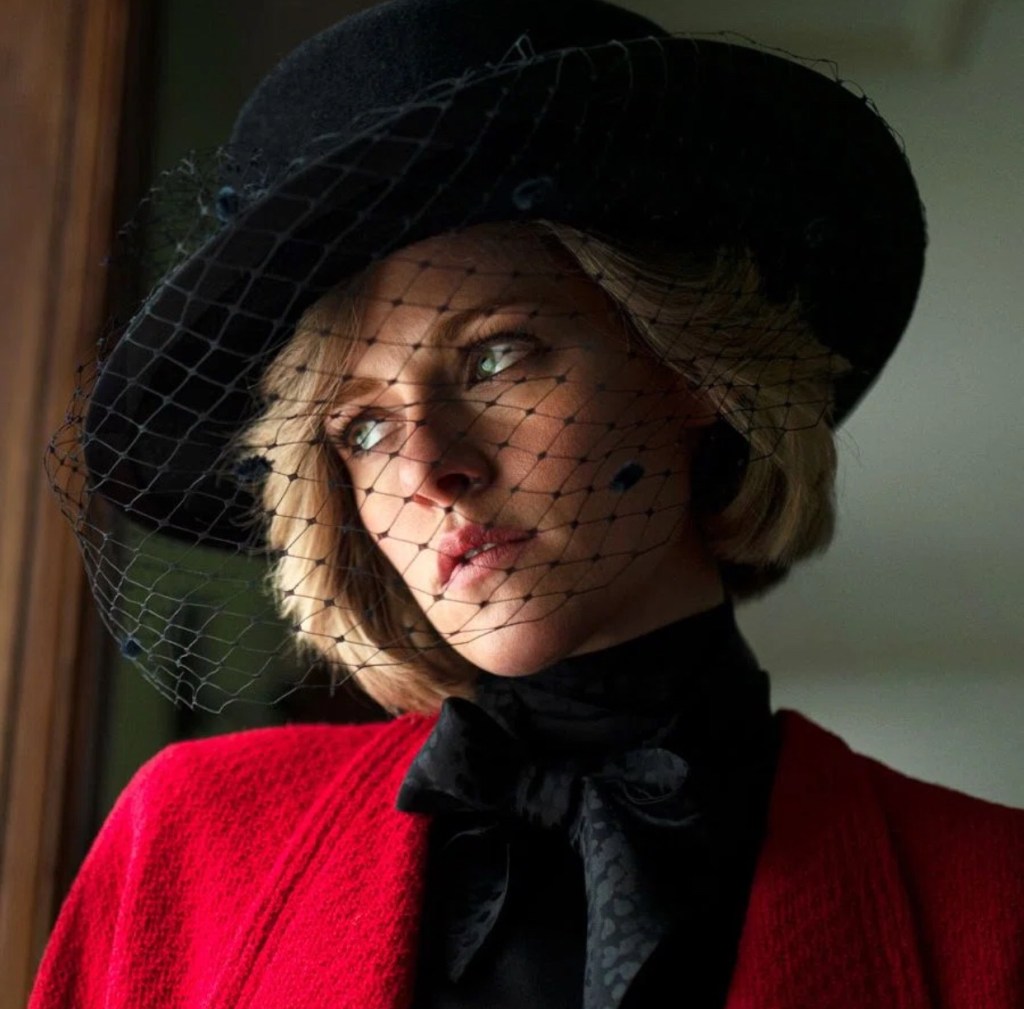
Kristen Stewart as Diana, Princess of Wales in Spencer (2021); directed by Pablo Larraín. Copyright 2021 Neon.
When we first meet Kristen Stewart’s Princess Diana, she is running late to spend the Christmas holiday with other members of the royal family at Sandringham House, one of Queen Elizabeth’s sprawling country estates. She is desperate and harried as she drives aimlessly through the countryside, her frustration mounting when she can’t seem to find her destination. Discordant notes and flourishes, which characterize the film’s score, heighten the moment’s anxiety, thereby drawing the viewer into concert with Diana’s inner turmoil.
Discordant notes and flourishes, which characterize the film’s score, heighten the moment’s anxiety, thereby drawing the viewer into concert with Diana’s inner turmoil.
It will not escape the notice of the attentive viewer that the story of Diana chosen to be told by the filmmakers is that of the events surrounding the royals’ Christmas holiday in 1991. Sandringham House lies in close proximity to Park House, the abandoned neighboring estate which was Diana’s childhood home. Periodic flashbacks return Diana to that idyllic past, one which remains for her devastatingly out of reach. Stewart’s Diana is a luminous and haunted creature, much like she was in real life. She is surrounded by the ghosts of all the lives she is not allowed to live and constrained by a future she can predict with startling accuracy. Throughout the course of the film, she is made at every turn to feel like she’s dancing on the knife edge of sanity, but to the working class viewer Diana appears to be the only sane one in the group of royals. I mean, how hard should it be to get someone to turn the heat on? And is it really asking too much to not want to be weighed before entering the hallowed premises like some Holstein cow at a livestock auction?
She is surrounded by the ghosts of all the lives she is not allowed to live and constrained by a future she can predict with startling accuracy.
To a far lesser degree, I feel as if I understand Diana’s plight. I know what it’s like to have seemingly everyone in the world wanting something from you that you feel ill-equipped to give, wanting nothing more for yourself than to be left alone. During one scene from the film, Diana is secretly eating when one of the Sandringham House caretakers accosts her and tells her that because of the recent media attention she’s attracted, she would do well to close her blinds while she changes clothes. It’s a little early to speculate, but if (and this is a big if) Stewart wins the Oscar for Best Actress, it will be in large part because of her retort, which I’m including below:
Their lenses are more like microscopes, really. And I’m the insect in the dish. See, they’re pulling my wings and my legs off one by one — making notes on how I react.
At every turn she is weighed and found wanting until there is nothing left of her but the image and the simulacrum of the person she wants to be.
Princess Diana was one of the first women castigated on a truly global scale by the mass media. Every grain of her private life was excavated and inspected for its potential value. The scales at Sandringham House become a metaphor for Diana’s entire existence: At every turn she is weighed and found wanting until there is nothing left of her but the image and the simulacrum of the person she wants to be.
It [Spencer] is a snapshot, a few pages torn from the diary of a life. It’s a deeply-felt character study of a woman flirting with the darkness in her own mind.
Whatever you want to call Spencer, it is not a biopic. It is a snapshot, a few pages torn from the diary of a life. It’s a deeply-felt character study of a woman flirting with the darkness in her own mind. There are parts of the film I wouldn’t hesitate to call Hitchcockian, and it wouldn’t surprise me a bit if Stewart watched Kim Novak’s performance in Vertigo before filming a pivotal scene at the ruins of Park House.
All in all, Spencer is a delightfully stylish, if unsettling portrait of one of the most beloved, misunderstood, and mercurial figures of the twentieth century. Just give Stewart the freaking Oscar already.
Spencer was released on November 5th, 2021 and is now available to stream on YouTube, Google Play Movies & TV, Amazon Prime Video, Apple TV, and Vudu.
Thanks as always for being a faithful reader of The Voracious Bibliophile. If you like what you see, please like, comment, follow, and subscribe to my email list to get notified of new posts as soon as they drop. You can also email me at fred.slusher@thevoraciousbibliophile.com or catch me on Twitter, Instagram, TikTok, and Pinterest @voraciousbiblog. Keep reading the world, one page (or pixel) at a time.





 The Voracious Bibliophile