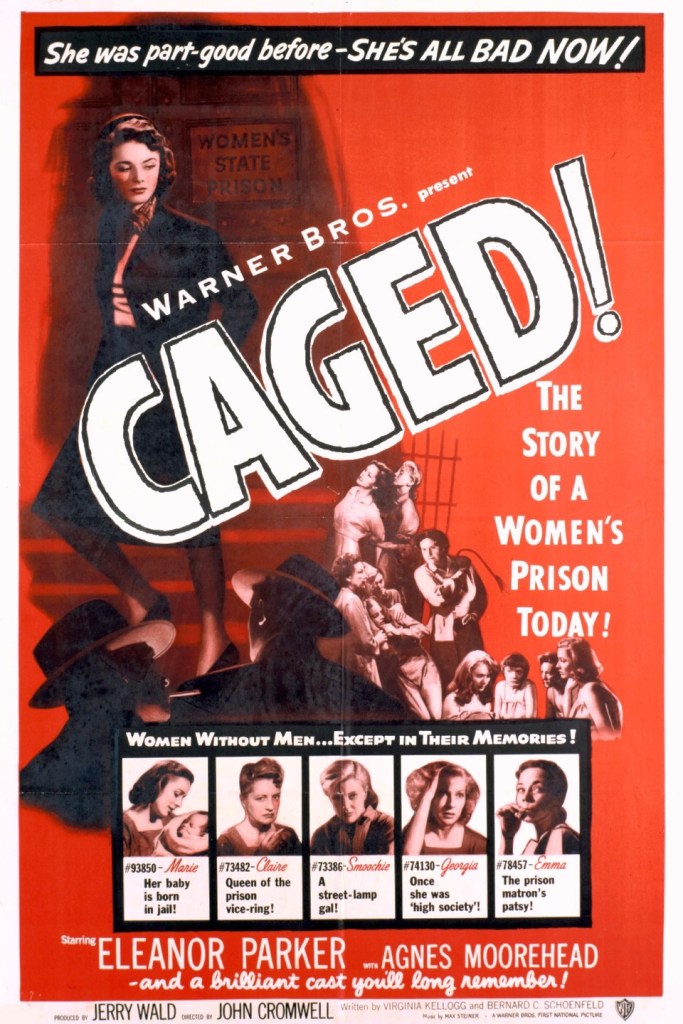
Film poster for Caged (1950); directed by John Cromwell.
Review
This is your warning that there are spoilers ahead. If you don’t want any of the plot of Caged spoiled, stop reading now until you’ve seen the film.
What a delicious, delightful treat this movie is. Hope Emerson is the ultimate screen baddie, and this is the meatiest role she ever got as prison matron Evelyn Harper. Emerson’s Evelyn is queer-coded to the nines, and there’s very little subtext. We love Evil Gays.
We love Evil Gays.
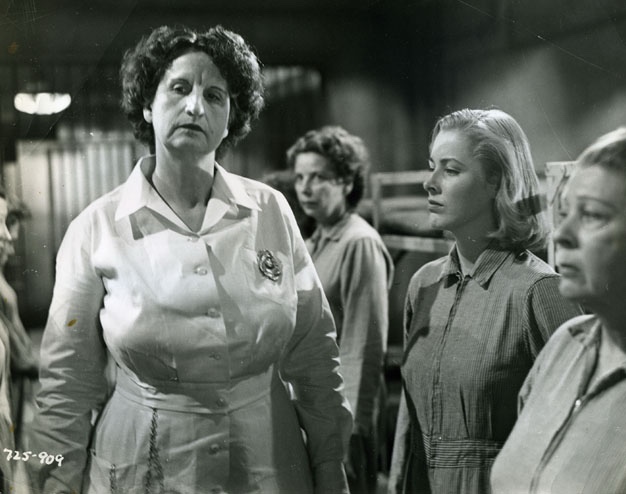
Hope Emerson (farthest left) as women’s prison matron Evelyn Harper. Image subject to copyright.
Eleanor Parker makes the biggest transformation of any of the characters in the film, going from a doe-eyed ingenue to a hardened criminal after losing her baby to adoption and finding out that the system is designed to keep her incarcerated, not help her transition to life on the outside.
Agnes Moorehead plays a rare sympathetic role as prison superintendent Ruth Benton, a no-nonsense but very caring woman who works overtime in the cruel and corrupt system to make her prison a place for rehabilitation and healing, not punishment and brutality.
Last but certainly not least, Betty Garde’s character Kitty Stark reminds one of Kate Mulgrew’s Red in Netflix’s Orange Is the New Black, so much so that one wonders if Mulgrew took inspiration from Garde. Garde as Kitty Stark is sardonic and hardened, but not unfeeling. She’s someone who’s had to play the cards she’s dealt, and she makes no apology for it. Seeing Evelyn break her is heartbreaking. But she gets what’s coming to her, thank God!
Cagedis streaming now on Watch TCM and was recently featured on Eddie Muller’s Noir Alley programming block on the channel.
Thanks as always for being a faithful reader of The Voracious Cinephile. If you like what you see, please like, comment, follow, and subscribe to my email list to get notified of new posts as soon as they drop. Keep watching the world, one frame at a time.
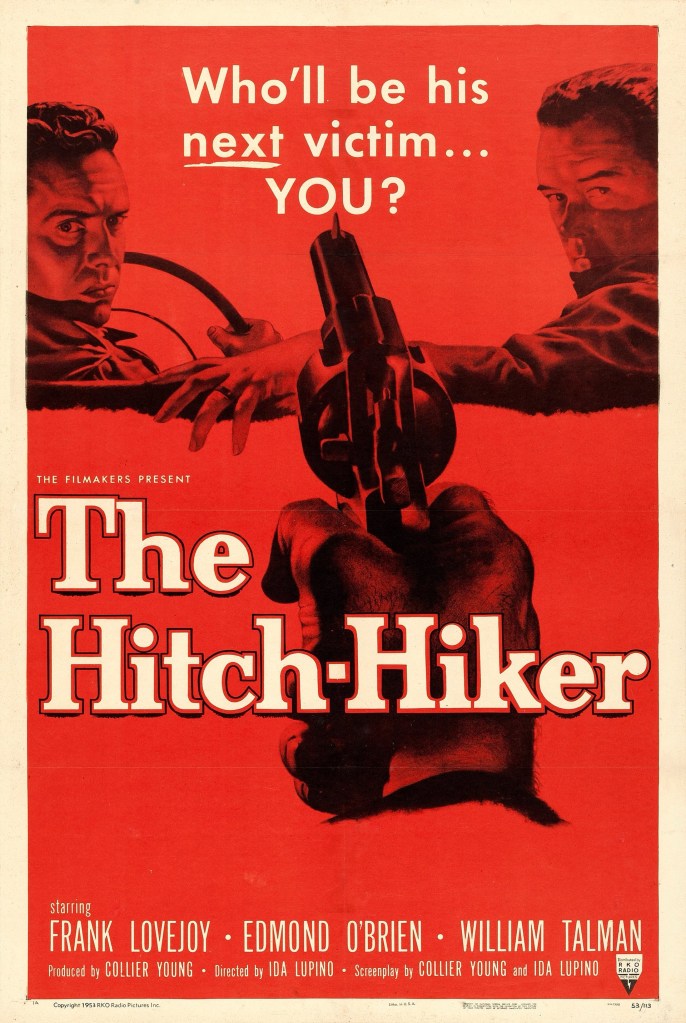
Film poster for The Hitch-Hiker (1953); directed by Ida Lupino.
In his intro or outro to this film (I can’t remember which now) on Noir Alley, Eddie Muller made the comment that it’s been said that only a woman could make a film like this at the time. I think that’s true because I think that women, despite being on the outside of the male psyche, are still the main recipient of the consequences of the decisions made by men.
Only a woman could capture the fragility behind the brand of toxic masculinity displayed by men like Emmett Myers (William Talman). It’s a masculinity that is by its very nature deeply insecure, pathologically violent, and needing constant reaffirmation of its potency. That’s why men like Myers feel the need to dominate women and (lesser, beta) men, to bring them under subjugation. It’s why rape culture exists. It’s why they ascribe characteristics of femininity to men who they read as queer or who they perceive aren’t as strong or masculine as they are. It’s a masculinity that cannot be opposed without the threat of violence, because it does not recognize consent, autonomy, or personal sovereignty, only brute force.
I would argue that this kind of masculinity is an epidemic, as serious and as deadly as any communicable disease or illness. When men like this are imbued with power of any kind, that power is abused to assuage their egos, to confirm to them their superior status. Give a man like that the nuclear codes and access to an arsenal of weapons the likes of which the world has never seen and the world holds it breath.
Based on the real-life case of Billy Cook, a hitchhiking serial killer who murdered six people, including a vacationing family of five between 1950-1951, The Hitch-Hiker follows two friends, Roy Collins (Edmond O’Brien) and Gilbert Bowen (Frank Lovejoy), who pick up a hitchhiker named Emmett Myers (William Talman) who’s recently escaped from prison. What started for them as a nice fishing trip becomes a nightmare experience that you think will never happen to you until it does.
Myers (Talman) wastes no time in pulling his gun on them and calling the shots. They drive him through the Baja California desert to Santa Rosalía, Baja California Sur, where his aim is to evade law enforcement by ferrying across the Gulf of California to Guaymas. He plays sick and sadistic mind games with them, one time making one of them shoot a tin can out of the other’s hand for sport. He takes every opportunity that presents itself to emasculate them and establish his own dominance.
This film had a profound effect on me. Props to Ida Lupino for being able to identify and articulate something that politicians and policymakers still struggle with. Edmond O’Brien, Frank Lovejoy, and William Talman all give career-defining performances here. The cinematography by Nicholas Musuraca is especially good, also among his best. The desert scenes were the best in the film. I thought I recognized the location, and Eddie Muller mentioned that it was used in other films, including High Sierra with Humphrey Bogart and Ida Lupino (cool, huh?).
The Hitch-Hiker was selected for preservation in 1998 by the United States National Film Registry. It has only grown in estimation since its release and remains an exemplar of film noir. Ida Lupino blew open the door for women filmmakers and gave them a blueprint to follow in a profession that is still (in 2026) gate-kept and dominated by men.
Thanks as always for being a faithful reader of The Voracious Cinephile. If you like what you see, please like, comment, follow, and subscribe to my email list to get notified of new posts as soon as they drop. Keep watching the world, one frame at a time.
Film poster for Black Tuesday (1954); directed by Hugo Fregonese.
Black Tuesday was Eddie Muller’s Noir Alley pick for October 18th, and I just got around to watching it. Edward G. Robinson is one of my favorite actors of all time. His ability to so completely inhabit the characters he plays while also remaining so indistinguishably himself is one of the reasons I love him so much.
Another reason is that in a career with such an expansive filmography, there’s more than a few hidden gems to be discovered. I would argue that it’s the performances of his that are less talked about that are among his best. I’m talking of course about the little-seen Two Seconds, a pre-Code crime drama from 1932 directed by Mervyn LeRoy, and The Red House, Delmer Daves’s exercise in abject terror from 1947. In both of these, we see Robinson embodying characters who, throughout the course of the film, unravel to reveal their baser selves. It is within this space of raw emotion and a naked psyche that Robinson really shines, and that can certainly be said for Black Tuesday.
Directed by Hugo Fregonese and released in 1954, Black Tuesday tells the story of Vincent Canelli (Robinson), a death-row inmate who escapes prison on the night of his execution. Note that he also played a death-row inmate in Two Seconds. As far as prison breaks go, Canelli masterminds the operation with no small amount of ingenuity. For the sake of not spoiling this aspect of the film, I’ll not say anything, but suffice it to say that I was impressed. If you’re going to be a crook, be a successful one.
Robinson’s Canelli is ruthless, cold-blooded, and misanthropic. His only vestige of humanity is seen in his love for his girlfriend, Hatti (Jean Parker), who helps him execute the details of the break. He has little regard for the feelings of others, and the end always justifies the means. He is violent for the sheer joy of it, and perhaps joy doesn’t even compute into the equation. He is violent simply because he can be, because he’s so full of hate that he can’t help but unleash it on whoever is unlucky enough to get in his way.
The supporting performances in this film really help bring it over the top, especially those of the aforementioned Jean Parker and Milburn Stone of Gunsmoke fame, who plays Father Slocum, a Catholic priest.
Thanks as always for being a faithful reader of The VoraciousCinephile. If you like what you see, please like, comment, follow, and subscribe to my email list to get notified of new posts as soon as they drop. Keep watching the world, one frame at a time.
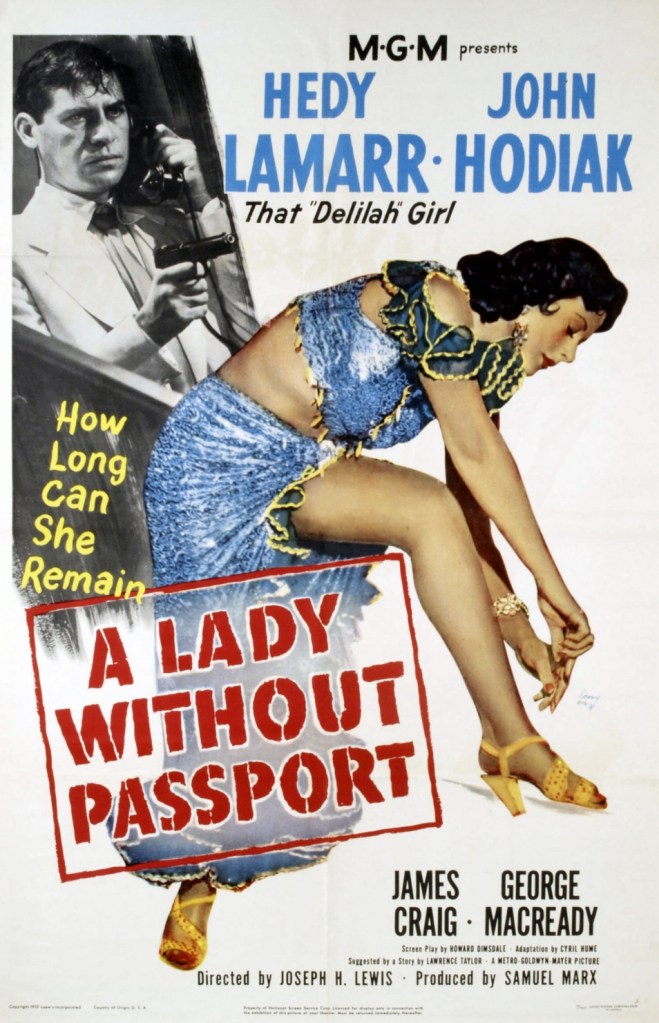
A Lady Without Passportwas the Noir Alley selection on TCM for September 14th. For those of you who are unfamiliar with Noir Alley, it is my favorite programming block on TCM (Turner Classic Movies) and it showcases films in the film noir genre. While I’ll fallen off from time to time due to work and school commitments, I’ve been a devout viewer and fan from the beginning. Eddie Muller, the host, is one of my favorite people. His encyclopedic knowledge of film noir as well as his verbose intros and outros, make him an excellent host.
I can’t exactly blame him [Lewis] for bilking the King Brothers for a chance at making a film with the bright lights, big-budget “Tiffany” studio MGM, but there’s something to be said about less money, more creative control, and the way tighter purse strings spur innovation.
One of the best things about Eddie is his straight-shooter, no-nonsense analyses. When something doesn’t quite land or is, to be frank, hot garbage with interesting window dressing, he says so. I’ve taken a few days to digest A Lady Without Passport and to be honest, it’s shocking to the system that this is the film Joseph H. Lewis made directly after Gun Crazy. I can’t exactly blame him for bilking the King Brothers for a chance at making a film with the bright lights, big-budget “Tiffany” studio MGM, but there’s something to be said about less money, more creative control, and the way tighter purse strings spur innovation.
Mostly, I’d say that I concur with what The New York Times had to say about the film*:
Romance is slightly more important than reason in this number and while the scenery, meaning Havana and Florida, is authentic and picturesque, the goings-on are as intriguing as those in any garden variety melodrama. The ring of connivers who are dedicated to smuggling aliens into this country get their come-uppance but it hardly seems worth all the effort.
I’m not disappointed I watched the movie, not least of all because John Hodiak was exceedingly handsome in the picture, but I don’t really think it bears repeat viewing either.
I’m not disappointed I watched the movie, not least of all because John Hodiak was exceedingly handsome in the picture, but I don’t really think it bears repeat viewing either. If you’re looking for a good John H. Lewis film to watch, Gun Crazyis a much better choice (and it does bear repeat viewing).
*The quote was taken froma review in The New York Times titled “Hedy Lamarr as ‘Lady Without Passport’” (linked here).
Thanks as always for being a faithful reader of The Voracious Bibliophile. If you like what you see, please like, comment, follow, and subscribe to my email list to get notified of new posts as soon as they drop. You can also email me at fred.slusher@thevoraciousbibliophile.com or catch me on Twitter, Instagram, TikTok, and Pinterest @voraciousbiblog. Keep reading the world, one page (or pixel) at a time.



 The Voracious Bibliophile