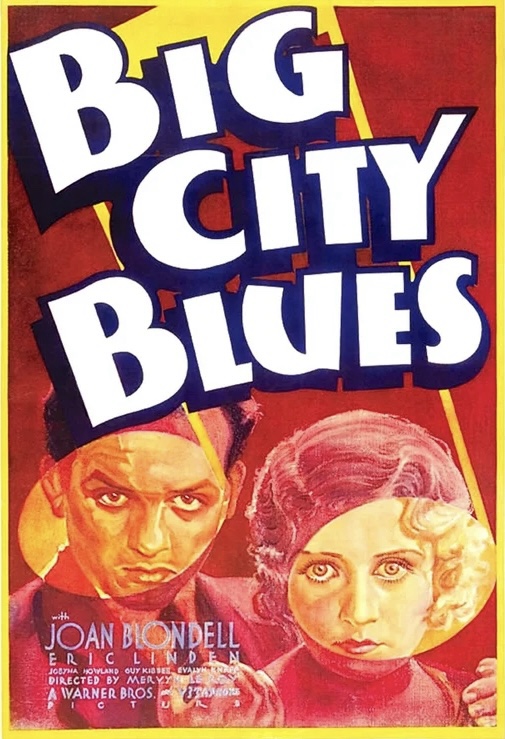
The Voracious Cinephile Film Review: Big City Blues (1932); Directed by Mervyn LeRoy

Film poster for Big City Blues (1932); directed by Mervyn LeRoy.

Big City Blues opens with Bud Reeves (Eric Linden) inheriting money from his aunt (which occurs offscreen) and buying a train ticket to New York City. Before he leaves, he entrusts care of his dog (who escaped to follow Bud to the station) to the wise old bus station clerk (Eddie Graham). The best monologue in the film comes courtesy of the clerk (Graham), who tries his best to inject a little reality into the moony-eyed youngster, all to no avail, of course. 

When Bud (Linden) gets to New York and checks into his hotel room overlooking the park, his older cousin Gibby (Walter Catlett) meets him and starts fleecing him out of his money, a little bit at a time. Gibby (Catlett) introduces him to two young ladies, Vida Fleet (Joan Blondell) and her friend Faun (Inez Courtney). Bud immediately falls head-over-heels in love with Vida (Blondell), and it appears she’s also taken with him. 

Gibby organizes a party in Bud’s hotel room, with plenty of booze flowing (all on Bud’s dime, you see) and a ragtag group of other young people (including Humphrey Bogart and Lyle Talbot in uncredited roles). A fight breaks out in which a young chorus girl named Jackie (Josephine Dunn) is accidentally killed, and the partygoers flee like cockroaches. Bud is left holding the bag, so to speak, but quickly flees. Vida goes back to the room looking for Bud but sees that he’s also gone. When she’s still in the room, Hummell (Guy Kibbee) the hotel dick discovers Jackie’s body and Vida slips out. 

Local police throw out a dragnet to snare the partygoers and get to the bottom of who killed Jackie. Bud goes in search of Vida and finally meets up with her at the 55 Club. For lack of anything better to do, the two go upstairs to gamble at dice and Bud loses what’s left of his inheritance. This is the most frustrating part of the film because why in the name of God would you gamble your fortune away when you’re facing trumped-up murder charges?! Please make it make sense. Such is the bedlam often found in so many Pre-Code classics. Anyway, a detective who’s been trailing Vida all day confronts the pair and arrests them. 

While Bud, Vida, and the other partygoers are being interrogated, Hummell (Kibbee) finds the body of Lenny (Talbot) hanging in a closet holding part of the broken bottle that matches the one found near Jackie. After accidentally killing her, he was overwhelmed with guilt (presumably) and hanged himself. Cleared of suspicion and free to go, Bud and Vida exchange a tearful goodbye. It’s insinuated that Bud will one day return for Vida, as his feelings for her are reciprocated, but he is flat broke and needs to go back home and save up money. 

The last shot of Blondell looking longingly at Bud as he’s heading to the station is perhaps the most emotion I’ve ever seen from her in a picture. There are tears welled up in her eyes, but she’s strength personified. In that brief moment, we see a woman who’s almost never had the breaks fall her way, but she’s resilient. It’s breathtaking, and a testament to her versatility as an actress. She truly was one of a kind. 

Big City Blues is streaming now on the Criterion Channel as part of the collection Gangsters, Gold Diggers, and Grifters: Mervyn LeRoy’s Pre-Code Films

Thanks as always for being a faithful reader of The Voracious Cinephile. If you like what you see, please like, comment, follow, and subscribe to my email list to get notified of new posts as soon as they drop. Keep watching the world, one frame at a time.
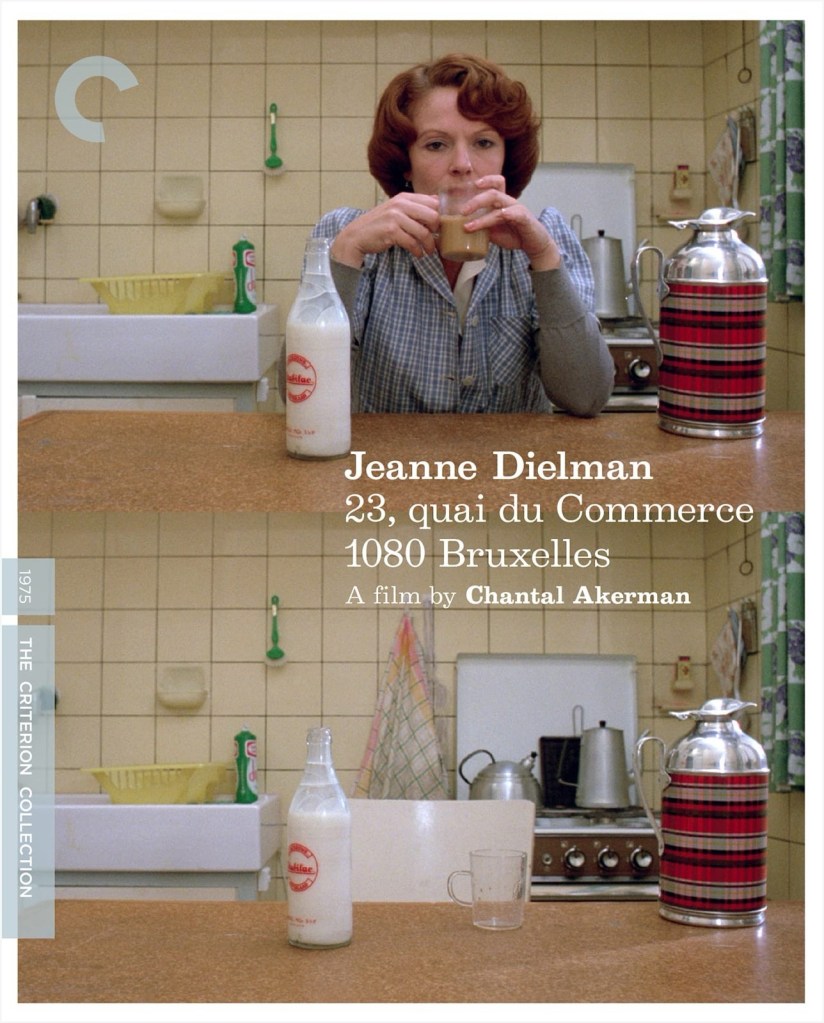

The Voracious Cinephile Film Review: Jeanne Dielman, 23, quai du Commerce, 1080 Bruxelles (1975); Directed by Chantal Akerman

Criterion Collection edition of Jeanne Dielman, 23, quai du Commerce, 1080 Bruxelles (1975); directed by Chantal Akerman.

A less astute viewer might get ten minutes into Jeanne Dielman and decide that it’s too boring to make the effort. Personally, I have no patience for this kind of viewer. People with an over-reliance on plot and dialogue have no imagination. They fail to see beyond the noise. 

One of the most brilliant aspects of this film is the fact that the viewer isn’t just invited, but coerced, into participating in Jeanne’s slow unraveling. Everything Jeanne does, every single day, is performed with precision and militaristic attention to detail. She is meticulous, structured. Even the johns who patronize her arrive on a schedule, telling her when they’ll return. 

Each frame is a painting, a still life unto itself. Her routinized existence becomes your only reality while watching, and you are therefore highly aware of the deviations that begin to appear: a missed button on a housecoat; potatoes cooked too long; the staccato bursts of forgetfulness, wherein Jeanne goes to perform one of her perfunctory tasks and loses herself in what she was doing. These things would mean nothing in a film with more noise, with a character we didn’t know as well. By the time these disruptions begin and the cracks in the facade become apparent, we know Jeanne very well. Perhaps better than she knows herself, if we may be so bold. And so comes the unraveling. 

Each frame is a painting, a still life unto itself.

It’s deeply unsettling, and an actress with less talent wouldn’t be able to pull off what Seyrig does here. There are probably fewer than five pages of dialogue in the entire three-plus hour runtime, so her entire performance is one of intense interiority, an almost unfathomable becoming. 

If you’ve tried to watch this film in the past and not been able to make it through it, I implore you to give it another shot. Wake up really early in the morning with nothing else on your schedule, no tasks or chores to distract you. Ensure your notifications are turned off, better yet put your phone on silent in another room. Immerse yourself in this intense exercise of concentrated empathy, and I dare you to remain unchanged.

There are probably fewer than five pages of dialogue in the entire three-plus hour runtime, so her entire performance is one of intense interiority, an almost unfathomable becoming. 

Jeanne Dielman, 23, quai du Commerce, 1080 Bruxelles is available to buy from the Criterion Collection wherever their films are available. It is also available to stream on The Criterion Channel here.

Thanks as always for being a faithful reader of The Voracious Cinephile. If you like what you see, please like, comment, follow, and subscribe to my email list to get notified of new posts as soon as they drop. Keep watching the world, one frame at a time.

Criterion Collection: My Personal Top 10: Purple Noon

Logo for The Criterion Collection

For cinephiles everywhere, The Criterion Collection represents the best that cinema has to offer. From the Silent Era to the Golden Age of Hollywood and beyond, The Criterion Collection selects only films that are groundbreaking, feature powerhouse performances, are technically astute, and/or have otherwise had a significant impact on the culture at large. According to their Mission, Criterion “has maintained its pioneering commitment to presenting each film as its maker would want it seen, in state-of-the-art restorations with special features designed to encourage repeated watching and deepen the viewer’s appreciation of the art of film.” (Full Mission available here)

One of the regular features on Criterion’s website is its Top 10 Lists, wherein filmmakers, musicians, writers, and other artists share their favorite films available in Criterion Collection editions. Along those lines, I thought it would be cool if I shared my (current) personal Top 10 with everyone who reads this blog. I am not going to present them in a ranked order because picking a favorite film is like trying to pick a favorite potato dish and that’s just not possible.

Purple Noon (1960); directed by
René Clément

It seems appropriate to highlight Purple Noon first, not just because it’s a terrific film, but because Alain Delon, the star of the film, just recently passed on August 18th at the age of 88. He was one of the greatest French actors to ever grace the screen. An argument can be made that he be given the superlative title of The Greatest French Actor of All Time. He had a charisma and a vitality that are rarely seen and when they are, they are rarely accompanied by the level of talent he displayed in front of a camera.

He [Alain Delon] had a charisma and a vitality that are rarely seen and when they are, they are rarely accompanied by the level of talent he displayed in front of a camera.

Purple Noon is adapted from The Talented Mr. Ripley, the first book in the Ripley series by Patricia Highsmith. The book has been adapted several times, first as an episode of the U.S. television anthology series Studio One, then the French/Italian co-production of Purple Noon, and so on. I won’t go into details on any of the other adaptations, not least of all because I haven’t seen them (yet).

The most gripping aspect of Purple Noon, aside from Delon’s sheer animal magnetism, is the lush and saturated cinematography. The colors in this film are breathtaking, and no one watching it could call it anything but beautiful. If they could, don’t trust them. You don’t want friends with that kind of taste, or lack thereof.

The most gripping aspect of Purple Noon, aside from Delon’s sheer animal magnetism, is the lush and saturated cinematography. The colors in this film are breathtaking, and no one watching it could call it anything but beautiful.

The Criterion Collection edition of Purple Noon is the newest (as of this writing) digital restoration of the film, with an uncompressed monaural soundtrack. All of the extras included add to the viewer’s appreciation of the film, but I particularly enjoyed the archival interviews with Alain Delon and Patricia Highsmith, who in addition to The Talented Mr. Ripley is also the author of Carol (or The Price of Salt) and Strangers on a Train, which both also boast excellent cinematic adaptations.

Check back soon for the rest of my Top 10 Criterion Collection picks!

Thanks as always for being a faithful reader of The Voracious Bibliophile. If you like what you see, please like, comment, follow, and subscribe to my email list to get notified of new posts as soon as they drop. You can also email me at fred.slusher@thevoraciousbibliophile.com or catch me on Twitter, Instagram, TikTok, and Pinterest @voraciousbiblog. Keep reading the world, one page (or pixel) at a time.