

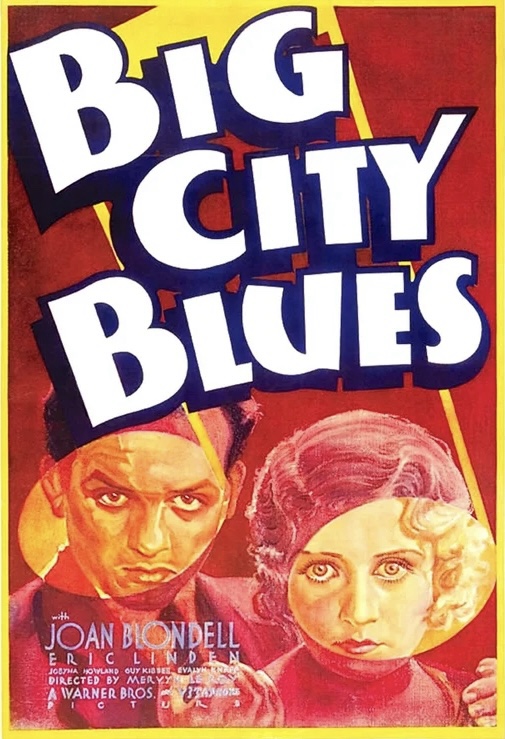
Big City Blues opens with Bud Reeves (Eric Linden) inheriting money from his aunt (which occurs offscreen) and buying a train ticket to New York City. Before he leaves, he entrusts care of his dog (who escaped to follow Bud to the station) to the wise old bus station clerk (Eddie Graham). The best monologue in the film comes courtesy of the clerk (Graham), who tries his best to inject a little reality into the moony-eyed youngster, all to no avail, of course.
When Bud (Linden) gets to New York and checks into his hotel room overlooking the park, his older cousin Gibby (Walter Catlett) meets him and starts fleecing him out of his money, a little bit at a time. Gibby (Catlett) introduces him to two young ladies, Vida Fleet (Joan Blondell) and her friend Faun (Inez Courtney). Bud immediately falls head-over-heels in love with Vida (Blondell), and it appears she’s also taken with him.
Gibby organizes a party in Bud’s hotel room, with plenty of booze flowing (all on Bud’s dime, you see) and a ragtag group of other young people (including Humphrey Bogart and Lyle Talbot in uncredited roles). A fight breaks out in which a young chorus girl named Jackie (Josephine Dunn) is accidentally killed, and the partygoers flee like cockroaches. Bud is left holding the bag, so to speak, but quickly flees. Vida goes back to the room looking for Bud but sees that he’s also gone. When she’s still in the room, Hummell (Guy Kibbee) the hotel dick discovers Jackie’s body and Vida slips out.
Local police throw out a dragnet to snare the partygoers and get to the bottom of who killed Jackie. Bud goes in search of Vida and finally meets up with her at the 55 Club. For lack of anything better to do, the two go upstairs to gamble at dice and Bud loses what’s left of his inheritance. This is the most frustrating part of the film because why in the name of God would you gamble your fortune away when you’re facing trumped-up murder charges?! Please make it make sense. Such is the bedlam often found in so many Pre-Code classics. Anyway, a detective who’s been trailing Vida all day confronts the pair and arrests them.
While Bud, Vida, and the other partygoers are being interrogated, Hummell (Kibbee) finds the body of Lenny (Talbot) hanging in a closet holding part of the broken bottle that matches the one found near Jackie. After accidentally killing her, he was overwhelmed with guilt (presumably) and hanged himself. Cleared of suspicion and free to go, Bud and Vida exchange a tearful goodbye. It’s insinuated that Bud will one day return for Vida, as his feelings for her are reciprocated, but he is flat broke and needs to go back home and save up money.
The last shot of Blondell looking longingly at Bud as he’s heading to the station is perhaps the most emotion I’ve ever seen from her in a picture. There are tears welled up in her eyes, but she’s strength personified. In that brief moment, we see a woman who’s almost never had the breaks fall her way, but she’s resilient. It’s breathtaking, and a testament to her versatility as an actress. She truly was one of a kind.
Big City Blues is streaming now on the Criterion Channel as part of the collection Gangsters, Gold Diggers, and Grifters: Mervyn LeRoy’s Pre-Code Films.
Thanks as always for being a faithful reader of The Voracious Cinephile. If you like what you see, please like, comment, follow, and subscribe to my email list to get notified of new posts as soon as they drop. Keep watching the world, one frame at a time.

 The Voracious Bibliophile