Film poster for Hallelujah (1929); directed by King Vidor.
Review
“Excuse me, Missy Rose, but it looks like the devil’s in me tonight.” – Zeke
Though not without its valid criticisms (for its racial stereotypes, chiefly), Hallelujah was a landmark for Black representation on film. And to reduce it to its stereotypes would do a great disservice to the cast and (racially-mixed) production crew, because all in all Hallelujah is a remarkable film. Nina Mae McKinney is especially delightful, and it’s a shame she didn’t get the same opportunities as white actresses of the time, because she was able to do comedy and drama equally well.
You can see the spiritual transformation play out on her face and in her body language.
Nina Mae McKinney as Chick in Hallelujah.
My favorite scene in the entire film is when Chick (Nina Mae McKinney) is listening to Zeke’s (Daniel L. Haynes) passionate sermon and goes from scornful to deeply moved. You can see the spiritual transformation play out on her face and in her body language. She’s a phenomenal actress with a vivaciousness and physicality that she makes look easy, while the opposite is true.
Hallelujahis available to stream for free on Tubi and is also available to own on DVD.
Thanks as always for being a faithful reader of The Voracious Cinephile. If you like what you see, please like, comment, follow, and subscribe to my email list to get notified of new posts as soon as they drop. Keep watching the world, one frame at a time.
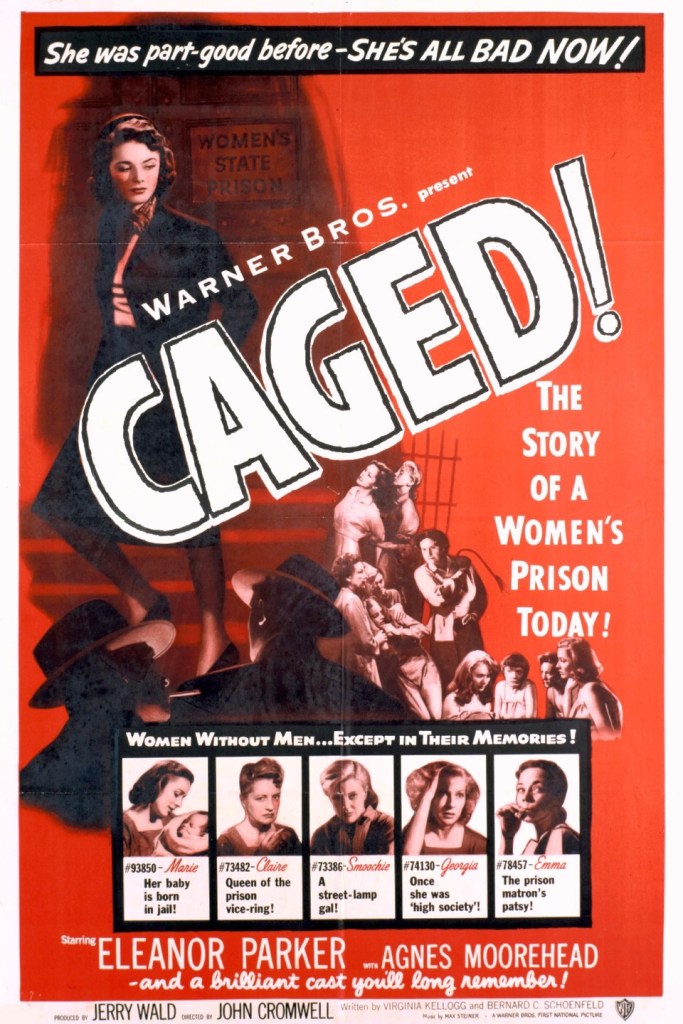
Film poster for Caged (1950); directed by John Cromwell.
Review
This is your warning that there are spoilers ahead. If you don’t want any of the plot of Caged spoiled, stop reading now until you’ve seen the film.
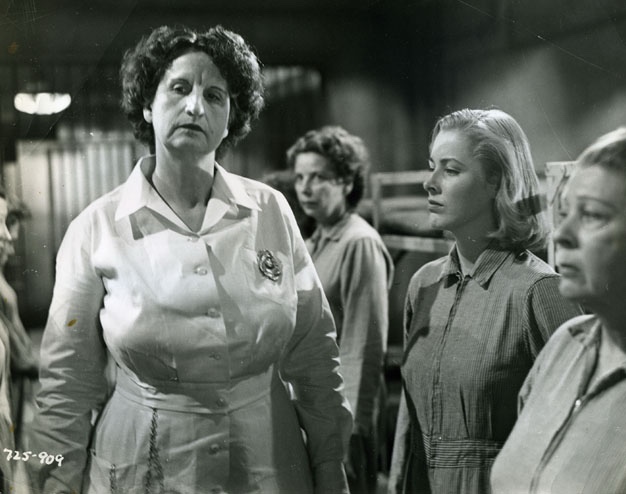
What a delicious, delightful treat this movie is. Hope Emerson is the ultimate screen baddie, and this is the meatiest role she ever got as prison matron Evelyn Harper. Emerson’s Evelyn is queer-coded to the nines, and there’s very little subtext. We love Evil Gays.
We love Evil Gays.
Hope Emerson (farthest left) as women’s prison matron Evelyn Harper. Image subject to copyright.
Eleanor Parker makes the biggest transformation of any of the characters in the film, going from a doe-eyed ingenue to a hardened criminal after losing her baby to adoption and finding out that the system is designed to keep her incarcerated, not help her transition to life on the outside.
Agnes Moorehead plays a rare sympathetic role as prison superintendent Ruth Benton, a no-nonsense but very caring woman who works overtime in the cruel and corrupt system to make her prison a place for rehabilitation and healing, not punishment and brutality.
Last but certainly not least, Betty Garde’s character Kitty Stark reminds one of Kate Mulgrew’s Red in Netflix’s Orange Is the New Black, so much so that one wonders if Mulgrew took inspiration from Garde. Garde as Kitty Stark is sardonic and hardened, but not unfeeling. She’s someone who’s had to play the cards she’s dealt, and she makes no apology for it. Seeing Evelyn break her is heartbreaking. But she gets what’s coming to her, thank God!
Cagedis streaming now on Watch TCM and was recently featured on Eddie Muller’s Noir Alley programming block on the channel.
Thanks as always for being a faithful reader of The Voracious Cinephile. If you like what you see, please like, comment, follow, and subscribe to my email list to get notified of new posts as soon as they drop. Keep watching the world, one frame at a time.
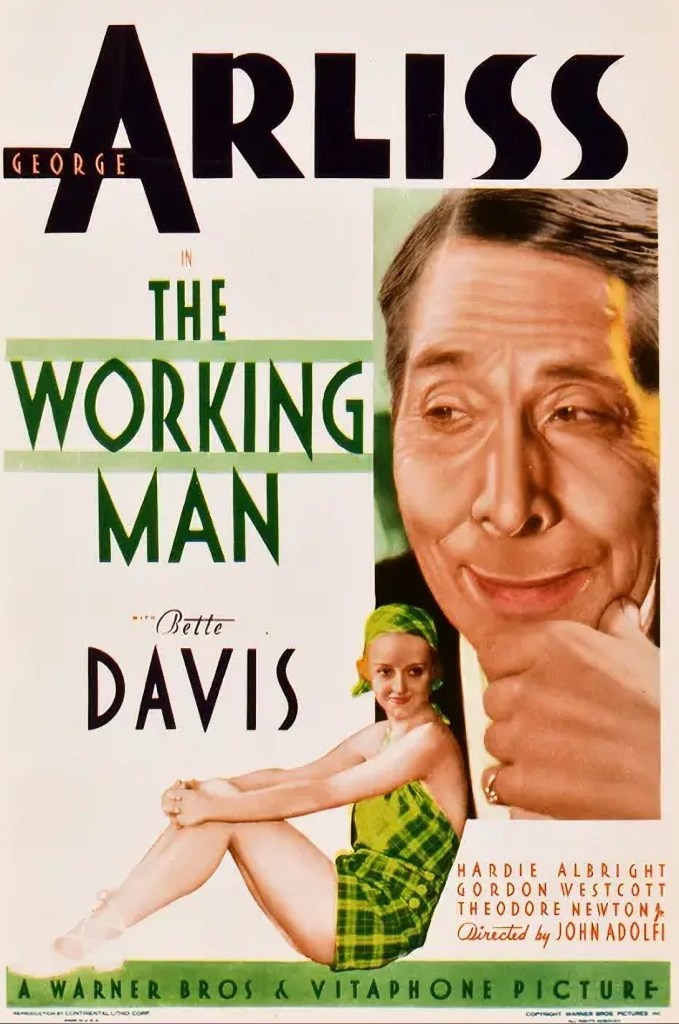
Film poster for The Working Man(1933); directed by John G. Adolfi.
The Working Manis a delightful, utterly charming Pre-Code comedy helmed by George Arliss and Bette Davis, with supporting performances by Theodore Newton, Hardie Albright (who is absolutely adorable here), and Gordon Westcott.
Arliss stars as John Reeves, a shoe magnate cut from the same cloth as Phil Knight. He runs his ship with an iron fist, insisting on growth and excellence despite the challenges of the Great Depression. His only competition comes from his former best friend Tom Hartland, who also owns a shoe company. At the start of the film, Reeves is beside himself because his firm is losing sales to Hartland, despite the purported superiority of the Reeves shoes.
When Hartland unexpectedly dies, Reeves experiences a bevy of complicated feelings. Despite their rivalry, they were once friends and he didn’t hold any real malice toward the man, despite the fact that Hartland had married the love of his life and he had remained a confirmed bachelor ever since.
At the prodding of his nephew, who is also the company’s general manager, he goes on a fishing trip to see an old friend in Maine. Coincidentally, their fishing expedition is interrupted by the mooring of a yacht full of carousing rabble-rousers. The yacht, it turns out, is owned by the Hartland heirs, the son and daughter (played by Theodore Newton and Bette Davis) of his recently deceased former friend. He becomes friendly with them and leaves his friend’s fishing boat to join them on their yacht to play cards.
At first, his intentions are to be nosy and size up his competition, but he quickly learns that the two youngsters have been burning the candle at both ends and squandering the fortune their father worked his entire life to amass for their comfort. It doesn’t help that the company is being terrible mismanaged (maliciously) by Fred Pettison, whom their father had trusted. He surmises that he plans to drive the company into the ground and buy it at a bargain so he can reinvigorate it and make himself rich. When he calls his lawyer to facilitate an offer for the company, Pettison summarily rejects it without evening bringing it to the Hartland siblings.
His suspicions confirmed, Reeves, feeling paternally toward the young man and woman, finagles his way into becoming a trustee and sets about straightening them out and teaching them about business, money, and life itself.
The irony is delicious here, because you watch Arliss as Reeves work overtime to make his competitor a success again, behind the back of his nephew and under an alias to the Hartland siblings.
As with any tale involving assumed identities and dirty business dealings (on Pettison’s part, that is), the house of cards eventually comes tumbling down. The resolution, which is rather predictable, is no less enjoyable to behold.
Bette Davis and George Arliss in a still from The Working Man.
This film was made early in Bette Davis’s career, when it was still not apparent to Warner Bros. what she was capable of. Still, even though she’s underutilized, she turns in a good performance. While she would become known for her saucy melodramas, it’s fun to see her in a lighthearted comedy (and as a blonde, no less).
The Working Manis now streaming on Watch TCM and is available to own on DVD through the Warner Archive Collection.
Thanks as always for being a faithful reader of The Voracious Cinephile. If you like what you see, please like, comment, follow, and subscribe to my email list to get notified of new posts as soon as they drop. Keep watching the world, one frame at a time.
Oh, but anyway, Toto, we’re home. Home! And this is my room, and you’re all here. And I’m not gonna leave here ever, ever again, because I love you all, and – oh, Auntie Em – there’s no place like home!
Thanks as always for being a faithful reader of The Voracious Bibliophile. If you like what you see, please like, comment, follow, and subscribe to my email list to get notified of new posts as soon as they drop. You can also email me at fred.slusher@thevoraciousbibliophile.com or catch me on Twitter, Instagram, TikTok, and Pinterest @voraciousbiblog. Keep reading the world, one page (or pixel) at a time.






 The Voracious Bibliophile