Thanks as always for being a faithful reader of The Voracious Bibliophile. If you like what you see, please like, comment, follow, and subscribe to my email list to get notified of new posts as soon as they drop. You can also email me at fred.slusher@thevoraciousbibliophile.com or catch me on Twitter, Instagram, TikTok, and Pinterest @voraciousbiblog. Keep reading the world, one page (or pixel) at a time.
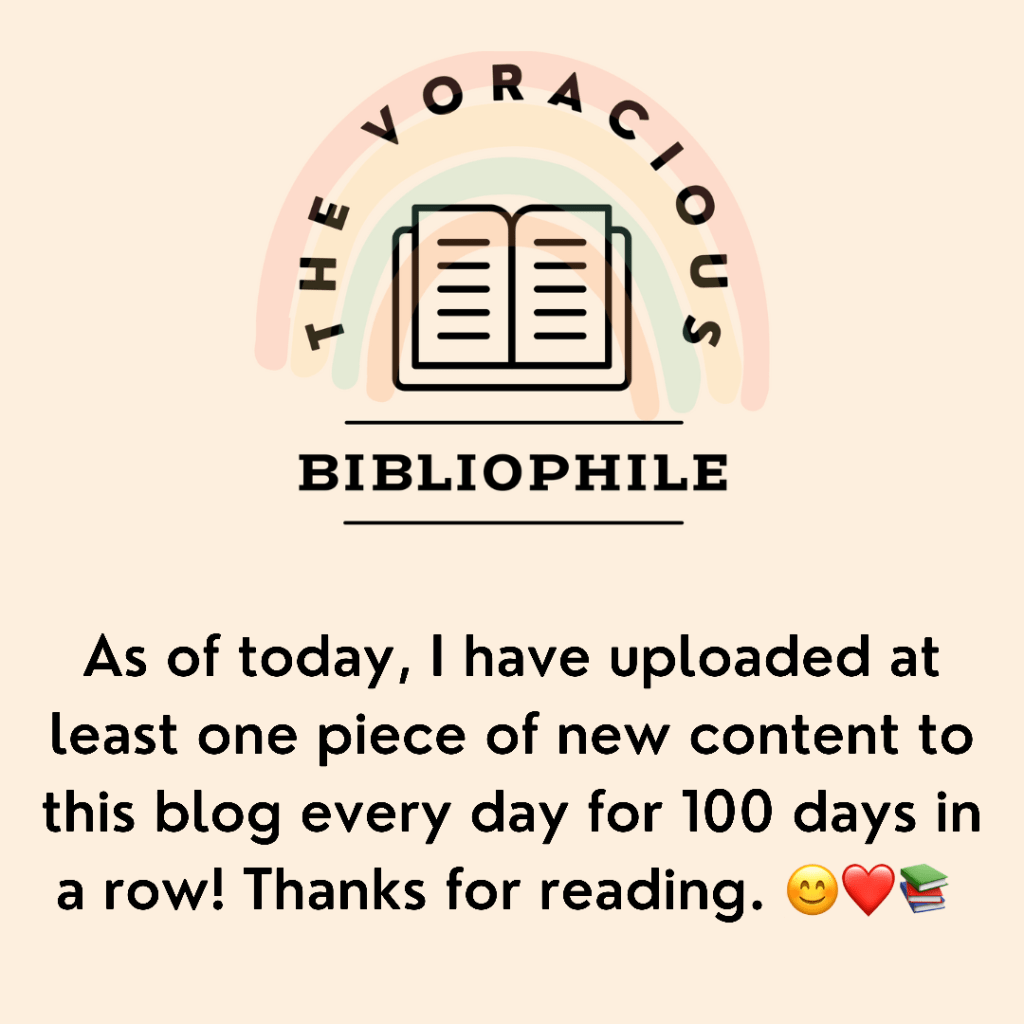
I’ve said this before, but I truly can’t remember what my life was like before I started The Voracious Bibliophile. Today made the 100th day in a row that I’ve posted at least one new piece of content to my blog. My intention was to start a blog but it quickly turned into a brand. I’d like to give a huge thank you to everyone who has read this blog and amplified its reach. You have my love and appreciation forever.
Thanks as always for being a faithful reader of The Voracious Bibliophile. If you like what you see, please like, comment, follow, and subscribe to my email list to get notified of new posts as soon as they drop. You can also email me at fred.slusher@thevoraciousbibliophile.com or catch me on Twitter, Instagram, TikTok, and Pinterest @voraciousbiblog. Keep reading the world, one page (or pixel) at a time.
On February 7, 1979, Pluto crossed over Neptune’s orbit and became the eighth planet from the sun for twenty years. A study in 1988 determined that Pluto’s path of orbit could never be accurately predicted. Labeled as “chaotic,” Pluto was later discredited from planet status in 2006.
Today, I broke your solar system. Oops. My bad. Your graph said I was supposed to make a nice little loop around the sun.
Naw.
I chaos like a motherfucker. Ain’t no one can chart me. All the other planets, they think I’m annoying. They think I’m an escaped moon, running free.
Fuck your moon. Fuck your solar system. Fuck your time. Your year? Your year ain’t shit but a day to me. I could spend your whole year turning the winds in my bed. Thinking about rings and how Jupiter should just pussy on up and marry me by now. Your day?
That’s an asswipe. A sniffle. Your whole day is barely the start of my sunset.
My name means hell, bitch. I am hell, bitch. All the cold you have yet to feel. Chaos like a motherfucker. And you tried to order me. Called me ninth. Somewhere in the mess of graphs and math and compass you tried to make me follow rules. Rules? Fuck your rules. Neptune, that bitch slow. And I deserve all the sun I can get, and all the blue-gold sky I want around me.
It is February 7th, 1979 and my skin is more copper than any sky will ever be. More metal. Neptune is bitch-sobbing in my rearview, and I got my running shoes on and all this sky that’s all mine.
Fuck your order. Fuck your time. I realigned the cosmos. I chaosed all the hell you have yet to feel. Now all your kids in the classrooms, they confused. All their clocks: wrong. They don’t even know what the fuck to do. They gotta memorize new songs and shit. And the other planets, I fucked their orbits. I shook the sky. Chaos like a motherfucker.
It is February 7th, 1979. The sky is blue-gold: the freedom of possibility.
“Pluto Shits on the Universe” is now probably in my top ten favorite poems of all time. I love Asghar’s irreverence here, the way she plays with the multiple meanings of certain words. Consider this part of the poem:
My name means hell, bitch. I am hell, bitch. All the cold you have yet to feel. Chaos like a motherfucker. And you tried to order me. Called me ninth.
Order here conveys certain ideas singularly and in conjunction with one another:
Order as “a state in which everything is in its correct or appropriate place”.*
Order as “the arrangement or disposition of people or things in relation to each other according to a particular sequence, pattern, or method”.”
Order as “an authoritative command, direction, or instruction”.*
Order as the opposite of Chaos, in Chaos Theory, which is “an interdisciplinary theory and branch of mathematics focusing on the study of chaos: dynamical systems whose apparently random states of disorder and irregularities are actually governed by underlying patterns and deterministic laws that are highly sensitive to initial conditions”.**
*Definition taken from Oxford Languages
**Definition taken from Wikipedia
There is the forced classification, the imposition of hierarchies, the reification of unnatural (human-made) systems, and the stark dismissal of them all.
Chaos like a motherfucker. / And you tried to order me. Called me ninth. There is an acknowledgment of the would-be controlling outside power and its unequivocal rejection. There is the forced classification, the imposition of hierarchies, the reification of unnatural (human-made) systems, and the stark dismissal of them all.
Today, I broke your solar system. Oops. My bad. Y’all. That slaps.
Fatimah Asghar Recites Her Poem, “Pluto Shits on the Universe”
You can learn more about Fatimah Asghar and her work at her website. Her debut poetry collection, If They Come for Us: Poems, was published by One World in August 2018 and is available to purchase wherever books are sold.
Thanks as always for being a faithful reader of The Voracious Bibliophile. If you like what you see, please like, comment, follow, and subscribe to my email list to get notified of new posts as soon as they drop. You can also email me at fred.slusher@thevoraciousbibliophile.com or catch me on Twitter, Instagram, TikTok, and Pinterest @voraciousbiblog. Keep reading the world, one page (or pixel) at a time.
Yeah, it’s not easy to make big changes, but you don’t get what you don’t fight for.
Elizabeth Warren
Thanks as always for being a faithful reader of The Voracious Bibliophile. If you like what you see, please like, comment, follow, and subscribe to my email list to get notified of new posts as soon as they drop. You can also email me at fred.slusher@thevoraciousbibliophile.com or catch me on Twitter, Instagram, TikTok, and Pinterest @voraciousbiblog. Keep reading the world, one page (or pixel) at a time.
Hymn to Intellectual Beauty by Percy Bysshe Shelley
The awful shadow of some unseen Power
         Floats though unseen among us; visiting
         This various world with as inconstant wing
As summer winds that creep from flower to flower;
Like moonbeams that behind some piny mountain shower,
                It visits with inconstant glance
                Each human heart and countenance;
Like hues and harmonies of evening,
                Like clouds in starlight widely spread,
                Like memory of music fled,
                Like aught that for its grace may be
Dear, and yet dearer for its mystery.

Spirit of BEAUTY, that dost consecrate
         With thine own hues all thou dost shine upon
         Of human thought or form, where art thou gone?
Why dost thou pass away and leave our state,
This dim vast vale of tears, vacant and desolate?
                Ask why the sunlight not for ever
                Weaves rainbows o'er yon mountain-river,
Why aught should fail and fade that once is shown,
                Why fear and dream and death and birth
                Cast on the daylight of this earth
                Such gloom, why man has such a scope
For love and hate, despondency and hope?

No voice from some sublimer world hath ever
         To sage or poet these responses given:
         Therefore the names of Demon, Ghost, and Heaven,
Remain the records of their vain endeavour:
Frail spells whose utter'd charm might not avail to sever,
                From all we hear and all we see,
                Doubt, chance and mutability.
Thy light alone like mist o'er mountains driven,
                Or music by the night-wind sent
                Through strings of some still instrument,
                Or moonlight on a midnight stream,
Gives grace and truth to life's unquiet dream.

Love, Hope, and Self-esteem, like clouds depart
         And come, for some uncertain moments lent.
         Man were immortal and omnipotent,
Didst thou, unknown and awful as thou art,
Keep with thy glorious train firm state within his heart.
                Thou messenger of sympathies,
                That wax and wane in lovers' eyes;
Thou, that to human thought art nourishment,
                Like darkness to a dying flame!
                Depart not as thy shadow came,
                Depart not—lest the grave should be,
Like life and fear, a dark reality.

While yet a boy I sought for ghosts, and sped
         Through many a listening chamber, cave and ruin,
         And starlight wood, with fearful steps pursuing
Hopes of high talk with the departed dead.
I call'd on poisonous names with which our youth is fed;
                I was not heard; I saw them not;
                When musing deeply on the lot
Of life, at that sweet time when winds are wooing
                All vital things that wake to bring
                News of birds and blossoming,
                Sudden, thy shadow fell on me;
   I shriek'd, and clasp'd my hands in ecstasy!

I vow'd that I would dedicate my powers
         To thee and thine: have I not kept the vow?
         With beating heart and streaming eyes, even now
I call the phantoms of a thousand hours
Each from his voiceless grave: they have in vision'd bowers
                Of studious zeal or love's delight
                Outwatch'd with me the envious night:
They know that never joy illum'd my brow
                Unlink'd with hope that thou wouldst free
                This world from its dark slavery,
                That thou, O awful LOVELINESS,
Wouldst give whate'er these words cannot express.

The day becomes more solemn and serene
         When noon is past; there is a harmony
         In autumn, and a lustre in its sky,
Which through the summer is not heard or seen,
As if it could not be, as if it had not been!
                Thus let thy power, which like the truth
                Of nature on my passive youth
Descended, to my onward life supply
                Its calm, to one who worships thee,
                And every form containing thee,
                Whom, SPIRIT fair, thy spells did bind
To fear himself, and love all human kind.
Thanks as always for being a faithful reader of The Voracious Bibliophile. If you like what you see, please like, comment, follow, and subscribe to my email list to get notified of new posts as soon as they drop. You can also email me at fred.slusher@thevoraciousbibliophile.com or catch me on Twitter, Instagram, TikTok, and Pinterest @voraciousbiblog. Keep reading the world, one page (or pixel) at a time.
It took me quite a long time to develop a voice and now that I have it, I’m not going to be silent.
Madeleine Albright
Thanks as always for being a faithful reader of The Voracious Bibliophile. If you like what you see, please like, comment, follow, and subscribe to my email list to get notified of new posts as soon as they drop. You can also email me at fred.slusher@thevoraciousbibliophile.com or catch me on Twitter, Instagram, TikTok, and Pinterest @voraciousbiblog. Keep reading the world, one page (or pixel) at a time.
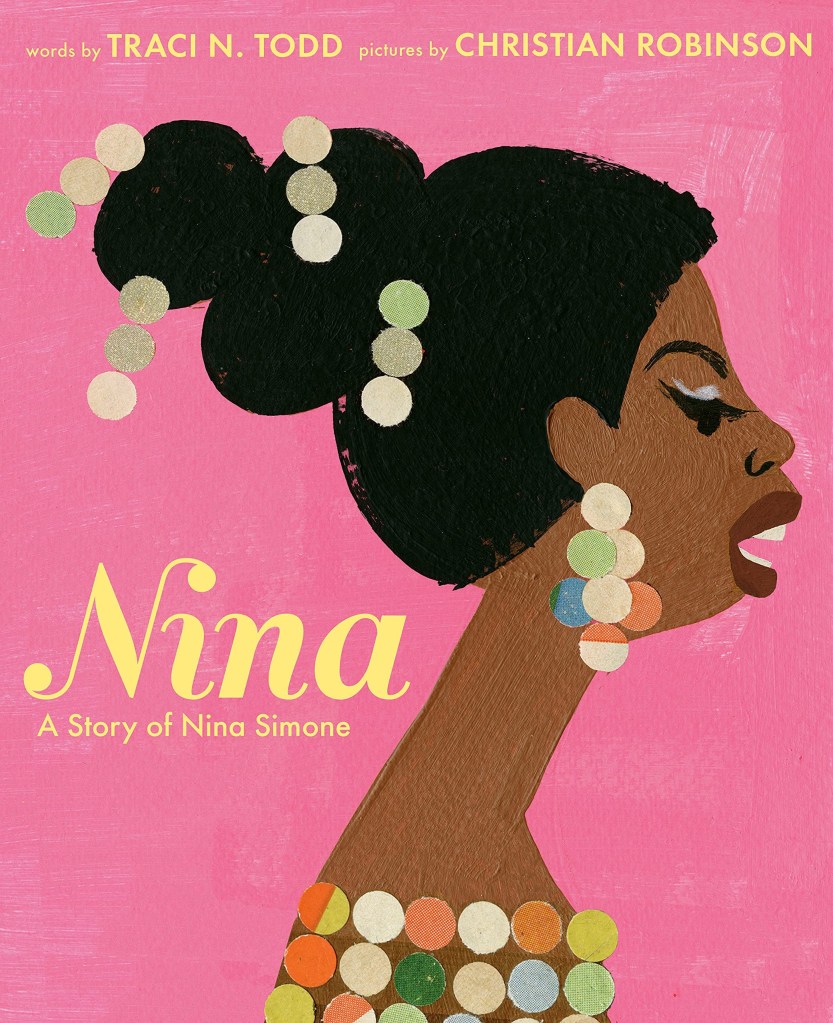
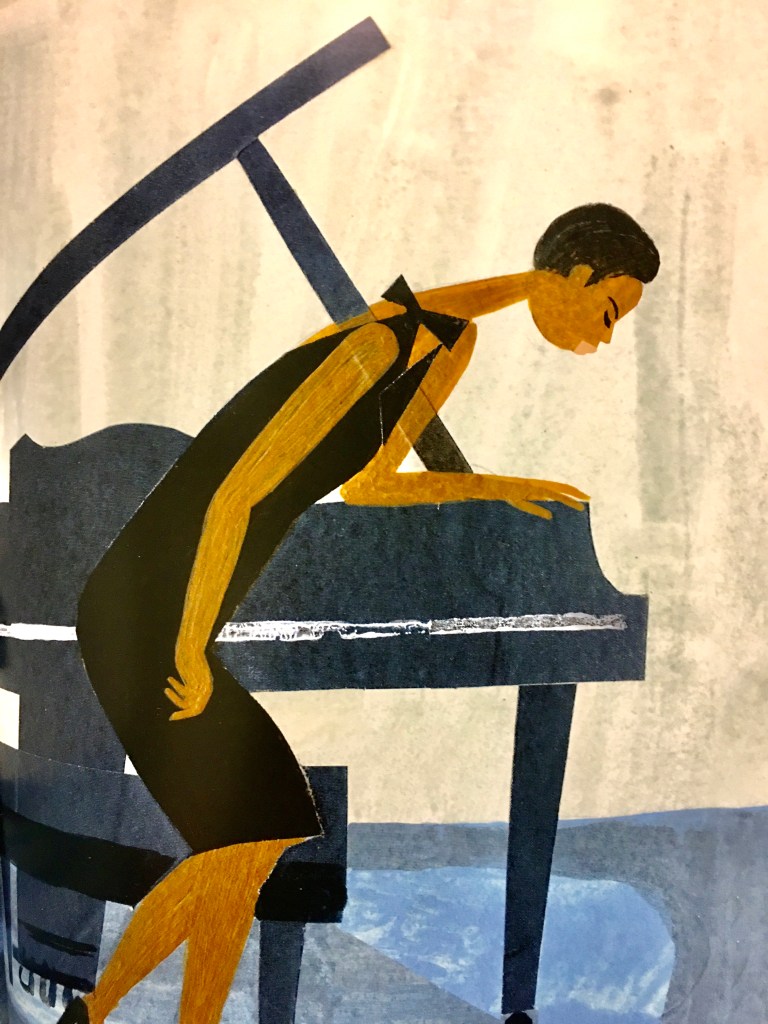
Nina: A Story of Nina Simone by Traci N. Todd (Words) and Christian Robinson (Pictures)
Stars when you shine
You know how I feel
“Feeling Good” by Nina Simone
The first thing that caught my eye when I picked up Nina was the familiar art style on the cover. I wracked my brain trying to remember where I’d seen it before, and all of a sudden it came to me: Christian Robinson had also done the artwork for Josephine, Patricia Hruby Powell’s pictorial biography of Josephine Baker, another Black woman performer who spat in the faces of her detractors and will forever be remembered as an iconoclast. Then I did some research and discovered that I’ve read and enjoyed several books featuring Robinson’s illustrations in addition to Nina and Josephine: You Matter, Antoinette, School’s First Day of School, Leo: A Ghost Story, Last Stop on Market Street, and Gaston.
One thing that holds true throughout history is that white supremacist racists can’t stand Black excellence.
One thing that holds true throughout history is that white supremacist racists can’t stand Black excellence. It cows them and forces them to confront their own inadequacies. Nina Simone is a quintessential example of that.
Nina Simone at Amsterdam Airport Schiphol inMarch 1969. Made available under the Creative Commons CC0 1.0 Universal Public Domain Dedication.
Eunice Kathleen Waymon, the little girl who would grow up to become Nina Simone, was born the sixth of eight children on February 21st, 1933. Her mother was a Methodist minister and housekeeper. Her father was a handyman who at one time owned a dry-cleaning business and who unfortunately suffered from bouts of ill health. Little Eunice showed signs of genius at an early age, displaying a seemingly preternatural talent for music that far exceeded what anyone could possibly have expected from such a small child. The music seemed to come from somewhere deep inside her, flowing from a secret river only she could access.
The music seemed to come from somewhere deep inside her, flowing from a secret river only she could access.
Eunice’s mother only allowed her to play hymns and other church music, but her father surreptitiously introduced her to the wonders of jazz. Her personal favorite composer grew to be Johann Sebastian Bach, whose compositions started off soft and crescendoed into a passionate fervor, which reminded Eunice of the rhythms of her mother’s preaching.
Since preaching didn’t pay all the bills, Eunice’s mother also worked as a housekeeper. One of the white women whose house Eunice’s mother cleaned learned of Eunice’s gift on the piano, and along with Eunice’s mother, endeavored to do anything in her power to help the little girl receive the best training possible and reach a wider audience with her music.
Because of the kind of music heard in these establishments and the predilections of the clientele, Eunice had to adopt a nom de plume to keep her family from learning of her moonlighting gigs. Thus Nina Simone was born.
Their efforts more than paid off when Eunice was accepted into the Juilliard School of Music. Afterwards, she also applied for a scholarship to the Curtis Institute of Music in Philadelphia. She was denied admission and started playing in jazz bars in Atlantic City to earn money. She mostly did this so she could continue studying with private tutors and further her classical education. No matter what she did, Eunice kept her eyes focused on improving her craft, which in my opinion is one of the main hallmarks of a true artist.
Because of the kind of music heard in these establishments and the predilections of the clientele, Eunice had to adopt a nom de plume to keep her family from learning of her moonlighting gigs. Thus Nina Simone was born.
From @theartoffun (Christian Robinson) on Instagram
The proprietors of the establishments Ms. Simone played in insisted she sing as well as play. Nina had never before thought of herself as a singer, being trained as a classical pianist from the time her legs were too short to touch the floor as she played. But if they wanted her to sing, then sing she would.
However, following the assassination of civil rights activist Medgar Evers in Jackson, Mississippi in June 1963 and the bombing of the 16th Street Baptist Church which killed four young Black girls in Birmingham, Alabama that September, Nina had finally had enough.
Soon after she started singing to accompany herself on piano in Atlantic City bars, she catapulted into the spotlight. From 1958-1974, Ms. Simone recorded more than 40 albums and captivated audiences in performances all over the world. She still felt the sting of anti-Black racism but for a long time chose not to use her platform for activism. However, following the assassination of civil rights activist Medgar Evers in Jackson, Mississippi in June 1963 and the bombing of the 16th Street Baptist Church which killed four young Black girls in Birmingham, Alabama that September, Nina had finally had enough.
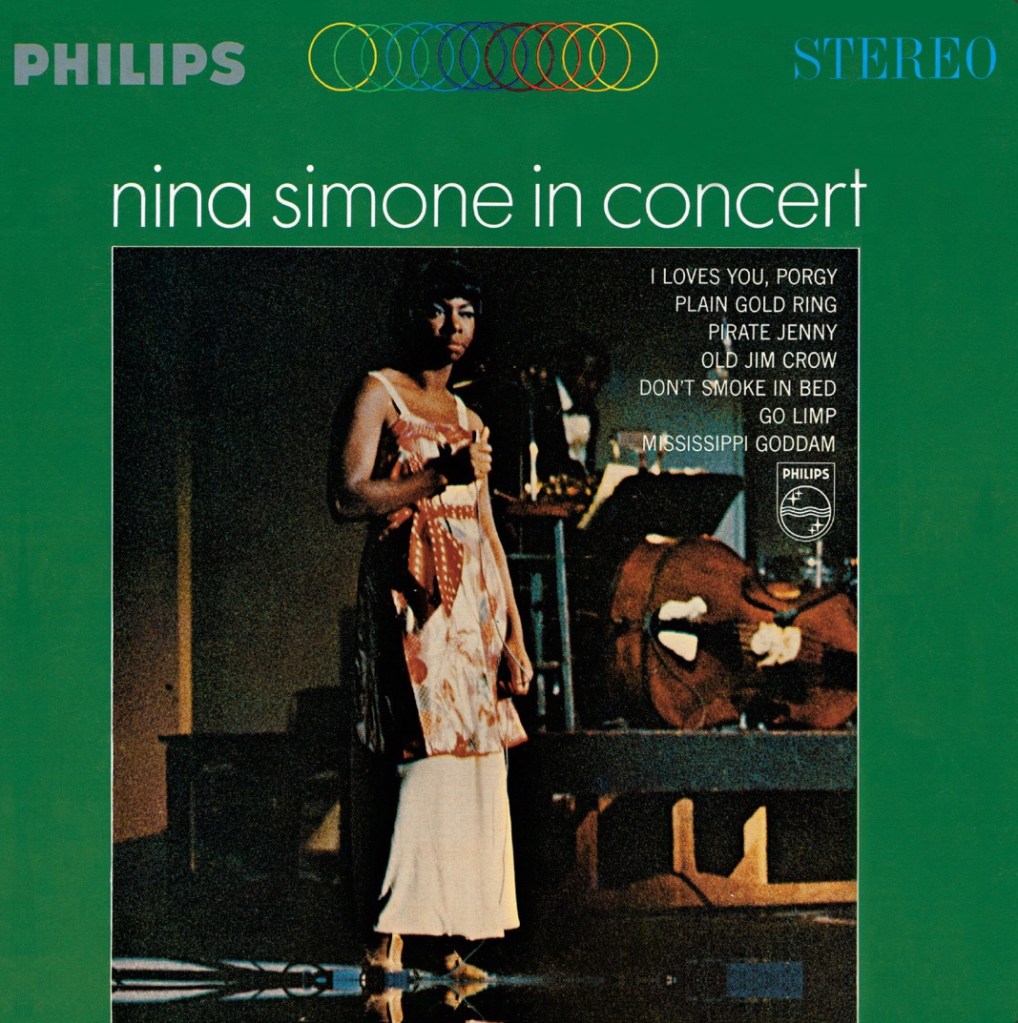
Her first protest song was “Mississippi G*****” (I’m censoring the title for my mom, who reads this blog), which appeared on the album Nina Simone in Concert(pictured below).
Nina Simone in Concert (1964)
White Southern Evangelicals were incensed at the audacity of this Black woman who refused to smile and simper and coddle their fragile feelings.
White Southern Evangelicals were incensed at the audacity of this Black woman who refused to smile and simper and coddle their fragile feelings. So outraged were they in fact that promotional singles sent to some radio stations were returned broken neatly in half. And what a metaphor for the America of the 60s and now the 20s. It should be a matter of profound shame that we are still fighting for basic human dignity in the year 2021 with two large contingents of the population debating whose lives should and should not (or don’t and will never) matter.
I love seeing Black creators celebrated by other Black creators because representation matters and little Black children deserve to see people who look like them living lives they want to emulate.
All in all, Nina is a pictorial biography of the highest caliber. I wouldn’t be one smidgen surprised if it’s named one of the best books of 2021 written for children because in my opinion it already is. I love seeing Black creators celebrated by other Black creators because representation matters and little Black children deserve to see people who look like them living lives they want to emulate. They need that blueprint. The creators already exist; it’s up to us to amplify their art.
From Nina: A Story of Nina Simone: “Nina Simone sang the whole story of Black America for everyone to hear. Her voice resounded with the love, joy, and power of it all. And when she sang of Black children—you lovely, precious dreams—her voice sounded like hope.”
Nina: A Story of Nina Simonewas released by G.P. Putnam’s Sons Books for Young Readers on September 28th, 2021 and is now available to purchase wherever books are sold.
Bonus: My Favorite Recording by Nina Simone
Thanks as always for being a faithful reader of The Voracious Bibliophile. If you like what you see, please like, comment, follow, and subscribe to my email list to get notified of new posts as soon as they drop. You can also email me at fred.slusher@thevoraciousbibliophile.com or catch me on Twitter, Instagram, TikTok, and Pinterest @voraciousbiblog. Keep reading the world, one page (or pixel) at a time.
All night I dreamed of my home,
of the roads that are so long
and straight they die in the middle—
among the spines of elderly weeds
on either side, among the dead cats,
the ants who are all eyes, the suitcase
thrown open, sprouting failures.

   2.
And this evening in the garden
I find the winter
inside a snail shell, rigid and
cool, a little stubborn temple,
its one visitor gone.

   3.
If there were messages or signs,
I might hear now a voice tell me
to walk forever, to ask
the mold for pardon, and one
by one I would hear out my sins,
hear they are not important—that I am
part of this rain
drumming its long fingers, and
of the roadside stone refusing
to blink, and of the coyote
nailed to the fence with its
long grin.

And when there are no messages
the dead lie still—
their hands crossed so strangely
like knives and forks after supper.

   4.
I stay up late listening.
My feet tap the floor,
they begin a tiny dance
which will outlive me.
They turn away from this poem.
It is almost Spring.
Thanks as always for being a faithful reader of The Voracious Bibliophile. If you like what you see, please like, comment, follow, and subscribe to my email list to get notified of new posts as soon as they drop. You can also email me at fred.slusher@thevoraciousbibliophile.com or catch me on Twitter, Instagram, TikTok, and Pinterest @voraciousbiblog. Keep reading the world, one page (or pixel) at a time.
An end is always punishment for a beginning.
If you’re Catholic, sadness is punishment
for happiness, you become the bug you squash
if you’re Hindu, a flinty space opens
in your head after a long night of laughter
and wine. For waking there are dreams,
from French poetry, English poetry,
for light fire although sometimes
fire must be punished by light
which is why psychotherapy had to be invented.
A father may say nothing to a son for years.
A wife may keep something small folded deep
in her underwear drawer. Clouds come in
resembling the terrible things we believe
about ourselves, a rock comes loose
from a ledge, the baby just cries
and cries. Doll in a chair,
windshield wipers, staring off
into the city lights. For years
you may be unable to hear the word monkey
without a stab in the heart because
she called you that the summer she thought
she loved you and you thought you loved
someone else and everyone loved
your salad dressing. And the daffodils
come up in the spring and the snow covers
the road in winter and the water covers
the deep trenches in the sea where all the time
the inner stuff of this earth surges up
which is how the continents are made
and broken.
Thanks as always for being a faithful reader of The Voracious Bibliophile. If you like what you see, please like, comment, follow, and subscribe to my email list to get notified of new posts as soon as they drop. You can also email me at fred.slusher@thevoraciousbibliophile.com or catch me on Twitter, Instagram, TikTok, and Pinterest @voraciousbiblog. Keep reading the world, one page (or pixel) at a time.
Caring for myself is not self-indulgence, it is self-preservation and that is an act of political warfare.
Audre Lorde
You can’t fight the good fight without fuel, and that fuel comes from intentionally carving out space to take care of yourself first. If you make yourself a priority, you have so much more to give the world. And you owe yourself that.
Thanks as always for being a faithful reader of The Voracious Bibliophile. If you like what you see, please like, comment, follow, and subscribe to my email list to get notified of new posts as soon as they drop. You can also email me at fred.slusher@thevoraciousbibliophile.com or catch me on Twitter, Instagram, TikTok, and Pinterest @voraciousbiblog. Keep reading the world, one page (or pixel) at a time.











 The Voracious Bibliophile