

I don’t have any tattoos (yet) but if I ever decide to get one, it’ll probably either be a mockingjay in flight or a Cheryl Strayed quote.
Anyone who’s been reading this blog for any amount of time whatsoever can probably tell you how much I love Cheryl Strayed. She is possibly the most quotable woman on the planet at the moment. I don’t have any tattoos (yet) but if I ever decide to get one, it’ll probably either be a mockingjay in flight or a Cheryl Strayed quote.
I saw that it was possible to not only not feel regret, but to be thankful for the mistakes I’ve made because ultimately they’ve shaped me into the person I’ve become.
When I read Wild for the first time, it really opened my eyes to the possibility of living in a state of acceptance. I saw that it was possible to not only not feel regret, but to be thankful for the mistakes I’ve made because ultimately they’ve shaped me into the person I’ve become. And is it even right to call them mistakes? You see, I grew up in an extremely religious household where sin was vile, hell was hot, and you most certainly wanted to do everything you could to avoid ending up there. That legalistic framework conditioned me to feel intense shame and regret every time I behaved outside the bounds of what was considered “acceptable” behavior.
You get treats (eternal life and salvation) for good behavior and punishments (eternal damnation and torment via hellfire) for bad behavior.
No one really talks about the paranoia of living that way. You live every day slobbering like a Pavlov dog. You get treats (eternal life and salvation) for good behavior and punishments (eternal damnation and torment via hellfire) for bad behavior. I can already hear my mom saying, “That’s not how it works. We are saved by grace, not by good behavior.” And I will give her points for that, but the act of living in grace and in a state of constant penitence functions exactly like the kind of conditioning Pavlov used on those pooches.
…the act of living in grace and in a state of constant penitence functions exactly like the kind of conditioning Pavlov used on those pooches.
I’m aware that I’m taking the long way around here, but I want you to try something for me. Think of fear as a border. Imagine it as a literal line of demarcation fencing you in. Fear tells you not only where you can go, but how you must behave there, what your limitations are, and ultimately, when you are allowed to leave. Fear is limiting. Now, don’t misread me. The opposite of fear is not bravery or courage—it is water. It simply flows.
Sometimes you must tell yourself you are safe and you are loved over and over again until it becomes the only story you know and the only sound that reverberates.
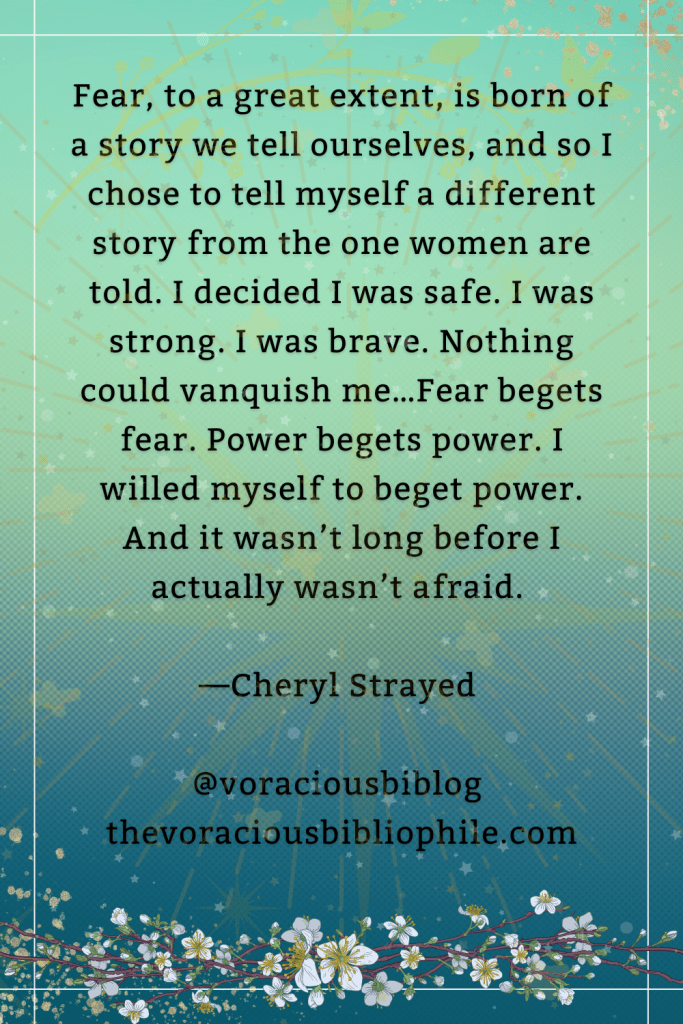
And like Cheryl says in the quote I’ve shared above, fear is borne out of the narratives we tell ourselves, the ones we play on a loop. Sometimes you must tell yourself you are safe and you are loved over and over again until it becomes the only story you know and the only sound that reverberates.
What I want for myself and what I want for all of you is for us to learn to tell ourselves a different story. From the time we were born, we’ve had narratives projected onto us. You’re too fat. You’re too thin. You’re too gay. You’re so needy. You’re too loud. You don’t fit in here. You can’t sit with us. You can’t show your skin if it’s not flawless. You can’t bare your midriff if it has stretch marks. The way you eat is disgusting. You must have a thigh gap. You must buy your clothes at Walmart. You must have muscles. Boys can’t wear skirts. That lipstick shade is slutty. Give more. Give less. Be quiet. Speak up. Sit down. Disappear. Become nothing.
What do all of these narratives have in common? They’re all lies. Tell your own story and live in your own truth. I promise you won’t regret it.
Thanks as always for being a faithful reader of The Voracious Bibliophile. If you like what you see, please like, comment, follow, and subscribe to my email list to get notified of new posts as soon as they drop. You can also email me at fred.slusher@thevoraciousbibliophile.com or catch me on Twitter, Instagram, TikTok, and Pinterest @voraciousbiblog. Keep reading the world, one page (or pixel) at a time.

 The Voracious Bibliophile