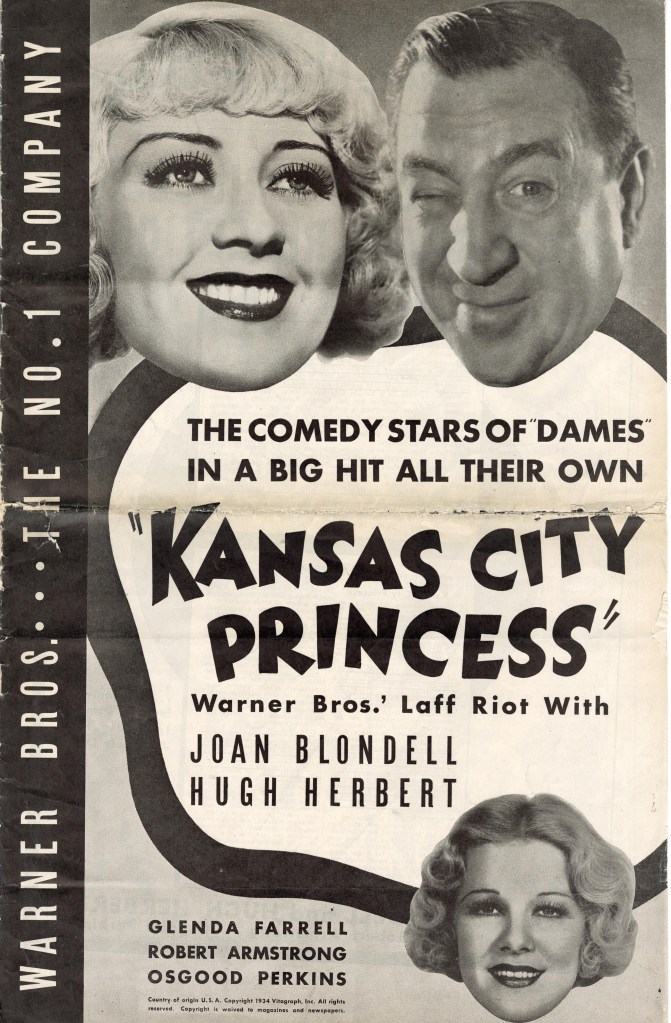
Film poster for Kansas City Princess (1934); directed by William Keighley.
Review
Any pairing of Joan Blondell and Glenda Farrell is a wonder to behold, even when the plot is a bit too contrived and there’s not enough screen time to make all the loose threads coming together believable. Blondell and Farrell play manicurists Rosie (Blondell) and Marie (Farrell) who are also roommates. Rosie’s boyfriend is a tough guy gangster named Dynamite Carson (Robert Armstrong). Marie doesn’t like him at all, so she talks Rosie into going to dinner with a customer who, unbeknownst to them, is an associate of Dynamite’s.
Joan Blondell as Rosie Sturges in Kansas City Princess. Image subject to copyright.
He finds out, of course, and vows revenge, so the girls hightail it out of town by posing as members of a girl’s group that looks like the Girl Scouts. They then finagle their way into the good graces of two businessmen who they swindle into paying for their tickets to Paris and clothes for the journey too. Hijinks ensue, especially after Dynamite catches up with them. It’s all very low stakes despite the threat of murder (which isn’t believable at all — Robert Armstrong’s Dynamite looks more likely to flip you off in traffic than actually initiate a physical altercation), so you’re not going to be on the edge of your seat or anything.
Glenda Farrell as Marie Callahan in Kansas City Princess. Image subject to copyright.
All in all, I enjoyed it. When I see those two on screen, I know I’m going to be entertained and that’s all that matters to me.
Kansas City Princessis streaming on Watch TCM through April 26th and is also available to own on DVD through the Warner Archive Collection.
Thanks as always for being a faithful reader of The Voracious Cinephile. If you like what you see, please like, comment, follow, and subscribe to my email list to get notified of new posts as soon as they drop. Keep watching the world, one frame at a time.
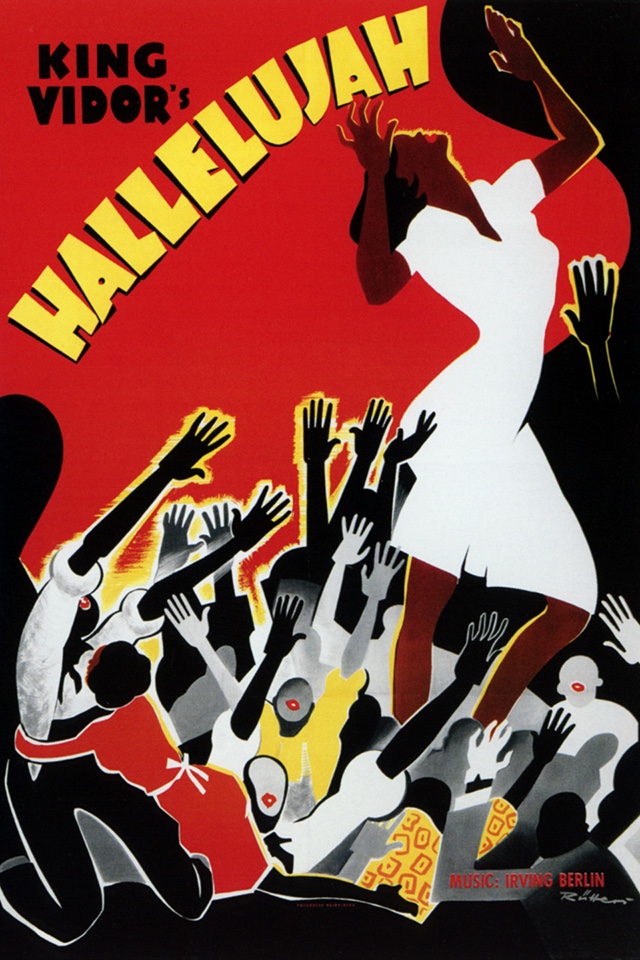
Film poster for Hallelujah (1929); directed by King Vidor.
Review
“Excuse me, Missy Rose, but it looks like the devil’s in me tonight.” – Zeke
Though not without its valid criticisms (for its racial stereotypes, chiefly), Hallelujah was a landmark for Black representation on film. And to reduce it to its stereotypes would do a great disservice to the cast and (racially-mixed) production crew, because all in all Hallelujah is a remarkable film. Nina Mae McKinney is especially delightful, and it’s a shame she didn’t get the same opportunities as white actresses of the time, because she was able to do comedy and drama equally well.
You can see the spiritual transformation play out on her face and in her body language.
Nina Mae McKinney as Chick in Hallelujah.
My favorite scene in the entire film is when Chick (Nina Mae McKinney) is listening to Zeke’s (Daniel L. Haynes) passionate sermon and goes from scornful to deeply moved. You can see the spiritual transformation play out on her face and in her body language. She’s a phenomenal actress with a vivaciousness and physicality that she makes look easy, while the opposite is true.
Hallelujahis available to stream for free on Tubi and is also available to own on DVD.
Thanks as always for being a faithful reader of The Voracious Cinephile. If you like what you see, please like, comment, follow, and subscribe to my email list to get notified of new posts as soon as they drop. Keep watching the world, one frame at a time.
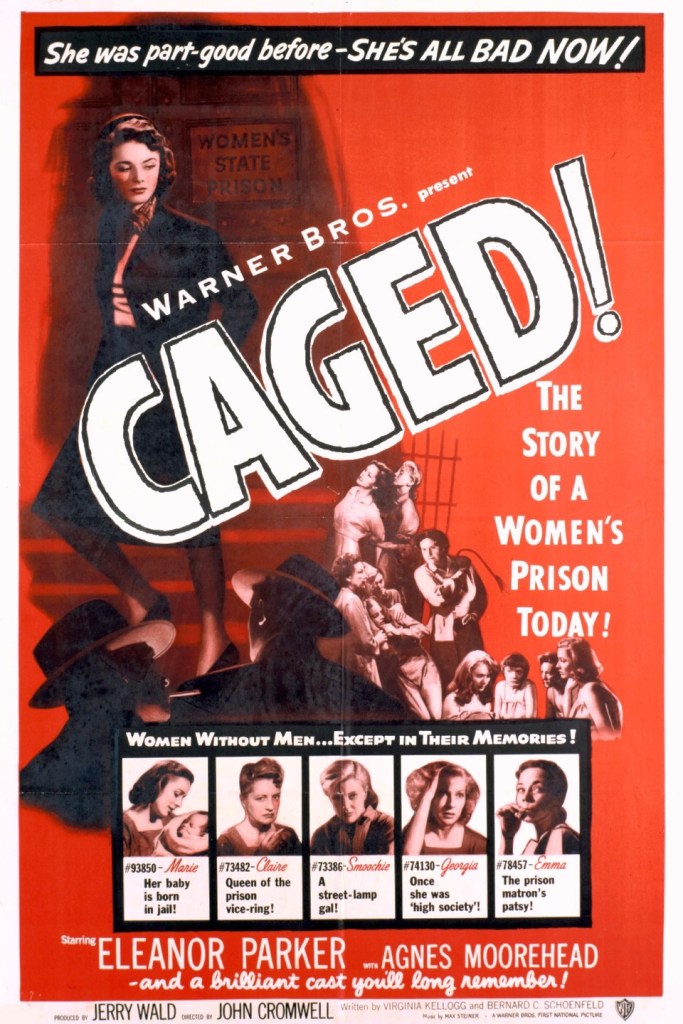
Film poster for Caged (1950); directed by John Cromwell.
Review
This is your warning that there are spoilers ahead. If you don’t want any of the plot of Caged spoiled, stop reading now until you’ve seen the film.
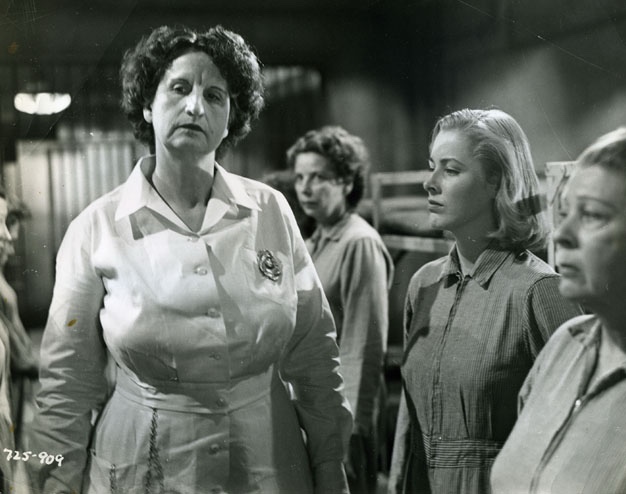
What a delicious, delightful treat this movie is. Hope Emerson is the ultimate screen baddie, and this is the meatiest role she ever got as prison matron Evelyn Harper. Emerson’s Evelyn is queer-coded to the nines, and there’s very little subtext. We love Evil Gays.
We love Evil Gays.
Hope Emerson (farthest left) as women’s prison matron Evelyn Harper. Image subject to copyright.
Eleanor Parker makes the biggest transformation of any of the characters in the film, going from a doe-eyed ingenue to a hardened criminal after losing her baby to adoption and finding out that the system is designed to keep her incarcerated, not help her transition to life on the outside.
Agnes Moorehead plays a rare sympathetic role as prison superintendent Ruth Benton, a no-nonsense but very caring woman who works overtime in the cruel and corrupt system to make her prison a place for rehabilitation and healing, not punishment and brutality.
Last but certainly not least, Betty Garde’s character Kitty Stark reminds one of Kate Mulgrew’s Red in Netflix’s Orange Is the New Black, so much so that one wonders if Mulgrew took inspiration from Garde. Garde as Kitty Stark is sardonic and hardened, but not unfeeling. She’s someone who’s had to play the cards she’s dealt, and she makes no apology for it. Seeing Evelyn break her is heartbreaking. But she gets what’s coming to her, thank God!
Cagedis streaming now on Watch TCM and was recently featured on Eddie Muller’s Noir Alley programming block on the channel.
Thanks as always for being a faithful reader of The Voracious Cinephile. If you like what you see, please like, comment, follow, and subscribe to my email list to get notified of new posts as soon as they drop. Keep watching the world, one frame at a time.
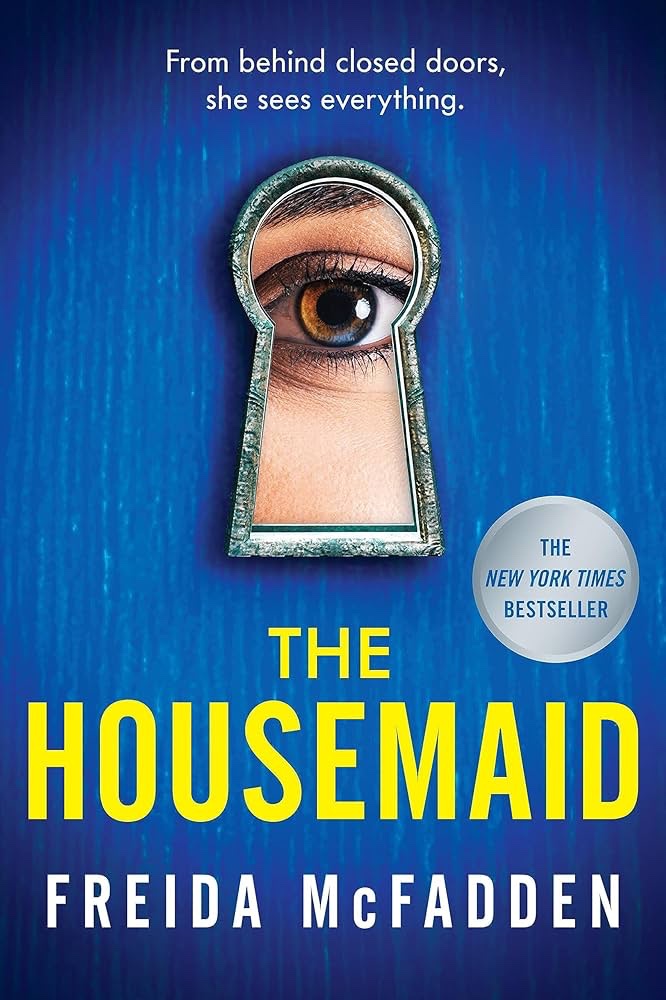
Full of the twists and turns that fans of Freida McFadden have come to expect from the newly-minted Queen of Suspense, The Housemaid is one of those books that takes old tropes and breathes new life into them. I tried my best to be a hater, thinking that no book this hyped could actually be good, but it was a thrill ride from beginning to end. I highly recommend reading it with a friend because you’ll want to have someone to talk to when the twists start coming.
I read it with one of my coworkers and we’re on to the second book now. Several of my customers have told me the second and third books in the series aren’t as good but I guess we’ll find out.
The Housemaidcan be purchased wherever books are sold, but I bought my copy through Books-A-Million, so that’s where I’m linking to.
Thanks as always for being a faithful reader of The Voracious Bibliophile. If you like what you see, please like, comment, follow, and subscribe to my email list to get notified of new posts as soon as they drop. You can also email me at fred.slusher@thevoraciousbibliophile.com or catch me on Twitter, Instagram, TikTok, and Pinterest @voraciousbiblog. Keep reading the world, one page (or pixel) at a time.
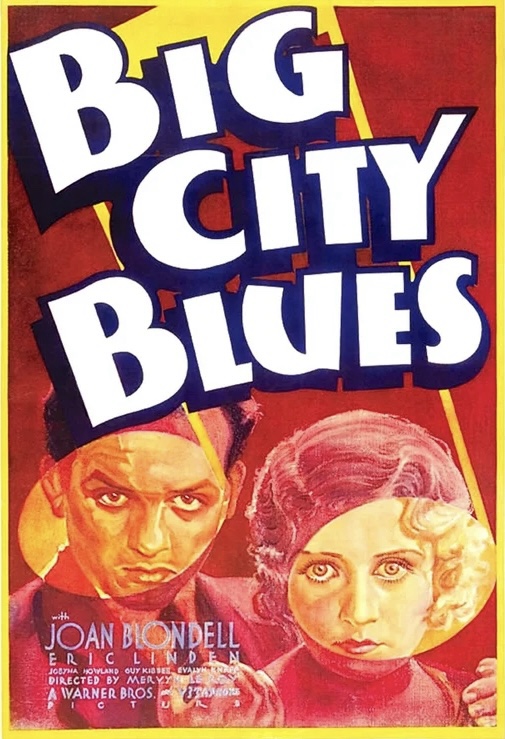
Film poster for Big City Blues (1932); directed by Mervyn LeRoy.
Big City Blues opens with Bud Reeves (Eric Linden) inheriting money from his aunt (which occurs offscreen) and buying a train ticket to New York City. Before he leaves, he entrusts care of his dog (who escaped to follow Bud to the station) to the wise old bus station clerk (Eddie Graham). The best monologue in the film comes courtesy of the clerk (Graham), who tries his best to inject a little reality into the moony-eyed youngster, all to no avail, of course.
When Bud (Linden) gets to New York and checks into his hotel room overlooking the park, his older cousin Gibby (Walter Catlett) meets him and starts fleecing him out of his money, a little bit at a time. Gibby (Catlett) introduces him to two young ladies, Vida Fleet (Joan Blondell) and her friend Faun (Inez Courtney). Bud immediately falls head-over-heels in love with Vida (Blondell), and it appears she’s also taken with him.
Gibby organizes a party in Bud’s hotel room, with plenty of booze flowing (all on Bud’s dime, you see) and a ragtag group of other young people (including Humphrey Bogart and Lyle Talbot in uncredited roles). A fight breaks out in which a young chorus girl named Jackie (Josephine Dunn) is accidentally killed, and the partygoers flee like cockroaches. Bud is left holding the bag, so to speak, but quickly flees. Vida goes back to the room looking for Bud but sees that he’s also gone. When she’s still in the room, Hummell (Guy Kibbee) the hotel dick discovers Jackie’s body and Vida slips out.
Local police throw out a dragnet to snare the partygoers and get to the bottom of who killed Jackie. Bud goes in search of Vida and finally meets up with her at the 55 Club. For lack of anything better to do, the two go upstairs to gamble at dice and Bud loses what’s left of his inheritance. This is the most frustrating part of the film because why in the name of God would you gamble your fortune away when you’re facing trumped-up murder charges?! Please make it make sense. Such is the bedlam often found in so many Pre-Code classics. Anyway, a detective who’s been trailing Vida all day confronts the pair and arrests them.
While Bud, Vida, and the other partygoers are being interrogated, Hummell (Kibbee) finds the body of Lenny (Talbot) hanging in a closet holding part of the broken bottle that matches the one found near Jackie. After accidentally killing her, he was overwhelmed with guilt (presumably) and hanged himself. Cleared of suspicion and free to go, Bud and Vida exchange a tearful goodbye. It’s insinuated that Bud will one day return for Vida, as his feelings for her are reciprocated, but he is flat broke and needs to go back home and save up money.
The last shot of Blondell looking longingly at Bud as he’s heading to the station is perhaps the most emotion I’ve ever seen from her in a picture. There are tears welled up in her eyes, but she’s strength personified. In that brief moment, we see a woman who’s almost never had the breaks fall her way, but she’s resilient. It’s breathtaking, and a testament to her versatility as an actress. She truly was one of a kind.
Thanks as always for being a faithful reader of The Voracious Cinephile. If you like what you see, please like, comment, follow, and subscribe to my email list to get notified of new posts as soon as they drop. Keep watching the world, one frame at a time.
Film poster for Sinners (2025); directed by Ryan Coogler.
Well, it’s official: Sinners now holds the record for having the most Oscar nominations for a single film in the Academy’s history with 16 nominations. Ryan Coogler’s (put some RESPECT on his name) film beats the previous record of 14 nominations held by three films: All About Eve (1950), Titanic (1997), and La La Land (2016). Out of those three films, only one of them (La La Land) didn’t win Best Picture. I know everyone is going wild over Paul Thomas Anderson’s One Battle After Another right now and it’s the favorite to win Best Picture, but I’m rooting for Sinners.
Here are the categories in which Sinners is nominated:
Best Picture (Zinzi Coogler, Sev Ohanian and Ryan Coogler)
Directing (Ryan Coogler)
Actor in a Leading Role (Michael B. Jordan)
Cinematography (Autumn Durald Arkapaw)
Visual Effects (Michael Ralla, Espen Nordahl, Guido Wolter and Donnie Dean)
Sound (Chris Welcker, Benjamin A. Burtt, Felipe Pacheco, Brandon Proctor and Steve Boeddeker
Film Editing (Michael P. Shawver)
Production Design (Production Design: Hannah Beachler; Set Decoration: Monique Champagne)
Original Song (“I Lied to You”, Music and Lyric by Raphael Saadiq and Ludwig Goransson)
Costume Design (Ruth E. Carter)
Casting (Francine Maisler)
Actor in a Supporting Role (Delroy Lindo)
Original Screenplay (Ryan Coogler)
Original Score (Ludwig Goransson)
Makeup and Hairstyling (Ken Diaz, Mike Fontaine and Shunika Terry)
Actress in a Supporting Role (Wunmi Mosaku)
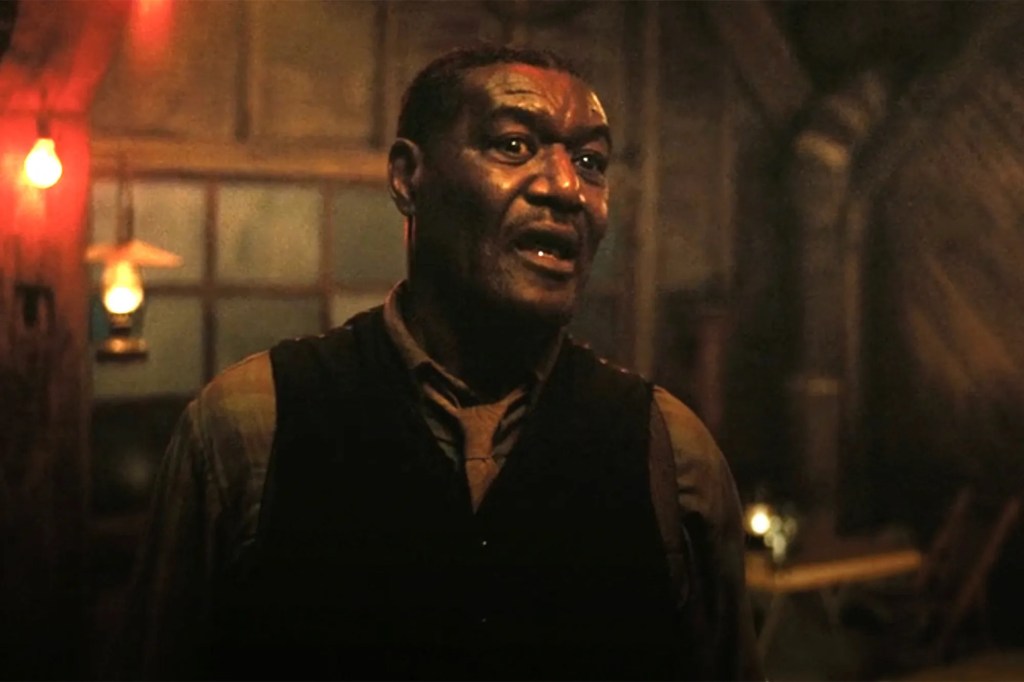
Sinners was my favorite film of 2025 from the moment I first saw it. I’ve watched it at least seven times now, and it only gets better with each viewing. I was worried that Delroy Lindo and Wunmi Mosaku might get shut out of their respective categories, but I’m happy to see that the Academy got it right. Mr. Lindo is 73 years old and this is his first Oscar nomination. That in itself is a travesty. That man has been turning in excellent performances for decades, and it is way past time for him to receive the accolades due him.
Sinners is now streaming on HBO Max and is available to own on DVD, Blu-ray, and 4K UHD.
Delroy Lindo as Delta Slim in Sinners. Credit: Warner Bros.
All I know is he’s got my vote. #TeamLindo
Thanks as always for being a faithful reader of The Voracious Cinephile. If you like what you see, please like, comment, follow, and subscribe to my email list to get notified of new posts as soon as they drop. Keep watching the world, one frame at a time.
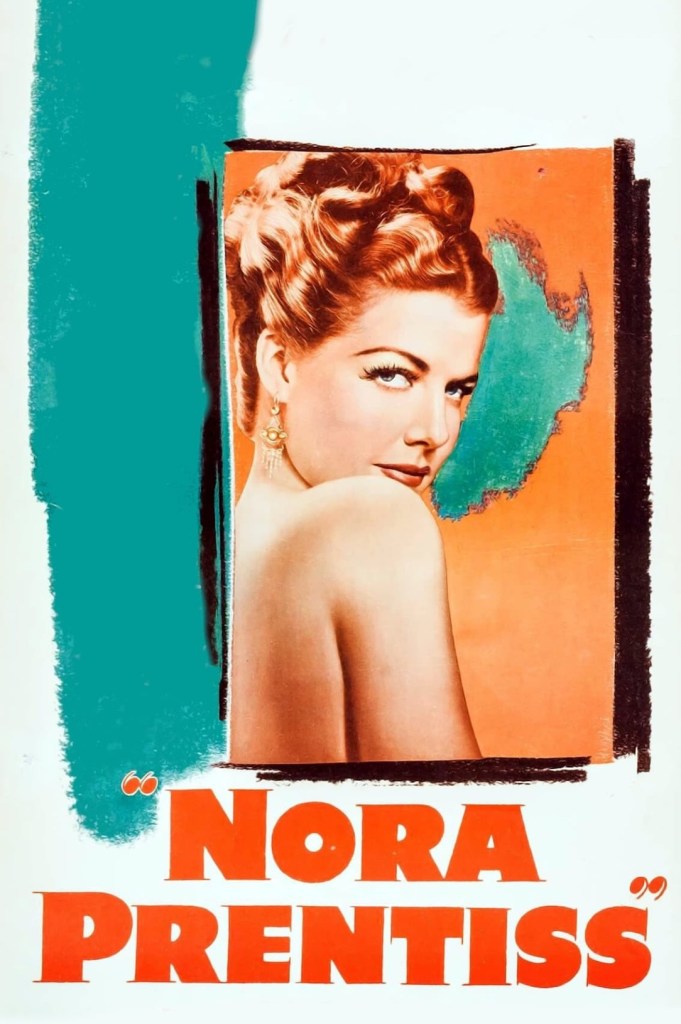
Film poster for Nora Prentiss(1947); directed by Vincent Sherman.
Rarely am I gobsmacked by a film, but Nora Prentissfully smacked my gob. The premise, if not executed as well as it was, reads a trifle ridiculous. A man convicted of his own murder — preposterous, right? Not if all the stars in the universe align at precisely the same time to screw you.
This film wouldn’t have worked if the femme fatale had been a slinky seductress, or the male lead an irredeemable womanizer. No, this is simply a tale of the wrong people falling hopelessly in love with one another when circumstances prevent them from being able to honor that love in a way that doesn’t hurt them both, with other people’s lives as collateral damage.
James Wong Howe’s cinematography and Franz Waxman’s score are both perfect complements to this dark tale of what happens when good people give in to their worst impulses and get in too deep too quickly to escape the pull of oblivion.
Thanks as always for being a faithful reader of The Voracious Cinephile. If you like what you see, please like, comment, follow, and subscribe to my email list to get notified of new posts as soon as they drop. Keep watching the world, one frame at a time.
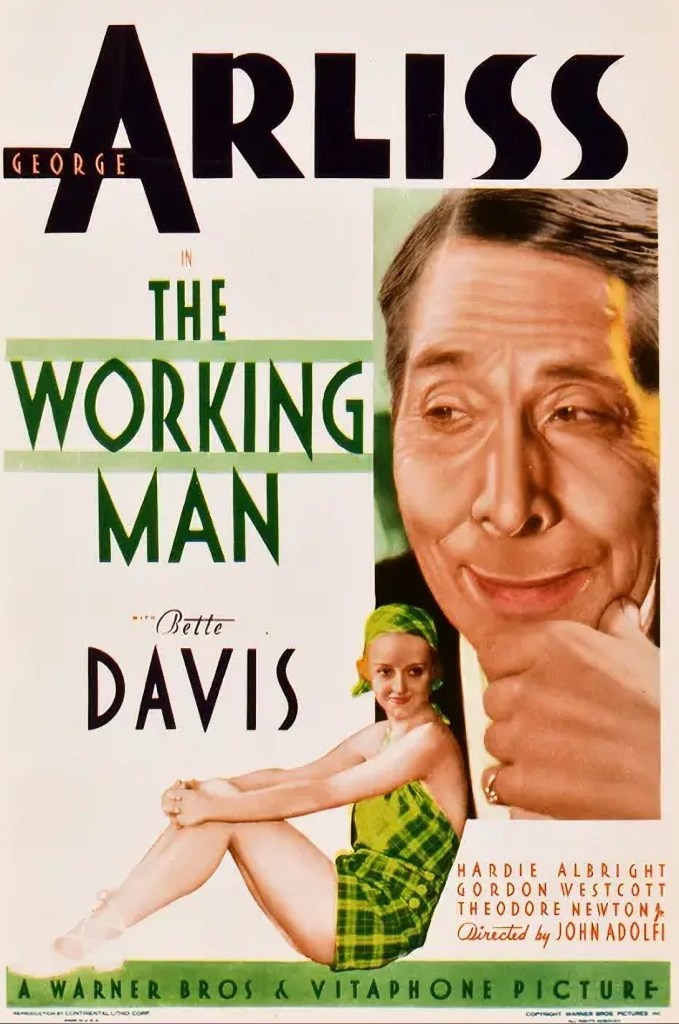
Film poster for The Working Man(1933); directed by John G. Adolfi.
The Working Manis a delightful, utterly charming Pre-Code comedy helmed by George Arliss and Bette Davis, with supporting performances by Theodore Newton, Hardie Albright (who is absolutely adorable here), and Gordon Westcott.
Arliss stars as John Reeves, a shoe magnate cut from the same cloth as Phil Knight. He runs his ship with an iron fist, insisting on growth and excellence despite the challenges of the Great Depression. His only competition comes from his former best friend Tom Hartland, who also owns a shoe company. At the start of the film, Reeves is beside himself because his firm is losing sales to Hartland, despite the purported superiority of the Reeves shoes.
When Hartland unexpectedly dies, Reeves experiences a bevy of complicated feelings. Despite their rivalry, they were once friends and he didn’t hold any real malice toward the man, despite the fact that Hartland had married the love of his life and he had remained a confirmed bachelor ever since.
At the prodding of his nephew, who is also the company’s general manager, he goes on a fishing trip to see an old friend in Maine. Coincidentally, their fishing expedition is interrupted by the mooring of a yacht full of carousing rabble-rousers. The yacht, it turns out, is owned by the Hartland heirs, the son and daughter (played by Theodore Newton and Bette Davis) of his recently deceased former friend. He becomes friendly with them and leaves his friend’s fishing boat to join them on their yacht to play cards.
At first, his intentions are to be nosy and size up his competition, but he quickly learns that the two youngsters have been burning the candle at both ends and squandering the fortune their father worked his entire life to amass for their comfort. It doesn’t help that the company is being terrible mismanaged (maliciously) by Fred Pettison, whom their father had trusted. He surmises that he plans to drive the company into the ground and buy it at a bargain so he can reinvigorate it and make himself rich. When he calls his lawyer to facilitate an offer for the company, Pettison summarily rejects it without evening bringing it to the Hartland siblings.
His suspicions confirmed, Reeves, feeling paternally toward the young man and woman, finagles his way into becoming a trustee and sets about straightening them out and teaching them about business, money, and life itself.
The irony is delicious here, because you watch Arliss as Reeves work overtime to make his competitor a success again, behind the back of his nephew and under an alias to the Hartland siblings.
As with any tale involving assumed identities and dirty business dealings (on Pettison’s part, that is), the house of cards eventually comes tumbling down. The resolution, which is rather predictable, is no less enjoyable to behold.
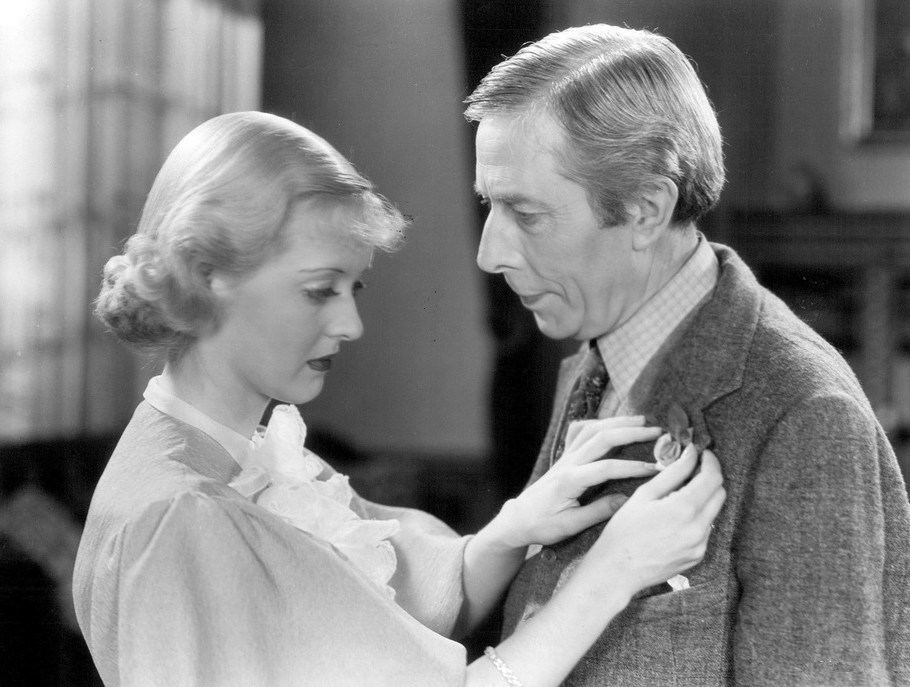
Bette Davis and George Arliss in a still from The Working Man.
This film was made early in Bette Davis’s career, when it was still not apparent to Warner Bros. what she was capable of. Still, even though she’s underutilized, she turns in a good performance. While she would become known for her saucy melodramas, it’s fun to see her in a lighthearted comedy (and as a blonde, no less).
The Working Manis now streaming on Watch TCM and is available to own on DVD through the Warner Archive Collection.
Thanks as always for being a faithful reader of The Voracious Cinephile. If you like what you see, please like, comment, follow, and subscribe to my email list to get notified of new posts as soon as they drop. Keep watching the world, one frame at a time.
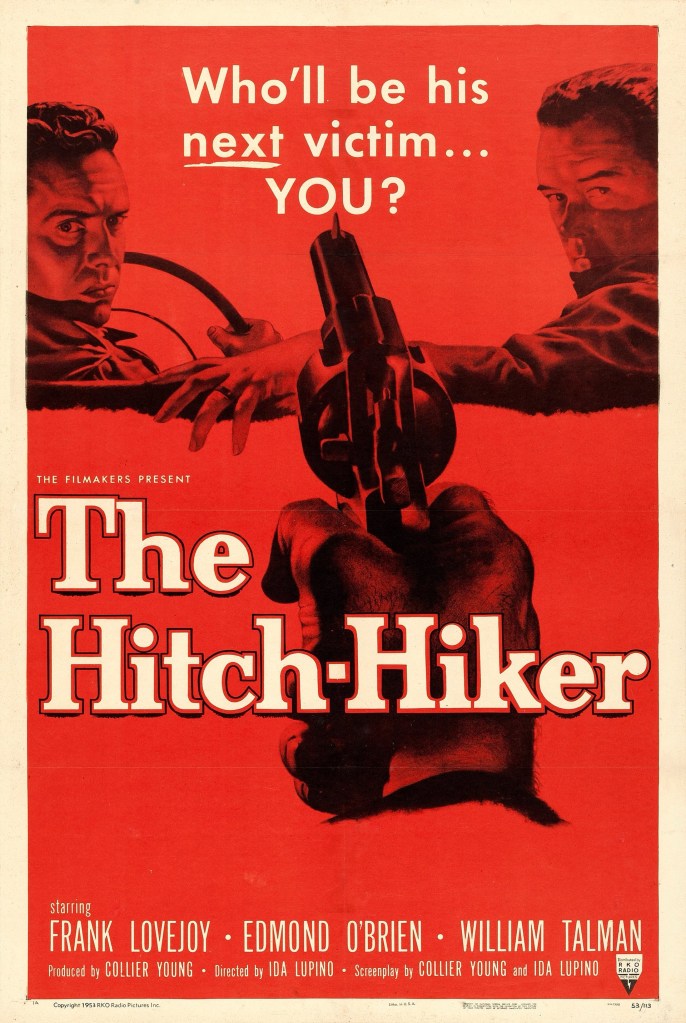
Film poster for The Hitch-Hiker (1953); directed by Ida Lupino.
In his intro or outro to this film (I can’t remember which now) on Noir Alley, Eddie Muller made the comment that it’s been said that only a woman could make a film like this at the time. I think that’s true because I think that women, despite being on the outside of the male psyche, are still the main recipient of the consequences of the decisions made by men.
Only a woman could capture the fragility behind the brand of toxic masculinity displayed by men like Emmett Myers (William Talman). It’s a masculinity that is by its very nature deeply insecure, pathologically violent, and needing constant reaffirmation of its potency. That’s why men like Myers feel the need to dominate women and (lesser, beta) men, to bring them under subjugation. It’s why rape culture exists. It’s why they ascribe characteristics of femininity to men who they read as queer or who they perceive aren’t as strong or masculine as they are. It’s a masculinity that cannot be opposed without the threat of violence, because it does not recognize consent, autonomy, or personal sovereignty, only brute force.
I would argue that this kind of masculinity is an epidemic, as serious and as deadly as any communicable disease or illness. When men like this are imbued with power of any kind, that power is abused to assuage their egos, to confirm to them their superior status. Give a man like that the nuclear codes and access to an arsenal of weapons the likes of which the world has never seen and the world holds it breath.
Based on the real-life case of Billy Cook, a hitchhiking serial killer who murdered six people, including a vacationing family of five between 1950-1951, The Hitch-Hiker follows two friends, Roy Collins (Edmond O’Brien) and Gilbert Bowen (Frank Lovejoy), who pick up a hitchhiker named Emmett Myers (William Talman) who’s recently escaped from prison. What started for them as a nice fishing trip becomes a nightmare experience that you think will never happen to you until it does.
Myers (Talman) wastes no time in pulling his gun on them and calling the shots. They drive him through the Baja California desert to Santa Rosalía, Baja California Sur, where his aim is to evade law enforcement by ferrying across the Gulf of California to Guaymas. He plays sick and sadistic mind games with them, one time making one of them shoot a tin can out of the other’s hand for sport. He takes every opportunity that presents itself to emasculate them and establish his own dominance.
This film had a profound effect on me. Props to Ida Lupino for being able to identify and articulate something that politicians and policymakers still struggle with. Edmond O’Brien, Frank Lovejoy, and William Talman all give career-defining performances here. The cinematography by Nicholas Musuraca is especially good, also among his best. The desert scenes were the best in the film. I thought I recognized the location, and Eddie Muller mentioned that it was used in other films, including High Sierra with Humphrey Bogart and Ida Lupino (cool, huh?).
The Hitch-Hiker was selected for preservation in 1998 by the United States National Film Registry. It has only grown in estimation since its release and remains an exemplar of film noir. Ida Lupino blew open the door for women filmmakers and gave them a blueprint to follow in a profession that is still (in 2026) gate-kept and dominated by men.
Thanks as always for being a faithful reader of The Voracious Cinephile. If you like what you see, please like, comment, follow, and subscribe to my email list to get notified of new posts as soon as they drop. Keep watching the world, one frame at a time.
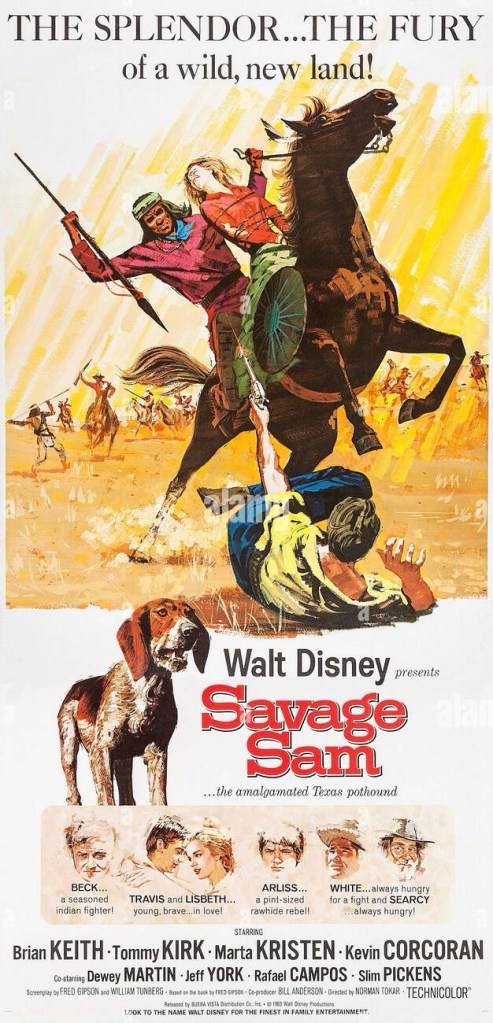
Film poster for Savage Sam (1963); directed by Norman Tokar.
Disclaimer: There’s some pretty serious anti-Indigenous racism on display here, and I’m not excusing that. The land we live on (if you’re reading this in the United States, but it also applies elsewhere) was taken from Indigenous peoples who were here long before white Europeans “settled” it.
That said, the film is both a product and summation of the time period in which it was made and set in, and therefore the attitudes and mores of the prevailing (read: ruling) majority are found therein.
Savage Sam picks up a few years after the events of Old Yeller. Jim and Katie Coates (Fess Parker and Dorothy McGuire, respectively) are away from the family homestead visiting a sick grandmother while 18-year old Travis (Tommy Kirk) is in charge of watching his rambunctious 12-year old brother Arliss (Kevin Corcoran). Their dynamic is the same as it was in Old Yeller, but without the calming influence of their mother Katie to quell the fire between them.
Instead, their Uncle Beck Coates (Brian Keith, who received top billing) acts as the adult mediator between them. Most of the plot revolves around Travis, Arliss, and Lisbeth Searcy (Marta Kristen, who replaced Beverly Washburn in the role from Old Yeller) getting captured by a group of Apaches led by a Comanche.
I’m not going to say that this follow-up comes even close to matching the heart of the first film, but it certainly was entertaining to watch. It’s made me want to watch the other films where Tommy Kirk and Kevin Corcoran play brothers, because I love their chemistry.
Bud Searcy (Jeff York, who also reprised his role from Old Yeller) also provides a lot of comic relief as Lisbeth’s insufferable, lazy, and perpetually hungry father.
As far as cinematic brilliance, you won’t find much here. But if you’re looking for a nostalgic romp with characters you remember from your childhood, then Savage Sam is a good pick.
Savage Sam is available to rent or own on several streaming platforms or on DVD.
Thanks as always for being a faithful reader of The Voracious Cinephile. If you like what you see, please like, comment, follow, and subscribe to my email list to get notified of new posts as soon as they drop. Keep watching the world, one frame at a time.






 The Voracious Bibliophile