Thanks as always for being a faithful reader of The Voracious Bibliophile. If you like what you see, please like, comment, follow, and subscribe to my email list to get notified of new posts as soon as they drop. You can also email me at fred.slusher@thevoraciousbibliophile.com or catch me on Twitter, Instagram, TikTok, and Pinterest @voraciousbiblog. Keep reading the world, one page (or pixel) at a time.
I hope you’ll forgive me for a while as this blog transforms from The Voracious Bibliophile to The Voracious Cinephile. Although, to be fair, this blog has always had more than its fair share of film-related posts, so forgiveness is probably not needed. At any rate, tomorrow (which is also my BIRTHDAY!) we will find out this year’s Oscar nominees in all 23 categories. The contendahs (Marlon Brando, anyone?) will be announced live starting at 8:18 AM EST by Tracee Ellis Ross and Leslie Jordan. What a delightful birthday present!
The Oscars are a bigger deal for me than Christmas.
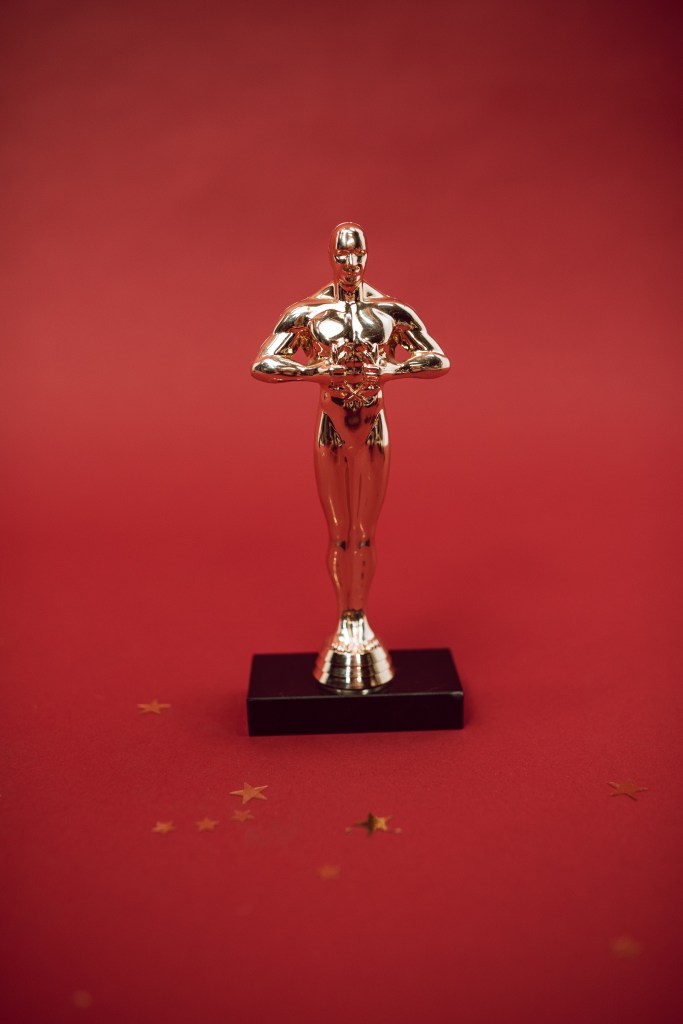
The Oscars are a bigger deal for me than Christmas. I make a special punch. I have my own Oscar my father made for me several years ago sitting proudly atop my movie shelf. I buy all the magazines. I read all the articles. I look at the odds much like an itchy gambler at a racetrack. I stalk the Twitter feeds of the hopefuls. I attempt to watch all of the films themselves before the big night but sometimes availability is an issue. For example, I feel like chances are slim I’ll get to see Licorice Pizza before the big night. I am more caught up this year than in most of the past several years, probably because many of the hopeful nominees are streaming natives. There’s been loads of buzz for streaming films this year, a trend which seems to be going nowhere but up. Don’t Look Up, The Lost Daughter, The Power of the Dog, and tick, tick… Boom! all hail from Netflix. Joel Coen’s The Tragedy of Macbeth and CODA are both denizens of Apple TV+. Being the Ricardos is the baby of Amazon Prime Video. As you can see, the field of Oscar hopefuls is simply verdant with streaming darlings.
He [Denzel Washington] somehow takes the Bard’s words and amplifies them from their original context into something even more powerful. He is expressive, multi-layered, and haunting in his portrayal of Macbeth, and the Academy would be remiss to not reward his work with a nomination for Best Actor.
I’m going to start with my strongest opinions and then work my way down. First of all, it will be an absolute tragedy if Joel Coen’s The Tragedy of Macbeth isn’t nominated for Best Picture. It is incredibly difficult to transform such a familiar work of art into something that is both classic and contemporary. Let me just say here that this is some of Denzel Washington’s best work. He somehow takes the Bard’s words and amplifies them from their original context into something even more powerful. He is expressive, multi-layered, and haunting in his portrayal of Macbeth, and the Academy would be remiss to not reward his work with a nomination for Best Actor. Frances McDormand is no slouch as Lady Macbeth, either, and while I wouldn’t be surprised to see her name on the list of nominees for Best Actress, I am much more invested in Denzel.
While the Academy doesn’t always go along with them [the New York Film Critics Circle] in this category, the winners for both awards were the same for three of the past eleven years: Laura Dern for Marriage Story in 2019; Regina King for If Beale Street Could Talk in 2018; and Patricia Arquette for Boyhood in 2014.
Likewise, I will personally send a letter of complaint to the Academy (the disposition of which I will leave up to their discretion) if Kathryn Hunter isn’t nominated for Best Supporting Actress for her roles as the Witches and the Old Man. She is delightfully creepy and otherworldly and I hope the Academy takes notice. In her favor is the fact that she was awarded the New York Film Critics Circle Award for Best Supporting Actress. While the Academy doesn’t always go along with them in this category, the winners for both awards were the same for three of the past eleven years: Laura Dern for Marriage Story in 2019; Regina King for If Beale Street Could Talk in 2018; and Patricia Arquette for Boyhood in 2014. Note: Laura Dern was awarded by the New York Film Critics Circle for her performances in both Little Women and Marriage Story.
Kristen Stewart was considered the front-runner for the longest time for her performance as Princess Diana in Pablo Larraín’s Spencer, but now there is talk that she may not even be nominated.
For me and it seems a lot of other critics and movie lovers, the Best Actress race is the most fraught right now. Kristen Stewart was considered the front-runner for the longest time for her performance as Princess Diana in Pablo Larraín’s Spencer, but now there is talk that she may not even be nominated. Talk about a dramatic turnaround. It’s somewhat annoying for the simple fact that this wouldn’t be Stewart’s first time being snubbed by the Academy. She was the first American actress to win the César Award for Best Supporting Actress for her work in Clouds of Sils Maria, and what did she get from the Academy? Crickets. For the past decade, she’s been churning out stellar performances in films one right after the other. See: Clouds of Sils Maria (2014), mentioned above, Still Alice (2014), Certain Women (2016), Personal Shopper (2016), Seberg (2019), and now Spencer (2021). When will the Academy stand up and take notice? This year should be the year, and shame on them if it’s not.
I don’t know many actresses with the chutzpah to take on Lucille Ball, especially since we have so much of Ball’s own screen work to use for comparison and judgment. Kidman isn’t one to shy away from a challenge, however, and she sinks her teeth into the life and work of the Queen of Comedy with aplomb and panache.
Also on my radar for the Best Actress race are Olivia Colman (The Lost Daughter) and Nicole Kidman (Being the Ricardos). Actually, I was all but certain the award was Stewart’s until I watched Maggie Gyllenhaal’s The Lost Daughter. In my review of the film, which you can read here, I said that Colman (along with Gyllenhaal) had gifted us with “one of the most honest depictions of motherhood ever seen in any medium”, and I stand by that assessment. Kidman is a darker horse. We know from her past work that she is quite adept at playing historical figures and real-life individuals. She won the Academy Award for Best Actress for her portrayal of Virginia Woolf in The Hours (2002). I don’t know many actresses with the chutzpah to take on Lucille Ball, especially since we have so much of Ball’s own screen work to use for comparison and judgment. Kidman isn’t one to shy away from a challenge, however, and she sinks her teeth into the life and work of the Queen of Comedy with aplomb and panache.
A more streamlined script [for Being the Ricardos] could have catapulted Kidman all the way to the stage to accept her second Oscar.
On the other hand, I was not a fan of Sorkin’s script and Javier Bardem’s turn as Desi Arnaz. Both have received mostly positive reviews from critics but I have to diverge from the pack here. Sorkin’s script is clunky and cluttered. A more streamlined script could have catapulted Kidman all the way to the stage to accept her second Oscar. Javier Bardem as Desi Arnaz is not believable at all. I knew I was watching Javier Bardem the whole time. It’s a delicate balance when you’re playing a real-life figure to not veer into caricature, and with Bardem that’s what I felt like I was watching. Not so with Kidman. Because they’re in so many scenes together, naturally, his lackluster performance distracts from hers. I honestly don’t see her winning, but I hope she is at least nominated.
Considering the race for Best Director this year, it is possible (and only right) that there are two women on the ballot: Jane Campion and Maggie Gyllenhaal. Maggie Gyllenhaal displayed an incredible amount of directorial talent with The Lost Daughter, and it’s safe to say that this won’t be the last film where she’s in the director’s chair. But I’m going to have to say that if there is any justice in the world, Jane Campion will take home the Oscar for Best Director for The Power of the Dog. Campion was previously recognized for her 1993 period drama The Piano, for which she was nominated for Best Director and won for Best Original Screenplay.
No matter what happens, I think this is going to be one of the most interesting Oscars we’ve had in a long time. Without further ado, here are my personal picks for the following eight races: Best Picture, Best Director, Best Actor, Best Actress, Best Supporting Actor, Best Supporting Actress, Best Original Screenplay, and Best Adapted Screenplay.
Best Picture
Belfast
CODA
Drive My Car
Dune
King Richard
Licorice Pizza
The Lost Daughter
The Power of the Dog
The Tragedy of Macbeth
West Side Story
Best Director
Paul Thomas Anderson, Licorice Pizza
Kenneth Branagh, Belfast
Jane Campion, The Power of the Dog
Maggie Gyllenhaal, The Lost Daughter
Ryûsuke Hamaguchi, Drive My Car
Best Actor
Benedict Cumberbatch, The Power of the Dog
Peter Dinklage, Cyrano
Andrew Garfield, tick, tick… Boom!
Will Smith, King Richard
Denzel Washington, The Tragedy of Macbeth
Best Supporting Actor
Bradley Cooper, Licorice Pizza
Ciarán Hinds, Belfast
Troy Kotsur, CODA
Jesse Plemons, The Power of the Dog
Kodi Smit-McPhee, The Power of the Dog
Best Actress
Jessica Chastain, The Eyes of Tammy Faye
Olivia Colman, The Lost Daughter
Nicole Kidman, Being the Ricardos
Frances McDormand, The Tragedy of Macbeth
Kristen Stewart, Spencer
Best Supporting Actress
Caitríona Balfe, Belfast
Jessie Buckley, The Lost Daughter
Ariana DeBose, West Side Story
Ann Dowd, Mass
Kathryn Hunter, The Tragedy of Macbeth
BestOriginal Screenplay
Belfast
Don’t Look Up
The French Dispatch of the Liberty, Kansas Evening Sun
King Richard
Licorice Pizza
Best Adapted Screenplay
CODA
Dune
The Lost Daughter
The Power of the Dog
The Tragedy of Macbeth
Thanks as always for being a faithful reader of The Voracious Bibliophile. If you like what you see, please like, comment, follow, and subscribe to my email list to get notified of new posts as soon as they drop. You can also email me at fred.slusher@thevoraciousbibliophile.com or catch me on Twitter, Instagram, TikTok, and Pinterest @voraciousbiblog. Keep reading the world, one page (or pixel) at a time.
Thanks as always for being a faithful reader of The Voracious Bibliophile. If you like what you see, please like, comment, follow, and subscribe to my email list to get notified of new posts as soon as they drop. You can also email me at fred.slusher@thevoraciousbibliophile.com or catch me on Twitter, Instagram, TikTok, and Pinterest @voraciousbiblog. Keep reading the world, one page (or pixel) at a time.
Autonomy, complexity, and a connection between effort and reward—are, most people will agree, the three qualities that work has to have if it is to be satisfying.
Thanks as always for being a faithful reader of The Voracious Bibliophile. If you like what you see, please like, comment, follow, and subscribe to my email list to get notified of new posts as soon as they drop. You can also email me at fred.slusher@thevoraciousbibliophile.com or catch me on Twitter, Instagram, TikTok, and Pinterest @voraciousbiblog. Keep reading the world, one page (or pixel) at a time.
The ultimate failure of the United States…will likely derive from our uncompromising belief in the things we consider unimpeachable and idealized and beautiful.
Thanks as always for being a faithful reader of The Voracious Bibliophile. If you like what you see, please like, comment, follow, and subscribe to my email list to get notified of new posts as soon as they drop. You can also email me at fred.slusher@thevoraciousbibliophile.com or catch me on Twitter, Instagram, TikTok, and Pinterest @voraciousbiblog. Keep reading the world, one page (or pixel) at a time.
I just finished watching W. Kamau Bell’s documentary miniseries We Need to Talk About Cosby. In it, Bell sits down with multiple people to discuss the life, legacy, and impact of Bill Cosby, and how his status as a convicted rapist alters his image for the millions of people who have loved and admired him. Bell’s interviewees include several of Cosby’s survivors, including Victoria Valentino, Lili Bernard, and Lise Lotte-Lublin; public intellectuals, cultural commentators, educators, and experts in various fields such as Marc Lamont Hill, Tressie McMillan Cottom, Kliph Nesteroff, Barbara Ziv, and Sonalee Rashatwar.
The Huxtables epitomized Black excellence for an entire generation of Americans. For Black people, they were a validation—they represented what was possible despite hundreds of years of systemic oppression and white supremacy.
At this point, after more than 60 women have come forward to credibly accuse Bill Cosby of rape and sexual assault, it would be intellectually dishonest, as well as morally reprehensible, for anyone to make attempts at character rehabilitation for Cosby. Like many people, I grew up watching The Cosby Show. I thought the Huxtables were funny, relatable, and cosmopolitan in a way that was accessible. Dr. and Mrs. Huxtable were people you wanted to know, whose approval you craved. Cliff was a reputable OB-GYN. Clair was a successful attorney. Their Brooklyn Heights brownstone was spacious yet cozy, with plenty of room for their boisterous and growing family. The Huxtables epitomized Black excellence for an entire generation of Americans. For Black people, they were a validation—they represented what was possible despite hundreds of years of systemic oppression and white supremacy.
They were Black and proud, but Black and proud in a way that was safe and palatable for white audiences.
They were sorely-needed representation on a screen that for too long had only shown one narrow-minded facet of Black existence. They weren’t telling a story of poverty or struggle or overcoming inequality. They weren’t caricatures or stereotypes. They were Black and proud, but Black and proud in a way that was safe and palatable for white audiences. For white people, the Huxtables provided a blueprint for connecting with Black people without having to contend directly with all of those messy racial feelings.
…he was someone who effected real change for Black people not just in the entertainment industry but in the wider public imagination, the collective consciousness of all Americans.
Now, I won’t pretend to have had the same feelings of admiration for Cosby that legions of Black folks had and that some may still have, because for people in the Black community he was more than just a symbol or an icon; he was someone who effected real change for Black people not just in the entertainment industry but in the wider public imagination, the collective consciousness of all Americans. His evocation of a Black family was one that resonated with audiences of all races, which is one of the reasons The Cosby Show was such a ratings success. It was so successful, in fact, that in addition to making Bill Cosby a household name, it also catapulted NBC from being the number three broadcasting network in America to being number one. Everyone wanted to watch the Huxtables, except of course for the women Bill Cosby was drugging and raping.
There’s lots of cringing, yes, and more than the occasional grimace. But there’s also lots of laughter and guarded smiles, covered up by hands clamped quickly over mouths. The lingering laughter Cosby is still able to elicit is accompanied by a powerful feeling of complicity and shame. The laughter, breaking through uninvited, makes you feel like a coconspirator in Cosby’s violent pathology.
Throughout the four-part docuseries, Bell intermittently has his interviewees watch clips of bits from Cosby’s stand-up shows or from episodes of The Cosby Show and then focuses in on their reactions. There’s lots of cringing, yes, and more than the occasional grimace. But there’s also lots of laughter and guarded smiles, covered up by hands clamped quickly over mouths. The lingering laughter Cosby is still able to elicit is accompanied by a powerful feeling of complicity and shame. The laughter, breaking through uninvited, makes you feel like a coconspirator in Cosby’s violent pathology. I found myself laughing hysterically at one clip featuring a now-famous conversation between Dr. Cliff Huxtable (Cosby) and his teenage son, Theo (Malcolm-Jamal Warner). Theo is expressing his feelings of helplessness and agitation at not being able to measure up to the academic achievements of his doctor-father and lawyer-mother. On the surface, the scene is tender and heartwarming, because you think Theo’s plea to have his father’s unconditional love and acceptance will result in Cliff’s capitulation. Instead, Cliff tells Theo that’s the dumbest thing he’s ever heard and reiterates to Theo their expectations of him, which will never be anything short of excellence.
Their image is a mirage, their likability the result of a series of clever parlor tricks. They seize on a narrative of their own virtue and repeat it long enough to believe it themselves.
How do you separate the icon from the monster? And better yet, should you want to? It is easy to see how Bill Cosby was able to get away with his crimes for so long, and in a way he is still getting away with them. He is incredibly charismatic, naturally funny, and lovable. Unless you know. And now we all know. Part of what makes predators like Cosby so dangerous is their inherent likability. They draw you in with an image, that of someone who is eminently trustworthy: a person of impeccable character. Just below the surface, though, and sometimes closer than that, is their truth. Their image is a mirage, their likability the result of a series of clever parlor tricks. They seize on a narrative of their own virtue and repeat it long enough to believe it themselves.
We were all too eager to believe his lies, and with them he damned us.
Bill Cosby is just one man in a long line of powerful men throughout history who have wielded their power, status, and wealth to subjugate, violate, and silence women simply because they could. In that he is not unique. What is unique about Cosby is the fact that he was able to fool so many of us for so long that the vague whispers of his true nature went unheard by the vast majority of us. The clues are there, though. They’re in his comedy tapes and late-night talk show appearances. We were all too eager to believe his lies, and with them he damned us. The truths of these women, however, must supplant any warm feelings of nostalgia that might be conjured when reevaluating Cosby’s legacy. We owe that to them. The least we can do is listen and believe, but we should all do more. Every story we hear of sexual violence should embolden us to stop rape culture in its tracks, to hold our leaders and legislators accountable for the policies they enact. Any silence on our part, once we know the truth, makes us no better than the perpetrator.
Any silence on our part, once we know the truth, makes us no better than the perpetrator.
One of the worst things about rapists, other than the fact that they exist at all, is that their victims inherit what they themselves rarely possess: shame. When they do feel shame, it is often for having been caught, called out, and held accountable for their behavior. The shame they experience is not tied to the suffering they have engendered but rather their failure in ensuring it never saw the light of day. You see, shame would be a powerful force for good if it were felt by the right people for the right reasons. Shame, if it manifested much differently than it so often does, would mitigate against humanity’s worst impulses. Murderers, rapists, colonizers, dictators, fascists—all of these people could do with a good dose of shame. But shame has no power as a preventative measure when the people who have these inclinations to do harm, to enact violence on other people, are without guilt. Guilt and shame are not the same thing. You can feel shame, which is a minimizing and ugly feeling, without feeling as if you have done anything wrong. Unfortunately, victims of sexual violence often feel guilt and shame, because our culture places the onus of violence on the shoulders of the victim. What was she wearing? How much had she had to drink? Doesn’t she have a reputation for being, well, slutty? Why was she out that late at night? She was asking for it. You know how she gets when she drinks. She’s so flirty, any man would think he had an open invitation. A couple of cocktails and she’s three sheets in the wind. And people wonder why women are afraid to speak out?
When they [rapists] do feel shame, it is often for having been caught, called out, and held accountable for their behavior. The shame they experience is not tied to the suffering they have engendered but rather their failure in ensuring it never saw the light of day.
We Need to Talk About Cosby asks more questions than it answers. It rejects the simple conclusions characteristic of less complicated narratives and instead interrogates the story of Bill Cosby within the larger framework of American history, specifically Black American history, in the latter half of the twentieth century. It challenges us, the viewers, to look rape culture in the face and to hold abusers accountable. Even when they’re our heroes. Perhaps even especially then.
It challenges us, the viewers, to look rape culture in the face and to hold abusers accountable. Even when they’re our heroes. Perhaps even especially then.
Many people have asked whether it is possible to separate the art from the artist. Is it possible to find beauty in the artistic creations of bad men and insist, as some would try to, that they (the works of art) sprang fully-formed (decontextualized and pure) from the head of the aggressor? I think that’s the wrong question to ask. Here are two things that we know to be true: one, Bill Cosby revolutionized the entertainment industry for Black performers and effected positive change for millions of Black Americans who watched and loved him on The Cosby Show; and two, he spent decades grooming, drugging, assaulting, raping, and silencing women who trusted and admired him. These facts exist in tandem. They are uncomfortable, to be sure, but it benefits no one, least of all his survivors, to try to mitigate his crimes based on the success of his career. We do not make it to Heaven based on our best moments. Perhaps the most succinct and pithy summary of Cosby’s life and career is given by Renée Graham, an associate editor and opinion columnist for The Boston Globe. In one part of her interview with W. Kamau Bell, she says that Cosby is “a rapist who had a successful TV show”. At the end of the day, it is as simple—and complicated—as that.
These facts exist in tandem. They are uncomfortable, to be sure, but it benefits no one, least of all his survivors, to try to mitigate his crimes based on the success of his career. We do not make it to Heaven based on our best moments.
We Need to Talk About Cosby is currently airing on Showtime on Sunday nights at 10:00 PM EST. It is also available to stream on various platforms, including Hulu, YouTube TV, Sling TV, and Amazon Prime Video.
Thanks as always for being a faithful reader of The Voracious Bibliophile. If you like what you see, please like, comment, follow, and subscribe to my email list to get notified of new posts as soon as they drop. You can also email me at fred.slusher@thevoraciousbibliophile.com or catch me on Twitter, Instagram, TikTok, and Pinterest @voraciousbiblog. Keep reading the world, one page (or pixel) at a time.
Thanks as always for being a faithful reader of The Voracious Bibliophile. If you like what you see, please like, comment, follow, and subscribe to my email list to get notified of new posts as soon as they drop. You can also email me at fred.slusher@thevoraciousbibliophile.com or catch me on Twitter, Instagram, TikTok, and Pinterest @voraciousbiblog. Keep reading the world, one page (or pixel) at a time.
I was told love should be unconditional…But if love has no boundaries, no limits, no conditions, why should anyone try to do the right thing ever? If I know I am loved no matter what, where is the challenge?
Thanks as always for being a faithful reader of The Voracious Bibliophile. If you like what you see, please like, comment, follow, and subscribe to my email list to get notified of new posts as soon as they drop. You can also email me at fred.slusher@thevoraciousbibliophile.com or catch me on Twitter, Instagram, TikTok, and Pinterest @voraciousbiblog. Keep reading the world, one page (or pixel) at a time.
The worst crime committed by totalitarian mindsets is that they force their citizens, including their victims, to become complicit in their crimes. Dancing with your jailer, participating in your own execution, that is an act of utmost brutality.
I’ve been listening to Azar Nafisi’s memoir which today’s quote comes from on audiobook, and I think it’s a timely read considering all the attempts at censorship which are taking place in the United States right now. For example, Gene McGee, the mayor of Ridgeland, Mississippi, is withholding $110,000 in funding from the Madison County Library System until such time as they remove all LGBTQ+-affirming content from their shelves. His personal religious beliefs are being used as the arbiter for the distribution of public tax monies, which is reprehensible. The matter is being brought before the city’s board of alderman, which will make the final decision. You can read more about the Madison County Library System’s fight to keep diverse content available to the community here.
His [McGee’s] personal religious beliefs are being used as the arbiter for the distribution of public tax monies, which is reprehensible.
On January 10th, just 17 days before Holocaust Remembrance Day, the school board of McMinn County, Tennessee voted to have Maus, Art Spiegelman’s graphic novel about the Holocaust, removed from the 8th-grade curriculum. In a statement released by the school board, they said the book was removed on the grounds “of its unnecessary use of profanity and nudity and its depiction of violence and suicide.” Art Spiegelman’s parents were survivors of the Auschwitz extermination camp, where 1.1 million people were murdered; nearly a million of the people murdered were Jews. Spiegelman’s mother later died by suicide. What do these adults expect? Shall the Holocaust be sanitized to accommodate their puritanical squeamishness? How is reading Maus any more traumatizing than the active shooter drills these children must endure?
Shall the Holocaust be sanitized to accommodate their puritanical squeamishness?
There are more examples of attempts at censorship sweeping the country. Just googling the word “censorship” will bring you up dozens of results, most of which are from incidents occurring in the past couple of years. The books which these people want to limit or remove access to are books which tell the truth about the world and about its history, a history which closely mirrors our present reality. What is that reality? A world in which the horrors of the past are silenced while the suffering of the marginalized is ignored in the present. And the world turns on: business-as-usual.
The books which these people want to limit or remove access to are books which tell the truth about the world and about its history, a history which closely mirrors our present reality.
It is important that we talk about the ideas, themes, and events in these books. It is important for our children to have access to narratives (historical and contemporary) about people with lived experiences divergent from their own. It is important that we say no every time someone tries to distort, sanitize, or artificially alter the reality of the past or the present. Our future depends on it.
It is important for our children to have access to narratives (historical and contemporary) about people with lived experiences divergent from their own.
World War II wasn’t that long ago. The concentration camps of the Nazis are not that long shut down. Anti-Jewish crimes are on the rise. Black people are still being murdered by police. We cannot afford to be silent.
Thanks as always for being a faithful reader of The Voracious Bibliophile. If you like what you see, please like, comment, follow, and subscribe to my email list to get notified of new posts as soon as they drop. You can also email me at fred.slusher@thevoraciousbibliophile.com or catch me on Twitter, Instagram, TikTok, and Pinterest @voraciousbiblog. Keep reading the world, one page (or pixel) at a time.
Thanks as always for being a faithful reader of The Voracious Bibliophile. If you like what you see, please like, comment, follow, and subscribe to my email list to get notified of new posts as soon as they drop. You can also email me at fred.slusher@thevoraciousbibliophile.com or catch me on Twitter, Instagram, TikTok, and Pinterest @voraciousbiblog. Keep reading the world, one page (or pixel) at a time.






 The Voracious Bibliophile