Criterion Collection edition of Jeanne Dielman, 23, quai du Commerce, 1080 Bruxelles (1975); directed by Chantal Akerman.
A less astute viewer might get ten minutes into Jeanne Dielman and decide that it’s too boring to make the effort. Personally, I have no patience for this kind of viewer. People with an over-reliance on plot and dialogue have no imagination. They fail to see beyond the noise.
One of the most brilliant aspects of this film is the fact that the viewer isn’t just invited, but coerced, into participating in Jeanne’s slow unraveling. Everything Jeanne does, every single day, is performed with precision and militaristic attention to detail. She is meticulous, structured. Even the johns who patronize her arrive on a schedule, telling her when they’ll return.
Each frame is a painting, a still life unto itself. Her routinized existence becomes your only reality while watching, and you are therefore highly aware of the deviations that begin to appear: a missed button on a housecoat; potatoes cooked too long; the staccato bursts of forgetfulness, wherein Jeanne goes to perform one of her perfunctory tasks and loses herself in what she was doing. These things would mean nothing in a film with more noise, with a character we didn’t know as well. By the time these disruptions begin and the cracks in the facade become apparent, we know Jeanne very well. Perhaps better than she knows herself, if we may be so bold. And so comes the unraveling.
Each frame is a painting, a still life unto itself.
It’s deeply unsettling, and an actress with less talent wouldn’t be able to pull off what Seyrig does here. There are probably fewer than five pages of dialogue in the entire three-plus hour runtime, so her entire performance is one of intense interiority, an almost unfathomable becoming.
If you’ve tried to watch this film in the past and not been able to make it through it, I implore you to give it another shot. Wake up really early in the morning with nothing else on your schedule, no tasks or chores to distract you. Ensure your notifications are turned off, better yet put your phone on silent in another room. Immerse yourself in this intense exercise of concentrated empathy, and I dare you to remain unchanged.
There are probably fewer than five pages of dialogue in the entire three-plus hour runtime, so her entire performance is one of intense interiority, an almost unfathomable becoming.
Jeanne Dielman, 23, quai du Commerce, 1080 Bruxelles is available to buy from the Criterion Collection wherever their films are available. It is also available to stream on The Criterion Channel here.
Thanks as always for being a faithful reader of The VoraciousCinephile. If you like what you see, please like, comment, follow, and subscribe to my email list to get notified of new posts as soon as they drop. Keep watching the world, one frame at a time.
Film poster for Black Tuesday (1954); directed by Hugo Fregonese.
Black Tuesday was Eddie Muller’s Noir Alley pick for October 18th, and I just got around to watching it. Edward G. Robinson is one of my favorite actors of all time. His ability to so completely inhabit the characters he plays while also remaining so indistinguishably himself is one of the reasons I love him so much.
Another reason is that in a career with such an expansive filmography, there’s more than a few hidden gems to be discovered. I would argue that it’s the performances of his that are less talked about that are among his best. I’m talking of course about the little-seen Two Seconds, a pre-Code crime drama from 1932 directed by Mervyn LeRoy, and The Red House, Delmer Daves’s exercise in abject terror from 1947. In both of these, we see Robinson embodying characters who, throughout the course of the film, unravel to reveal their baser selves. It is within this space of raw emotion and a naked psyche that Robinson really shines, and that can certainly be said for Black Tuesday.
Directed by Hugo Fregonese and released in 1954, Black Tuesday tells the story of Vincent Canelli (Robinson), a death-row inmate who escapes prison on the night of his execution. Note that he also played a death-row inmate in Two Seconds. As far as prison breaks go, Canelli masterminds the operation with no small amount of ingenuity. For the sake of not spoiling this aspect of the film, I’ll not say anything, but suffice it to say that I was impressed. If you’re going to be a crook, be a successful one.
Robinson’s Canelli is ruthless, cold-blooded, and misanthropic. His only vestige of humanity is seen in his love for his girlfriend, Hatti (Jean Parker), who helps him execute the details of the break. He has little regard for the feelings of others, and the end always justifies the means. He is violent for the sheer joy of it, and perhaps joy doesn’t even compute into the equation. He is violent simply because he can be, because he’s so full of hate that he can’t help but unleash it on whoever is unlucky enough to get in his way.
The supporting performances in this film really help bring it over the top, especially those of the aforementioned Jean Parker and Milburn Stone of Gunsmoke fame, who plays Father Slocum, a Catholic priest.
Thanks as always for being a faithful reader of The VoraciousCinephile. If you like what you see, please like, comment, follow, and subscribe to my email list to get notified of new posts as soon as they drop. Keep watching the world, one frame at a time.
When you finish a book in one sitting, you know it’s good. Filled with the witticism, humor, and wisdom of someone who’s lived a lot of life and tried to live it well, Poems & Prayers chronicles decades of McConaughey’s life distilled into the most important and most reflective moments.
I laughed out loud, bookmarked certain passages to remember and review later, and nodded my head in assent throughout the book. I highly recommend listening to the audiobook. There are riffs and musings in there that aren’t included in the printed text. Myself, I listened to the audiobook and followed along in my printed copy that arrived today. Autographed, because who’s going to miss out on having a signed book by Matthew McConaughey?
Poems & Prayersis available to buy wherever books are sold, but of course I encourage you to buy it at your local Books-a-Million, and if you don’t have one you can buy it online at booksamillion.com.
Thanks as always for being a faithful reader of The Voracious Bibliophile. If you like what you see, please like, comment, follow, and subscribe to my email list to get notified of new posts as soon as they drop. You can also email me at fred.slusher@thevoraciousbibliophile.com or catch me on Twitter, Instagram, TikTok, and Pinterest @voraciousbiblog. Keep reading the world, one page (or pixel) at a time.
You are reading the first blog post from The Voracious Cinephile, the second blog in the Voracious family. I have toyed with the idea of having two completely separate blogs, but for now I think I’ll just post my film-related blogs with the above logo to differentiate them from those written for The Voracious Bibliophile.
Film poster for The Left Handed Gun (1958); directed by Arthur Penn.
Review
The Left Handed Gun was the first directorial effort of Arthur Penn, who would become famous for ushering in the New Hollywood movement with Bonnie and Clyde (1967). It was also only the seventh film featuring screen siren and Hollywood heartthrob Paul Newman, just a few months before he would receive rave reviews for the role of “Brick” Pollitt in Cat on a Hot Tin Roof.
Newman plays William Bonney, more famously known as Billy the Kid. I didn’t know this before watching this film, but William Bonney was also an alias of Billy the Kid’s. His birth name was Henry McCarty, and he lives on in infamy due to his part in New Mexico’s Lincoln County War, which you can read more about here.
Paul Newman as Billy the Kid in The Left Handed Gun.
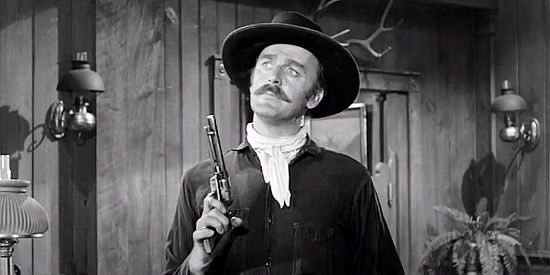
While lacking in the pomp and circumstance surrounding bigger-budget Western fare of the era, The Left Handed Gun still stands above the serialized radio and television Western shows released in the late 50s. This is due in no small part to the excellent performances given by Newman and John Dehner, who imbues the role of Pat Garrett with a rugged stoicism that pairs well with Newman’s brash and sensitive Kid. It’s my opinion that only Newman could have pulled off a Billy the Kid who is so tender, yet ultimately too caught up in his own violent passion for revenge to let his softer nature win. So who cares if he was too old for the role? If we allow ourselves to get overly legalistic in our desire for realism, the magic of the cinema loses its potency. For me, of course, the same sentiment doesn’t apply to George Cukor’s 1936 adaptation of Romeo and Juliet with Norma Shearer and Leslie Howard, but that’s a matter for another blog post.
John Dehner as Pat Garrett in The Left Handed Gun.
The Left Handed Gun may have been a box office bomb in the United States, but the Belgians were a lot more discerning and appreciative of the film, awarding it with the 1961 Grand Prix of the Belgian Film Critics Association. Other winners of the prize include such classics as 12 Angry Men, Dr. Strangelove, and Cabaret.
While I of course always recommend owning physical media, you can stream The Left Handed Gun on HBO Max.
Thanks as always for being a faithful reader of The VoraciousCinephile. If you like what you see, please like, comment, follow, and subscribe to my email list to get notified of new posts as soon as they drop. Keep watching the world, one frame at a time.
This is not me making a plug for Barnes & Noble. As a proud employee of Books-a-Million, I am encouraging you to buy your books at your nearest Books-a-Million or online at booksamillion.com.
That said, I believe in the continued existence of every single brick-and-mortar bookstore and believe that every dollar spent at a physical bookstore that doesn’t go to line the pockets of Jeff Bezos is a good dollar.
Plus, these editions were B&N exclusives so technically I’m not cheating on my spouse.
Thanks as always for being a faithful reader of The Voracious Bibliophile. If you like what you see, please like, comment, follow, and subscribe to my email list to get notified of new posts as soon as they drop. You can also email me at fred.slusher@thevoraciousbibliophile.com or catch me on Twitter, Instagram, TikTok, and Pinterest @voraciousbiblog. Keep reading the world, one page (or pixel) at a time.
I usually try to only pick one or two books (and in recent months I’ve even picked an audiobook since BOTM offers that option) but this month was just an embarrassment of riches so I ended up with three. Below are my picks (for the people who don’t want to watch the video):
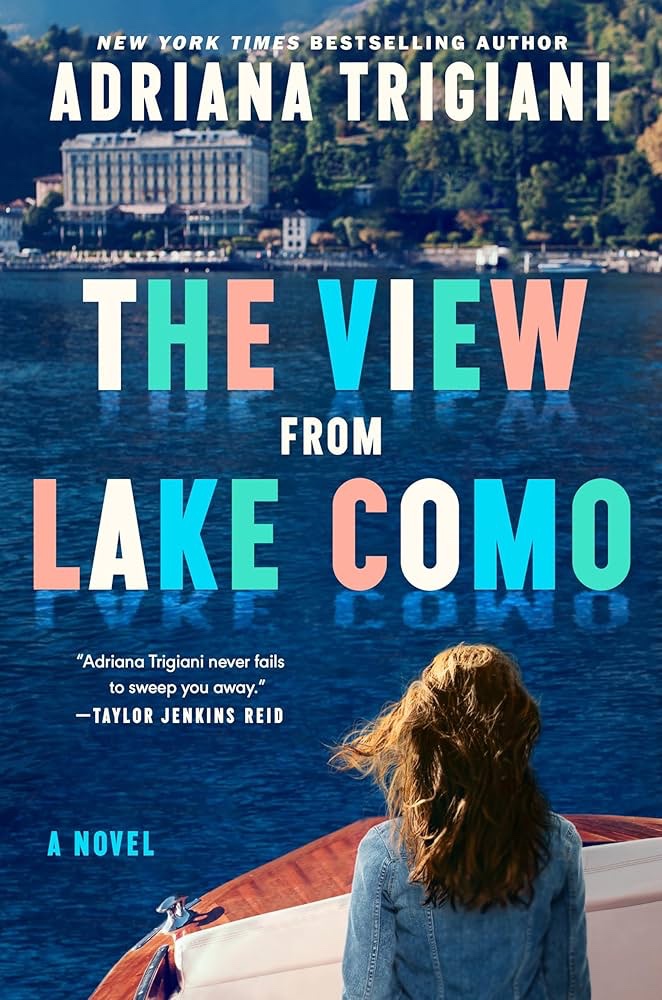
Book cover for Among Friends: A Novel by Hal EbbottBook cover for Finding Grace: A Novel by Loretta Rothschild Book cover for The View From Lake Como: A Novel by Adriana Trigiani
If you’re not already a BOTM Club member, it’s only $16.99 for a brand-new hardcover book and you can add on additional titles (2 for new members, up to 4 for Friends and BFFs, a status you can achieve by keeping your subscription active) for just $11.99 each. I’m sharing my link below for anyone who reads my blog and wants to join:
Thanks as always for being a faithful reader of The Voracious Bibliophile. If you like what you see, please like, comment, follow, and subscribe to my email list to get notified of new posts as soon as they drop. You can also email me at fred.slusher@thevoraciousbibliophile.com or catch me on Twitter, Instagram, TikTok, and Pinterest @voraciousbiblog. Keep reading the world, one page (or pixel) at a time.
Film poster for Cool Hand Luke (1967); directed by Stuart Rosenberg.
“What we’ve got here is failure to communicate.”
Captain (Strother Martin)
It might just be me, but this saga of a man named Luke (Paul Newman), crushed but not deterred under the weight of a system designed to deprive him of his body, mind, and soul, is the perfect metaphor for late-stage capitalism and rising fascism in 2025. The circumstances are somewhat different, but still startlingly relevant as it concerns the prison industrial complex, police brutality, and slavery. Some people might call that last one a stretch, but what are prisons if not legal warehouses of forced labor and deprivation of liberty? If your labor creates economic value for someone who isn’t you or your family and you aren’t allowed to leave, are you not a slave?
I mean, let’s be serious for a moment. Luke was a nonviolent offender sentenced to two years of extremely hard labor in deplorable conditions for destroying some parking meters and stealing the change out of them. And the captain and guards are given free rein to treat the incarcerated men however they see fit, up to and including executing them for trying to escape said conditions. They can even manufacture circumstances ex post facto to justify actions they take in the moment. There are no oversight or accountability mechanisms in place to discourage their violent conduct. One wonders if the wrong people are deprived of their freedom.
The captain and guards are soldiers in the war of the death of these men’s souls. These violent men (the guards, not the inmates) derive pleasure from and revel in the control they wield over every move the inmates make. It’s sickening and morally reprehensible, but very realistic and apt, even and especially in 2025.
The captain and guards are soldiers in the war of the death of these men’s souls.
There’s one particularly striking moment in the film where Luke’s mother (Jo Van Fleet) passes away and news of her passing reaches Luke. Rather than let him go and pay his respects to her, they lock him in a wooden shed called The Box, sentencing him to solitary confinement for no reason other than to deter his escape. Let it be noted that up until this point he had given no indication of a desire to escape.
This hot, enclosed shed is dark, dank, and reeking of shit and piss. Right before one of the guards (or bosses, as the inmates refer to them) locks him up in The Box, he says, “Sorry, Luke. I’m just doing my job. You gotta appreciate that.” And Luke responds, “Nah – calling it your job don’t make it right, boss.”
“Nah – calling it your job don’t make it right, boss.”
Luke (Newman)
That moment hit me like lightning. So many horrific acts of cruelty have been committed by people “just doing their jobs”. Slave catchers were just doing their jobs. The cops who arrested Rosa Parks were just doing their jobs. The SS were just doing their jobs. The same for ICE agents and Republican lawmakers who craft the law in favor of the rich and powerful and punish the poor for the sin of being poor. They’re all just doing their jobs.
One must have a moral compass, a sense of duty and responsibility to common humanity that transcends legality, convention, and organized religion. I included that last one because so many people use religion (mostly Christianity, in the context of the United States) as a pretext for depriving others of their rights and freedoms. Their moral superiority obfuscates the actual dictates of their prescribed beliefs and therefore gives them a license to ignore those dictates in favor of advancing an agenda of their own creation. They worship power, and reap desolation.
One must have a moral compass, a sense of duty and responsibility to common humanity that transcends legality, convention, and organized religion.
Paul Newman as Luke.
They worship power, and reap desolation.
Strother Martin as Captain.
The only way to beat the system, to stick it to The Man, is to keep a part of yourself that can’t be touched or corrupted by evil men. They can take your body, but they can’t touch your soul. Just like Luke.
Thanks as always for being a faithful reader of The Voracious Bibliophile. If you like what you see, please like, comment, follow, and subscribe to my email list to get notified of new posts as soon as they drop. You can also email me at fred.slusher@thevoraciousbibliophile.com or catch me on Twitter, Instagram, TikTok, and Pinterest @voraciousbiblog. Keep reading the world, one page (or pixel) at a time.
***Note: I received a free digital review copy of this book from NetGalley and Bloom Books in exchange for an honest review. I have not received compensation for the inclusion of any links for purchase found in this review or on any other page of The Voracious Bibliophile which mentions Terror at the Gates (Blood of Lilith, #1), its author, or its publisher.***
Rating: ⭐️⭐️⭐️⭐️⭐️
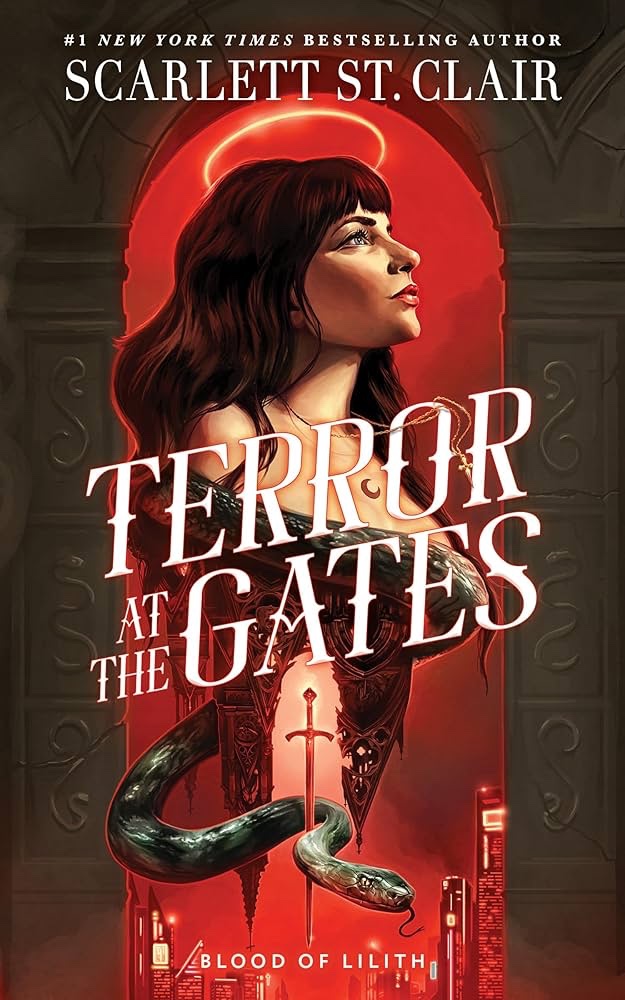
Terror at the Gates (Blood of Lilith, #1) is coming out at a time in America where the rights of women and other marginalized groups are constantly under threat. In many places, they have fewer rights and freedoms than their mothers enjoyed. Weak men, wielding whatever shallow power is afforded them by the state and other weak men, are hell-bent on ensuring women serve not their own dreams and desires. No, it is their will that women remain curtailed, simply incubators to house and grow future servants (girls) and leaders (boys).
Weak men, wielding whatever shallow power is afforded them by the state and other weak men, are hell-bent on ensuring women serve not their own dreams and desires.
I know there’s something to the fact that Scarlett St. Clair is releasing a story like this in a post-Roe world, because in our own world almost every woman is a Lilith Leviathan. Indoctrinated by religious zealot parents, repressed by a controlling church community that dictates how women should live and serve the church, and desperately in love with a man from a rival family who can’t love her the way she wants to be loved, Lilith is the female main character the world needs right now.
I loved Lilith so much. Like many of us moving through the world with religious trauma, Lilith is forced to unlearn the doctrines wielded to deprive her of her humanity and to siphon away her power. Without spoiling anything, I will say that I loved watching the development of the relationship between Lilith and Zahariev Zareth. Oh Zahariev, you dark and brooding hottie, how lucky we are to read of you on the page. If only all men were like you, there’d be no MAGA, no world without Roe, and no need for any woman to ever have to say #MeToo.
Oh Zahariev, you dark and brooding hottie, how lucky we are to read of you on the page.
MINOR SPOILER ALERT, LOOK AWAY IF YOU MUST!:
You do eventually get spice, even though you have to wait about 400 pages for it. When you get there, though, Lord have mercy! You’ll sweat through your clothes about eight different times 😉. Needless to say, I don’t think anyone involved (carnally, that is) with Zahariev would ever need a gym membership, at least not for cardio. Probably not for strength training, either, because your core would also get quite the workout. But enough of my innuendo.
I can’t wait to recommend this book to my customers, friends, and followers on this blog and elsewhere on social media. It’s the story all of us need right now, of women reclaiming their power and forging their own paths in spite of what others might choose for them, and we’re lucky to have Scarlett St. Clair to be the one to give it to us.
By the way, that ending was one of the best I’ve ever read. I’m eagerly awaiting the second book in the series.
Terror at the Gates (Blood of Lilith, #1) is now available at your local bookstore or library. I am obligated to make a plug for Books-a-Million, since I work there and it’s my favorite bookstore. You can order the signed edition of Terror at the Gates (Blood of Lilith, #1) from BAM! for 40% off right now, either shipped to your house or through a buy-online, pick-up-in-store order.
Fun Bonus Content
I had a little bit of fun creating content for my social media pages ahead of this book’s release. I hope you like it.
Thanks as always for being a faithful reader of The Voracious Bibliophile. If you like what you see, please like, comment, follow, and subscribe to my email list to get notified of new posts as soon as they drop. You can also email me at fred.slusher@thevoraciousbibliophile.com or catch me on Twitter, Instagram, TikTok, and Pinterest @voraciousbiblog. Keep reading the world, one page (or pixel) at a time.
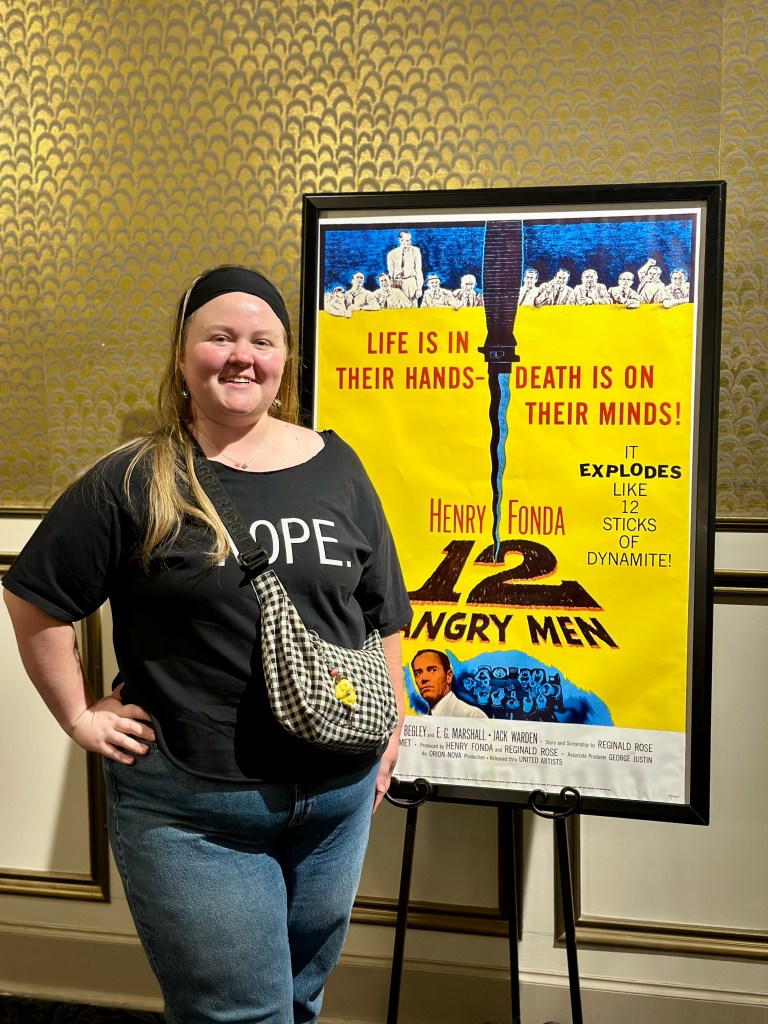
Me in front of the movie poster for 12 Angry Men. Shelby in front of the movie poster for 12 Angry Men. We saw this cool mural in Lexington while we were out walking trying to find a place to eat. Me and Shelby in the car after we made it back home.
I’m on vacation this week (today is actually my last day), and one of the things I did this week was go on a date with my friend Shelby to the Kentucky Theatre in Lexington to see 12 Angry Men. We are both hardcore cinephiles. She recently made a joke on her Instagram about when she and her sisters were in a vendors mall that looked like the Criterion Closet and she filmed a little clip showing her picks. We love the movies everyone else likely hates, aside from film lovers like ourselves. Our tastes range from the artsy-yet-accessible to the experimental and avant-garde.
I had a recurring thought while 12 Angry Men was playing on the screen: It was highly probable that it had shown in the very screening room we were sitting in during its original run. What a full circle moment.
12 Angry Men made the third film we’ve seen in this theater (the first two were The Brutalist and I’m Still Here), which is one of the oldest in Kentucky. It has been in operation ever since the 1920s, so it feels particularly poignant and weighty in the best way to sit and watch a film here. I had a recurring thought while 12 Angry Men was playing on the screen: It was highly probable that it had shown in the very screening room we were sitting in during its original run. What a full circle moment.
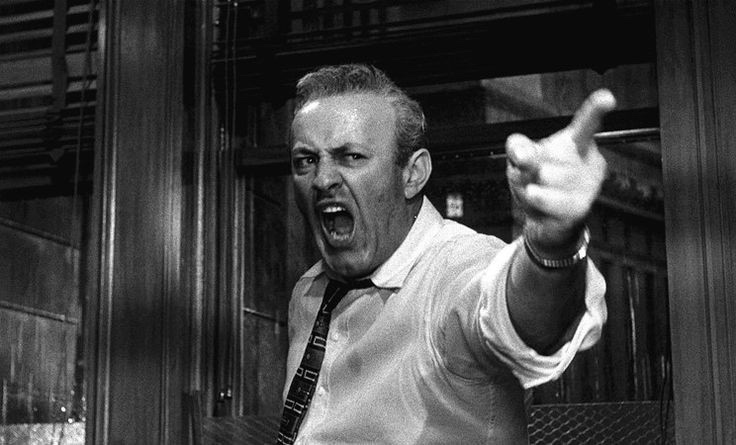
If you’ve never had the chance to watch it, it’s truly one of the most electrifying and relevant films ever made. I feel like it’s more relevant now than it was in 1957. Directed by Sidney Lumet in his directorial debut, 12 Angry Men stars an ensemble cast which includes Henry Fonda, Lee J. Cobb, and Ed Begley. The story follows a jury of 12 men in a deliberation room after hearing a case of a young man (still a teenager) accused of killing his father. All the flimsy yet convenient circumstantial evidence points to his overwhelming guilt. On the surface level, it is easy to not see any possible reason why it was not this young man who killed his father. However, hesitant to end a man’s life without being absolutely certain of his guilt, Juror 8 (Henry Fonda) insists the men carefully review the facts of the case before they send him on his way to the electric chair.
All the flimsy yet convenient circumstantial evidence points to his overwhelming guilt.
12 Angry Men is one of those brilliant films that uses an enclosed space (these films are commonly referred to as chamber pieces) to heighten dramatic tension and force the characters therein to reckon with not only each other, but with themselves, on the deepest and most human level. The only other chamber piece I can think of that does this as well as 12 Angry Men is Rear Window, although an argument can also be made for The Shining. But I don’t think it’s fair to even call The Shining a chamber piece when there’s a significant portion of the film that occurs outside the Overlook Hotel.
12 Angry Men is one of those brilliant films that uses an enclosed space (these films are commonly referred to as chamber pieces) to heighten dramatic tension and force the characters therein to reckon with not only each other, but with themselves, on the deepest and most human level.
I’m not going to spoil how the rest of the movie goes, mainly because I want everyone alive in the Age of Trump to watch it. It has a lot of very important things to say about democracy, the pitfalls of a mob mentality, due process, and who is entitled to due process. It absolutely astounds me that this film didn’t receive any acting nominations at the Academy Awards, although it was nominated for Best Picture, Best Director, and Best Adapted Screenplay. Fonda himself should have been nominated for Best Actor. Lee J. Cobb and Joseph Sweeney also should have been nominated as Best Supporting Actors.
Henry Fonda as Juror 8.Lee J. Cobb as Juror 3. Joseph Sweeney as Juror 9.
The Kentucky Theatre is doing a Summer Classics series with more classic film showings throughout the summer and I hope we’re able to go and see more of them. For anyone reading this, I want to encourage you to support your local theater in any way you can. Cinema is a living art form that teaches us not only about our past, present, and future, but offers us possibilities about other ways of living. About the ways in which other people live and love and believe and dream. Cinema at its core is a vehicle for empathy. There’s something sacred and profound about sitting a room with other people, watching the same moving image at the same time, and feeling a part of a conversation that started long before you were born and will be going on long after you’re dead. It is a holy space of being unlike any other in the world, and it deserves to be cherished and protected. It transmutes grief into hope, isolation into community, and sorrow into profoundest joy.
It [the cinema] is a holy space of being unlike any other in the world, and it deserves to be cherished and protected. It transmutes grief into hope, isolation into community, and sorrow into profoundest joy.
Thanks as always for being a faithful reader of The Voracious Bibliophile. If you like what you see, please like, comment, follow, and subscribe to my email list to get notified of new posts as soon as they drop. You can also email me at fred.slusher@thevoraciousbibliophile.com or catch me on Twitter, Instagram, TikTok, and Pinterest @voraciousbiblog. Keep reading the world, one page (or pixel) at a time.
Taylor Swift stunned the music industry and the world when just this morning, she announced she had purchased back the master recordings of her first six albums from Shamrock Capital. Every single recording, including unreleased tracks, as well as the music videos, album artwork, concert films, and everything in between, now belongs to her.
So what about the Taylor’s Versions? We already have four of the six re-recorded albums: Fearless (Taylor’s Version) (2021), Red (Taylor’s Version) (2021), Speak Now (Taylor’s Version) (2023), and 1989 (Taylor’s Version) (2023). reputation (Taylor’s Version), putatively thought to be the next re-recording on Swift’s roster, is according to her roughly 25% complete. She may release the vault tracks at some unspecified point in the future, but has found little to improve upon in the original recordings. Taylor Swift (Taylor’s Version) is already complete, and I can’t imagine she’ll leave it unreleased, although who’s to say if it will come with the Taylor’s Version branding that’s preceded the other four re-recordings?
reputation (Taylor’s Version), putatively thought to be the next re-recording on Swift’s roster, is according to her roughly 25% complete. She may release the vault tracks at some unspecified point in the future, but has found little to improve upon in the original recordings.
Swift started this whole process when her masters were sold out from under her to someone who had no respect for her artistry, vision, or even her humanity. She had been subjected to “incessant, manipulative bullying” at his hands for years. It was a worst-case scenario for Swift, with her worst enemy owning her life’s work. I won’t glorify his actions by naming him. You can Google it if you so desire. This story isn’t his anyway.
I won’t glorify his actions by naming him. You can Google it if you so desire. This story isn’t his anyway.
Since she was the main songwriter for her entire body of work, she was allowed to start re-recording her first six albums after a certain amount of time had passed. What followed was the most masterful move of Swift’s career, or indeed any musician’s career in the industry’s history. If she couldn’t reclaim her masters, she would simply record new ones. To sweeten the pot for fans and incentivize streaming and buying the new versions, vault tracks were included that weren’t available on the original albums.
The idea of reclamation became a rallying cry for Swifties the world over. If Taylor could say no, and could systematically claim back pieces of herself piece by piece, then there was a blueprint in place for others to do the same. I don’t want to lose sight of the bigger picture here. As a wealthy white woman with a zealous and dedicated fanbase (among whose ranks is yours truly), and a marketing genius rivaling any brand of the past century, Swift already wielded an enormous amount of economic and social capital. Even people who didn’t know about her knew about her. But I don’t think that lessens the power of what she did, nor its significance for every artist in every medium moving forward.
The idea of reclamation became a rallying cry for Swifties the world over. If Taylor could say no, and could systematically claim back pieces of herself piece by piece, then there was a blueprint in place for others to do the same.
Her name is now shorthand for the culture at large, a canvas upon which ideas of femininity, wealth, sex, and power are painted with reckless abandon. She released not one but two career-defining albums in the early days of the global pandemic, giving voice to the loneliness and isolation that still lingers like a ghost in the world’s house.
Her name is now shorthand for the culture at large, a canvas upon which ideas of femininity, wealth, sex, and power are painted with reckless abandon.
The juggernaut that was The Eras Tour (which I attended twice, in Nashville and Cincinnati) catapulted Swift to a level of fame, presence, and wealth that was and is truly astounding. Every night, she allowed us to see not only every version of ourselves, but every version of herself, and that dialogue of change and constancy is part of the unique alchemy that makes Swift so lovable and so inimitable.
Every night, she allowed us to see not only every version of ourselves, but every version of herself, and that dialogue of change and constancy is part of the unique alchemy that makes Swift so lovable and so inimitable.
Picture of me at The Eras Tour in Nashville. My surprise songs that night were “Fifteen” and “Out Of The Woods”.Picture of me at The Eras Tour in Cincinnati. My surprise songs that night were “ivy” (feat. Aaron Dessner), “I miss you, I’m sorry” (feat. Gracie Abrams), and “Call It What You Want”.
We’re all reeling now because everything has changed. Does she even need to release the final two re-recordings? Her name and reputation are already hers once again, so the point seems moot. The completist in me still wants them, wants to see the end of the Yellow Brick Road we started off on with her back in 2021, the first time we heard the new versions of the old songs. I still want her to make it to the Wizard, to kill the Wicked Witch of the West and figure out she had the power in her to go back home all along. But then again, she did, didn’t she? She got everything she ever wanted, everything that was hers all along. She willed her own way home.
It is selfish and myopic of us to ask her to give us more, to cut off another piece of her flesh to feed us when it’s time for her to have some peace. Now once again having everything that was lost, it feels like the ending to a chapter. Not the story, of course. The story of us, of Taylor and her Swifties, will continue to be written. It will never end, not when we’re all dead and buried. We’re timeless. Long live the memories, the magic, and the moments we created together. The photographs will tell the only story that matters, the one the world will remember all too well.
The photographs will tell the only story that matters, the one the world will remember all too well.
Thanks as always for being a faithful reader of The Voracious Bibliophile. If you like what you see, please like, comment, follow, and subscribe to my email list to get notified of new posts as soon as they drop. You can also email me at fred.slusher@thevoraciousbibliophile.com or catch me on Twitter, Instagram, TikTok, and Pinterest @voraciousbiblog. Keep reading the world, one page (or pixel) at a time.
























 The Voracious Bibliophile